


"It's only a game," teased the invitation to Alexander McQueen's show, a joker card. Sure, fashion is just a game, but when the players are Karl Lagerfeld of Chanel, Phoebe Philo of Chloe, Jean Paul Gaultier of Hermes, and even that bluffer John Galliano, the rest might as well be playing Old Maid.
In a spree of excellence over the weekend, the French collections displayed world-class finesse, making the New York shows seem not only a distant memory but also, as one American store executive said, speaking on condition of anonymity, "like a bridge collection."

At the same time, the shows here have pointed up a curious new tension between the luxury rivals LVMH Moet Hennessy Louis Vuitton, which is struggling to find talent, and Pinault-Printemps-Redoute, which owns Gucci Group. For all the doubts that the suits at P.P.R. wouldn't be able to appreciate strong-willed designers like McQueen and Nicolas Ghesquiere at Balenciaga -- or even milder ones like Stella McCartney -- it is the Gucci Group brands that have generally shown more imagination. You don't sense that class has been tempered by the demands of commerce.

Although McQueen closed his superb show on Friday night with Suspicious Minds, its refrain "we can't go on like this" seemingly directed at P.P.R. executives in the front row, the choice was more likely his way of winding people up.
One can't forget that McQueen and Galliano are British; if the French can lie with a straight face, the British can pull your pants down. Nothing is sacred. People leaving the Galliano show on Saturday night looked slightly stricken, as if, after seeing his grass-hut hats, pink flamingo sweaters and dotty evening dresses (chased by a small inflated zoo of animals), they had swallowed a wasp.

That tricky Galliano
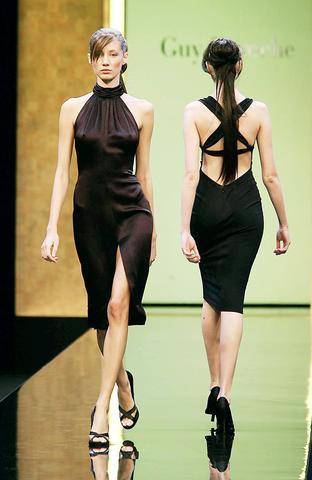
But think of the action at Galliano in terms of a Guy Ritchie movie. The characters in his chaotic films are always trying to trip someone up. There were lots of great looks in the Galliano show, looks that cool girls will get in about half a second -- skirts in psychedelic Sgt. Pepper prints, a white shag jacket with a dull tartan belt, oversize T-shirt dresses draped with hosiery-colored chiffon. But Galliano can't abide playing things straight. As fashion turns pretty (ghastly word), he has to trip it up.
For McQueen, something else must happen. He has too much pride to make clothes that don't meet his conceptual dreams. It's not for nothing that he presented his show, its initial inspiration the film Picnic at Hanging Rock, on an illuminated chessboard, the models standing in a Vanessa Beecroft-type formation. Themes ranged from Edwardian children's jackets with delicate ribbon trim and ticking-striped shirts to deceptively light teacup skirts, though the stellar piece was a layered chiffon gown with hobby horses spiraling in applique around the hem.

But it takes another kind of discipline to become a full success, and that's what McQueen must strive for, too. "In Dreams Begin Responsibilities," to use the title of Delmore Schwartz's seminal short story: McQueen is too good, too vital to fashion, to become, like Schwartz (or, in fashion, Paul Poiret), a lurid example of failed genius.

"Shh, don't mention Poiret," Lagerfeld said during fittings at Chanel. "It's bad luck. Poiret went out of business." Lagerfeld was referring to the starry nighttime ceiling he had created for the post-show party at his home to salute Nicole Kidman and Baz Luhrmann and their new Chanel No. 5 commercial. Poiret famously held a ball with an inflatable rubber sky.
Lagerfeld is in no danger of ending in a garret, however. He isn't joking when he says of himself, "lots of class but working class." If younger designers are to expect freedom from their bosses, as he has from his, they have to have something of his discipline.
His "Red Carpet" Chanel show worked ingeniously on several levels. There was the art-imitating-life moment when he plucked Kidman from her front-row seat and escorted her through a crush of photographers, as if toward a film premiere. And then there was the reverse, when life behaved as you want it to: with skimmy black evening dresses sashed in ribbon, pastel tweed coats with tiny kid gloves, playful sportswear in paper-thin gold denim, cobweb knits, and a slick black bathing suit robed in black lace that was a great blend of porno and Deauville.
How does he do it? Carpe diem. After Kidman had retired for the night, and as the young people were dancing in his ballroom, Lagerfeld took portraits of guests in an adjacent room filled with German posters and furniture from the 1910s. He was still shooting at 2am.
Smaller lights shine bright
Gaultier and Philo also put on terrific shows, touched with a Parisian lightness that looks increasingly right. At Hermes, Gaultier moved away from the horsy theme of his first collection, concentrating on scarf prints and on sweet organza blouses in toile prints worn with jeans and armfuls of bangles. And he wisely reined in the excess, leaving a luxe imprint with lace-up platforms in crocodile.
Philo knows how to make a dirty dress look clean. Which is to say, here was a loose-fitting cocktail dress in white silk with silver sparkles at the neckline and a hem of hosiery-colored chiffon. She played with volume, pairing small jackets in ticking stripes with full skirts in cotton. The look was relaxed, and the illusion hemlines, also achieved with stripes and shiny fabrics, were a neat way to make clothes appear longer.
Eager to move away from his free-form layers, Rick Owens got too tricky with his cutting, creating jackets with weird ice-cream cone points and tubular skirts that were more horizontal than straight up. Christian Lacroix tried to give airy coats and lace minidresses a sun-bleached lightness, but the results often looked budget-restricted.
Marc Jacobs's collection for Louis Vuitton also seemed misjudged -- heavy on sequined embellishment, heavy on volumes that looked neither new nor user-friendly. Pharrell Williams collaborated on the cool shades, but having Christina Ricci walk down the runway at the start of the show and take her seat in the audience seemed a case of imitating Chanel. Anyway, as some of the photographers concluded afterward, they were put alongside the runway not to create extra heat but to be at eye-level with Vuitton's bottom line: its pocketbooks.

Sept.16 to Sept. 22 The “anti-communist train” with then-president Chiang Kai-shek’s (蔣介石) face plastered on the engine puffed along the “sugar railway” (糖業鐵路) in May 1955, drawing enthusiastic crowds at 103 stops covering nearly 1,200km. An estimated 1.58 million spectators were treated to propaganda films, plays and received free sugar products. By this time, the state-run Taiwan Sugar Corporation (台糖, Taisugar) had managed to connect the previously separate east-west lines established by Japanese-era sugar factories, allowing the anti-communist train to travel easily from Taichung to Pingtung’s Donggang Township (東港). Last Sunday’s feature (Taiwan in Time: The sugar express) covered the inauguration of the

The corruption cases surrounding former Taipei Mayor and Taiwan People’s Party (TPP) head Ko Wen-je (柯文哲) are just one item in the endless cycle of noise and fuss obscuring Taiwan’s deep and urgent structural and social problems. Even the case itself, as James Baron observed in an excellent piece at the Diplomat last week, is only one manifestation of the greater problem of deep-rooted corruption in land development. Last week the government announced a program to permit 25,000 foreign university students, primarily from the Philippines, Indonesia and Malaysia, to work in Taiwan after graduation for 2-4 years. That number is a
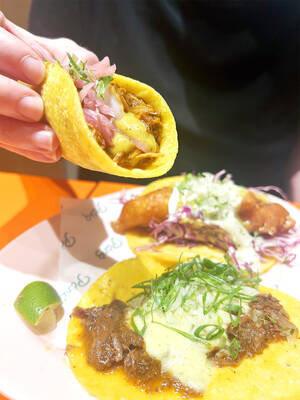
This year’s Michelin Gourmand Bib sported 16 new entries in the 126-strong Taiwan directory. The fight for the best braised pork rice and the crispiest scallion pancake painstakingly continued, but what stood out in the lineup this year? Pang Taqueria (胖塔可利亞); Taiwan’s first Michelin-recommended Mexican restaurant. Chef Charles Chen (陳治宇) is a self-confessed Americophile, earning his chef whites at a fine-dining Latin-American fusion restaurant. But what makes this Xinyi (信義) spot stand head and shoulders above Taipei’s existing Mexican offerings? The authenticity. The produce. The care. AUTHENTIC EATS In my time on the island, I have caved too many times to

In a stark demonstration of how award-winning breakthroughs can come from the most unlikely directions, researchers have won an Ig Nobel prize for discovering that mammals can breathe through their anuses. After a series of tests on mice, rats and pigs, Japanese scientists found the animals absorb oxygen delivered through the rectum, work that underpins a clinical trial to see whether the procedure can treat respiratory failure. The team is among 10 recognized in this year’s Ig Nobel awards (see below for more), the irreverent accolades given for achievements that “first make people laugh, and then make them think.” They are not


 RSS
RSS