


Fancy a beer after work? The choice used to be pretty limited, with Taiwan Beer (
With the deregulation of the alcoholic beverages market, beverage companies immediately began to open up local operations, and now are beginning to make their presence felt in the marketplace.

PHOTOS: IAN BARTHOLOMEW, TAIPEI TIMES
Now, three years after the manufacturer of Taiwan Beer lost its stranglehold on the production of alcoholic beverages in Taiwan, another change is set to rock the beer market -- the emergence of locally made microbrews.

According to Ministry of Finance statistics, since deregulation 353 companies have registered as producers of alcoholic beverages, as of last month. Eighteen of these are microbreweries.
While none of these companies will be taking down Taiwan Beer any time soon, they are performing the important function of diversifying the local beer market and also trying to create a new kind of beer culture.

Local production of alcoholic beverages has taken a significant hit from imports, which rose from 13.89 percent of the market in 2001 to 27.37 percent last year -- this despite the best efforts of the Taiwan Tobacco and liquor Corporation (TTLC) to give its products a more sexy image.
Local beer producers are sidestepping any confrontation with the considerable marketing muscle of TTLC and going the route of providing fresher, healthier or simply more diverse beers for people whose emphasis is on quality rather than quantity.
"We recognize that we are a niche market," Kevin Chou (
With an alcoholic-beverage market measuring over 6 million hectoliters a year, Chou is confident that there is room for his German-style beers in the Taiwan market.
"We are not newbies in this business," said Chou, whose family has operated a brewery in Thailand for the last seven years. It is this kind of experience that has allowed the company to get up and running within two years. "Even so, some of the early brews were, well, barely drinkable," he said.
"It has taken a lot of experimentation to get the right taste for Taiwan." Formerly selling their beers through a membership system, Le ble d'or has now expanded its operations to two outdoor beer gardens in fashionable parts of town.
If last week's opening of operations in Tianmu is anything to go by, Chou's beer already has a solid customer base. Chou said that Le ble d'or abided by the Reinheitsgebot, the German Purity Law, first promulgated in 1516 and one of the foundation stones of real ale movements around the world. The only ingredients permitted under this law for the manufacturing of beer are malted barley, hops, yeast and water.
"We add nothing else," Chou insisted. The malt comes from Australia, the yeast from Germany (reproduced in a simple laboratory in the basement of the beer factory) and the water comes from Taipei County. The source of the water, which has traditionally been such an important aspect of brewing and distilling, is hardly reassuring, but Chou dismisses such concerns.
"We have people who can customize the water for us," he said. "We give them the profile we want and they can produce it."
Still, despite this unseemly interference with nature, it is the lack of adulteration that is one of Le ble d'or's main selling points.
"We have a turn-around period of two days," Chou said. This is done to ensure that the beer is always drunk fresh. The beer is not pasteurized, which gives it a much higher nutritional value than regular canned lager.
Meeting the needs of Taiwanese consumers was a priority for Chou in developing his beers. Of the three beers offered by the company, it is the pale ale, which is the most similar to Taiwan Beer that sells the best.
The Weiss beer, with its distinctive hint of sourness, sells better among the foreign community. Even the stout is a relatively light, easily drinkable even in the heat of summer.
Taiwan Micro Brewing Co (
Taiwan Micro Brewing, which was the first beer company to be granted a license after the deregulation of the alcoholic beverages industry in 2001, offers a golden ale, a honey ale, a stout and variety of fruit beers. According to Li, these beers, if properly stored, can last for three weeks.
Current regulations forbid the operation of microbreweries outside land zoned for industrial use, a regulation that has hampered the development brewery pubs in Taiwan. Currently, both Le ble d'or and Taiwan Micro Brewing focus production in factories in industrial areas and ship the beer to their outlets in the city.
Both companies expressed the hope that these regulations could be changed to allow brewing directly at venues in commercial areas. For the moment, they rely on their own or outside courier services to distribute the beer direct from the factory.
"It's basically because the government still has insufficient understanding of microbrewing," Chou said. "They regard it as a polluting industry, but in fact everything is natural. We have people lining up to collect the dregs of our brewing because it makes excellent fertilizer."

Sept.16 to Sept. 22 The “anti-communist train” with then-president Chiang Kai-shek’s (蔣介石) face plastered on the engine puffed along the “sugar railway” (糖業鐵路) in May 1955, drawing enthusiastic crowds at 103 stops covering nearly 1,200km. An estimated 1.58 million spectators were treated to propaganda films, plays and received free sugar products. By this time, the state-run Taiwan Sugar Corporation (台糖, Taisugar) had managed to connect the previously separate east-west lines established by Japanese-era sugar factories, allowing the anti-communist train to travel easily from Taichung to Pingtung’s Donggang Township (東港). Last Sunday’s feature (Taiwan in Time: The sugar express) covered the inauguration of the

The corruption cases surrounding former Taipei Mayor and Taiwan People’s Party (TPP) head Ko Wen-je (柯文哲) are just one item in the endless cycle of noise and fuss obscuring Taiwan’s deep and urgent structural and social problems. Even the case itself, as James Baron observed in an excellent piece at the Diplomat last week, is only one manifestation of the greater problem of deep-rooted corruption in land development. Last week the government announced a program to permit 25,000 foreign university students, primarily from the Philippines, Indonesia and Malaysia, to work in Taiwan after graduation for 2-4 years. That number is a
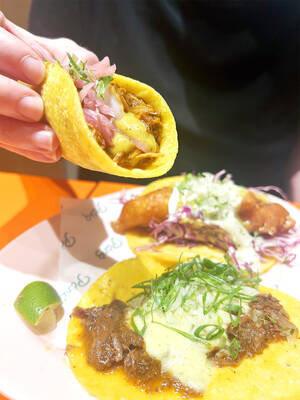
This year’s Michelin Gourmand Bib sported 16 new entries in the 126-strong Taiwan directory. The fight for the best braised pork rice and the crispiest scallion pancake painstakingly continued, but what stood out in the lineup this year? Pang Taqueria (胖塔可利亞); Taiwan’s first Michelin-recommended Mexican restaurant. Chef Charles Chen (陳治宇) is a self-confessed Americophile, earning his chef whites at a fine-dining Latin-American fusion restaurant. But what makes this Xinyi (信義) spot stand head and shoulders above Taipei’s existing Mexican offerings? The authenticity. The produce. The care. AUTHENTIC EATS In my time on the island, I have caved too many times to

In a stark demonstration of how award-winning breakthroughs can come from the most unlikely directions, researchers have won an Ig Nobel prize for discovering that mammals can breathe through their anuses. After a series of tests on mice, rats and pigs, Japanese scientists found the animals absorb oxygen delivered through the rectum, work that underpins a clinical trial to see whether the procedure can treat respiratory failure. The team is among 10 recognized in this year’s Ig Nobel awards (see below for more), the irreverent accolades given for achievements that “first make people laugh, and then make them think.” They are not


 RSS
RSS