


My opponent and I faced each other across the white lines, separated by an arm's length in the dark, smoky bar. He planted his feet firmly, shoulder-width apart, while I fell into a fighting stance, right foot forward -- a natural response from years of taekwondo. The referee stood between us. The crowd looked on expectantly.
The rules were deceptively simple -- rules that people all over the world grasp as young children.
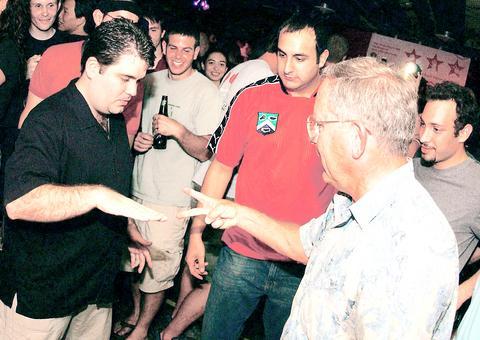
PHOTO: NY TIMES
Paper covers rock. Rock crushes scissors. Scissors cut paper.
But like the game Othello, another childhood favorite, Rock Paper Scissors takes a minute to learn and a lifetime to master.
Rock Paper Scissors has gained a cult following in much of the English-speaking world over the last few years. The World Rock Paper Scissors Society, based in Toronto, says that its history dates to London in the mid-1800s and that its membership has grown to 2,300 from five since its Web site, www.worldrps.com, first appeared in 1995.
Word of mouth generated by the Web site, and by the world championships that the society has sponsored since 2002, have led to a spread of formal and impromptu tournaments in bars, fraternity houses, homes and high schools. A bar in Chapel Hill, North Carolina, for example, held a tournament on Aug. 15 that drew 40 competitors. A tournament held for the past two years at the Roshambo Winery in Healdsburg, California, has attracted hundreds of spectators and competitors.
The Official Rock Paper Scissors Strategy Guide, by the brothers Douglas and Graham Walker, the society's directors, will be published next month by Fireside Books, and Rock Paper Scissors: The Movie, a documentary about the world championships in Toronto last year, is to be released in January.
When I decided to compete in a local tournament and started training, some of my friends scoffed at the idea that the game could involve strategy. But this was not the Rock Paper Scissors of the playground, a hurried competition to see which team got the ball first, or even of the fraternity, to see who would go and buy the beer. This was tournament-style Rock Paper Scissors, in which the stakes are high, and expert players do well over time only because of skill and hard work.
There were 128 of us competing for the top three places in the DC National Rock Paper Scissors Tournament at DC9, a Washington bar. The first prize was US$1,000 and an XM satellite radio, a significant haul -- although modest compared with the US$31,000 BMW that was awarded at a tournament in Vail, Colorado, last April, or the 1 million shekels (about US$220,000) that a 13-year-old boy won by beating 700 other competitors in an Israeli tournament on Aug. 5.
Advice came to me from all directions. An office-mate offered wisdom gleaned from his days at the frat house: "The key is to throw scissors early and often." Aaron Hoffman, a math graduate student at Brown University, suggested that I counter the risk of overthinking my throws with a seemingly random sequence of numbers. "You could memorize the digits of pi in base 3," he said. "Zero is rock, one is scissors and two is paper." Sure I could.
I called experienced players to ask for tips, and learned about the common tells that can reveal an impending throw. For example, many people will open up paper early. I was told that most people have a go-to throw, reflective of their character, when they are caught off guard. Paper, considered a refined, even passive, throw, is apparently favored by literary types and journalists; I found I was no exception.
I started going up to people at parties and in the office and challenging them to quick matchups. I even attended a training session with the tournament's organizer, Master Roshambollah (also known as Jason Simmons), and some local players.
Over time, my game was getting sharper. I was winning more than I was losing.
But now that I was here in a Washington bar on a Saturday night, surrounded by a crowd of onlookers in their 20s and 30s, I was nervous. Tournament Rock Paper Scissors proceeds a bit like a tennis competition: game, set, match. The first to win two games wins the set, the first to win two sets wins the match. The winner moves on to the next round; the loser, generally, is eliminated. I had never played under the stress of tournament conditions.
Earlier, in my effort to size up and profile the other people in my heat, I had spoken with an opponent, Ryan Taylor. I had been warned of the importance of understanding the opponent's personality and level of experience. Taylor was 23 and had a shaggy 1970s-style haircut, and he said he had never played competitively before.
The referee put his hand between us and asked, "Ready?" He reminded us that vertical paper (which resembles a handshake) was a no-no. Many people had fouled on vertical paper over the years. We nodded.
I decided that I would try to psych out Taylor, using a technique I had learned from the strategy guide.
I arched my eyebrows, looked him in the eyes and said slowly, in a flat voice, "I'm going to throw rock."
He seemed momentarily thrown, but then regained his composure.
The referee lifted his hand and we started pumping our fists in sync, the part of the game known as the prime.
"One. Two. Three. Shoot."
Taylor was wondering, as he later told me, if I was really going to throw rock. "If she is, she expects me to throw paper, in which case she would throw scissors, in which case I should throw rock. If she really will throw rock, then at worst we would tie."
He threw rock. I threw paper. I won.
What Taylor didn't realize was that I was playing a defensive rather than offensive game, on the advice of one of the experienced players I had spoken with.
It was logic worthy of The Princess Bride. The referee raised his hand to ready us for the next throw.
I tried to divine what Taylor was planning. I decided he wasn't going to throw rock again after I had just beat him, so scissors was a safe throw for me.
I threw scissors. He threw paper. Game and set were mine. I was only one set from advancing to the next round.
But then I lost the next two throws in rapid succession. Knowing that novices tend to cycle all three throws, I threw a rock, thinking it was time for him to throw scissors. Instead he splayed his hand in flat paper formation. Then his scissors beat my paper. A one-two punch.
We were tied. My heart beat faster. How had I lost a set so quickly?
I gestured for a time-out, to break his momentum and regain my senses.
I threw my first rock. He went with paper. Ugh. Now it was down to match point.
I breathed deeply. Everything was on the line with this throw. I threw the second rock. He repeated paper. I was out, eliminated from the tournament.
I saw Taylor later that night, after he had made it to the top 32. I learned that he had just moved to Washington a few months ago to work at a local theater. (Theater! If I had known that about him, I could have profiled him as a paper guy.)
He offered to buy me a drink, and asked for my number. I gave it to him. But only because I want a rematch.

Sept.16 to Sept. 22 The “anti-communist train” with then-president Chiang Kai-shek’s (蔣介石) face plastered on the engine puffed along the “sugar railway” (糖業鐵路) in May 1955, drawing enthusiastic crowds at 103 stops covering nearly 1,200km. An estimated 1.58 million spectators were treated to propaganda films, plays and received free sugar products. By this time, the state-run Taiwan Sugar Corporation (台糖, Taisugar) had managed to connect the previously separate east-west lines established by Japanese-era sugar factories, allowing the anti-communist train to travel easily from Taichung to Pingtung’s Donggang Township (東港). Last Sunday’s feature (Taiwan in Time: The sugar express) covered the inauguration of the

The corruption cases surrounding former Taipei Mayor and Taiwan People’s Party (TPP) head Ko Wen-je (柯文哲) are just one item in the endless cycle of noise and fuss obscuring Taiwan’s deep and urgent structural and social problems. Even the case itself, as James Baron observed in an excellent piece at the Diplomat last week, is only one manifestation of the greater problem of deep-rooted corruption in land development. Last week the government announced a program to permit 25,000 foreign university students, primarily from the Philippines, Indonesia and Malaysia, to work in Taiwan after graduation for 2-4 years. That number is a
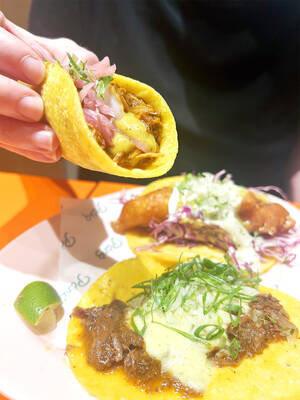
This year’s Michelin Gourmand Bib sported 16 new entries in the 126-strong Taiwan directory. The fight for the best braised pork rice and the crispiest scallion pancake painstakingly continued, but what stood out in the lineup this year? Pang Taqueria (胖塔可利亞); Taiwan’s first Michelin-recommended Mexican restaurant. Chef Charles Chen (陳治宇) is a self-confessed Americophile, earning his chef whites at a fine-dining Latin-American fusion restaurant. But what makes this Xinyi (信義) spot stand head and shoulders above Taipei’s existing Mexican offerings? The authenticity. The produce. The care. AUTHENTIC EATS In my time on the island, I have caved too many times to

In a stark demonstration of how award-winning breakthroughs can come from the most unlikely directions, researchers have won an Ig Nobel prize for discovering that mammals can breathe through their anuses. After a series of tests on mice, rats and pigs, Japanese scientists found the animals absorb oxygen delivered through the rectum, work that underpins a clinical trial to see whether the procedure can treat respiratory failure. The team is among 10 recognized in this year’s Ig Nobel awards (see below for more), the irreverent accolades given for achievements that “first make people laugh, and then make them think.” They are not


 RSS
RSS