


In 1999, when the Environmental Protection Administration began a program to raise the nation's low recycling rate for used batteries, the total amount of discarded was 3,500 tonnes -- of which only 29 tonnes were recycled.
Since then, the nation hasn't sat idly by and mass collection programs are now commonplace throughout the country.

PHOTO COURTESY OF PEAT INTERNATIONAL
Sadly, the nation's ever-increasing reliance on battery powered devices has meant that reducing the number of discarded batteries -- while at the same time increasing the amount recycled -- has been thwarted by increasing consumer usage and, some feel, inadequate education.

PHOTO COURTESY OF PEAT INTERNATIONAL
"The number of mobile phones in use today has increased almost tenfold over the past four to five years, which of course had led to an equal, if not greater, increase in the number of discarded batteries," said battery collection agent Michael Lee (李志強). "If something is not done about it Taiwan could be looking at a grim future with widespread groundwater contamination and other problems caused by toxins."
Based on the revenue collected through taxes levied on battery manufacturers, which are added for recycling purposes, the amount of spent batteries stood at roughly 10,000 tonnes last year. Of this only 1,017 tonnes, or less than 15 percent, was collected and exported for processing in France or the US, where all of Taiwan's used batteries are currently sent for recycling.

The remaining 8,500-plus tonnes were dumped in landfills or incinerated in organic waste incineration plants, where dioxins and other toxic wastes seeped into groundwater sources and returned to earth in the form of acid rain.

While the government plans to increase the amount of recycled batteries to 2,000 tonnes this year, non-recycling of spent batteries in Taiwan has become so great an environmental problem that the American Chamber of Commerce included the issue in this year's Taiwan White Paper. The report made recommendations that included raising citizen awareness, rethinking the existing recycling model and the need to encourage an overall reduction in battery usage.
One major factor behind Taiwan's overwhelming cache of spent batteries is its heavy reliance on cheap zinc-carbon batteries. Taiwan might consider itself a developed country, but when it comes to zinc carbon battery expenditure it ranks alongside China as one of the world's most prolific users.
A staggering 65 percent of the batteries used by the nation's gadget hungry masses are of the zinc carbon type, which, though cheaper, have a shorter life span and are more harmful to the environment than alkaline batteries. This number comes frighteningly close to China's 75 percent reliance on zinc-carbon batteries and is a far cry from those of other developed Asian regions such as South Korea and Hong Kong, where zinc-carbon batteries account for no more than 25 percent of the total number of batteries used.
"In the US and Britain, the rates of alkaline battery usage are at almost 90 percent and in terms of developed countries you'd expect to see Taiwan amongst them," said Andrew Houlberg, General Manager of Gillette Taiwan. "But instead [Taiwan] looks almost like China."
Although not wanting to apportion the blame on any one agency, Houlberg, whose company owns Duracell, feels the nation's over use of zinc-carbon batteries is related to the way in which advertising campaigns are closely intertwined with Asian ideals, where face is more important than the facts.
"Comparative marketing is frowned upon and considered to be confrontational," he said. "It's not illegal, but we're unable to show that alkaline batteries outlast zinc ones ... as soon as you set to show that the Easter Bunny with the [alkaline] batteries lasts five times longer than the one with zinc batteries, somebody files a complaint with the fair trade commission."
Comparative advertising may be a no-no, but Houlberg continues, albeit more tactfully than he'd like, to promote the use of alkaline batteries and the importance of recycling.
Over the past year, Houlberg has led campaigns aimed at reaching out to the expat community and has worked closely with several well-known foreign supermarket chains.
And his message hasn't gone unheeded. Aware of the mounting problem and the need for an increase in the amount of batteries collected for recycling, the government has already set quotas for the coming two years.
It aims to increase the recycling level to 20 percent by next year and hopes to reach 30 percent by the year after. These numbers still lag far behind those of European nations like the Netherlands, however, where 75 percent of all used batteries are now recycled.
According to David Yu (尤嘉言), Chairman of the Taipei County Recycling Committee (台北縣廢棄物回收公會), the government's projected figures are probably as good as it's going to get until a serious rethink is given to the way in which recycling programs are organized.
"The spent battery collection system works like an industry. It's solely reliant on incentive rather than education," he said. "People do it to make money. They don't necessarily care where the batteries end up, only that they've been paid."
At present there are three distinct stages of collection, each of which offers a different rate per kilo of spent batteries. First, tire collectors, a group comprising predominantly private individuals, receive on average NT$12 per kilo from one of the 1,000 official battery collection agencies. These companies are in turn paid an average of between NT$15 to NT$20 per kilo by one of the only two companies currently licensed to ship batteries abroad. And, in turn, these companies are paid between NT$20 and NT$23 by the government for every kilo shipped out of the country.
"The government has certainly made an effort to increase collection, but I think that it needs to make a concerted attempt to make both its policy and its aims a lot clearer," said Yu. "It's not only a question of telling people to do this because you'll be rewarded at the end. It's a matter of telling them why they are doing it, which is, of course, more important in the long run."
Recycling campaigns at national, county and city levels now include fliers, which inform local residents where they can take their spent batteries and poster campaigns, which include cartoon educational pictorials explaining the merits of battery recycling. While local authorities may feel such campaigns are reaping benefits, those in the trade feel that neither local nor central governments have done enough to promote recycling.
"Everyone knows that convenience stores have collection bins. But how many people remember to take their old batteries out with them when they pop out for the milk? And how many people do see putting batteries in them when you go to the convenience store?" Lee said. "I think this is where a strong campaign that incorporates television advertising and bill-boarding would make a big difference."
Spent battery bins are now located in nearly all of the nation's convenience stores, camera stores and supermarkets and are also affixed to garbage trucks. These boxes, however, account for a small fraction of the total number of batteries collected nationwide.
The most productive collection sites have proven to be those found in schools. Currently every elementary, junior high and high school in Taipei City has at least one spent battery bin and thousands of other schools nationwide have their own boxes. According to a spokesperson for the Taipei City Government, the combined weight of these bins accounts for roughly 10 tonnes of the monthly collection rate for Taipei City.
In order to boost the tonnage of spent batteries collected at schools as well as to raise awareness of the need to recycle batteries across the board, the American Chamber of Commerce is currently planning its own recycling campaign. Set to begin in early October, the program is aimed at raising awareness within both the expat and local communities.
"We're in the process of putting together an education campaign with the environment protection committee that will create publicity through the American School," said Executive Director of the American Chamber of Commerce Richard Vuylsteke. "The aim is not to compete with local schools, but to help them to promote and generate more publicity about battery
recycling."
The batteries themselves and the individuals and groups willing to promote the need for recycling may not be in short supply, but the lack of an indigenous facility capable of recycling any increase in the amount of batteries collected remains an issue in itself.
According to a government report, a 30 percent recycling-rate would be the bare minimum before it would consider investing in a waste treatment plant capable of processing batteries.
Regardless of the government's statistically based concerns about building a NT$60 million-plus plant, US based PEAT International has already taken the initiative. Along with applying for a license to collect spent batteries, the company has also constructed its own hazardous waste treatment facility in Kaoshiung.
Located in Kaoshiung's Linhai Industrial Park (臨海工業園), PEAT's plasma waste conversion plant is Taiwan's first fully functional facility. While still in the trial phase of operations the plant will, according to President of PEAT International Jose Capote, be running and hopefully processing waste -- which will include batteries -- by September.
Using plasma torch technology the plant is able to process up to 10 tonnes of non-organic wastes contaminated with PCBs and other organo-chlorides and recover lead, mercury, nickel and other heavy metals per day. In turn, the heavy metals and slag produced at the plant can be sold on for industrial use.
"We'd like to see a much higher increase in the amount of recycled batteries and support any program that is being done to collect and recycle batteries," said Capote. "We've applied for a license to collect and have to the space to store batteries."
If all goes to plan and the Lin Hai site proves its worth then PEAT has further plans to build a 50-tonnes-per-day plant: Such a plant will eliminate the need to export spent batteries and allow Taiwan to reap the rewards of its spent battery recycling awareness and collection programs.
Last week, Viola Zhou published a marvelous deep dive into the culture clash between Taiwanese boss mentality and American labor practices at the Taiwan Semiconductor (TSMC) plant in Arizona in Rest of World. “The American engineers complained of rigid, counterproductive hierarchies at the company,” while the Taiwanese said American workers aren’t dedicated. The article is a delight, but what it is depicting is the clash between a work culture that offers employee autonomy and at least nods at work-life balance, and one that runs on hierarchical discipline enforced by chickenshit. And it runs on chickenshit because chickenshit is a cultural
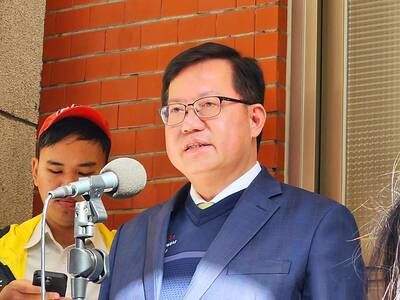
By far the most jarring of the new appointments for the incoming administration is that of Tseng Wen-tsan (鄭文燦) to head the Straits Exchange Foundation (SEF). That is a huge demotion for one of the most powerful figures in the Democratic Progressive Party (DPP). Tseng has one of the most impressive resumes in the party. He was very active during the Wild Lily Movement and his generation is now the one taking power. He has served in many of the requisite government, party and elected positions to build out a solid political profile. Elected as mayor of Taoyuan as part of the
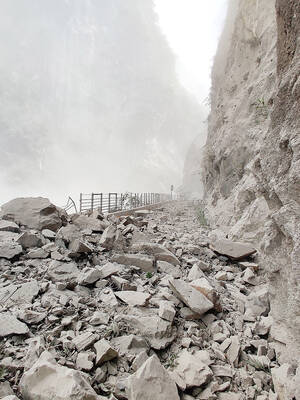
Moritz Mieg, 22, lay face down in the rubble, the ground shaking violently beneath him. Boulders crashed down around him, some stones hitting his back. “I just hoped that it would be one big hit and over, because I did not want to be hit nearly to death and then have to slowly die,” the student from Germany tells Taipei Times. MORNING WALK Early on April 3, Mieg set out on a scenic hike through Taroko Gorge in Hualien County (花蓮). It was a fine day for it. Little did he know that the complex intersection of tectonic plates Taiwan sits

When picturing Tainan, what typically comes to mind is charming alleyways, Japanese architecture and world-class cuisine. But look beyond the fray, through stained glass windows and sliding bookcases, and there exists a thriving speakeasy subculture, where innovative mixologists ply their trade, serving exquisite concoctions and unique flavor profiles to rival any city in Taiwan. Speakeasies hail from the prohibition era of 1920s America. When alcohol was outlawed, people took their business to hidden establishments; requiring patrons to use hushed tones — speak easy — to conceal their illegal activities. Nowadays legal, speakeasy bars are simply hidden bars, often found behind bookcases


 RSS
RSS