


Norfolk Island's view of itself as a South Pacific paradise free from crime, road rage, vice, gambling, drugs, fast food restaurants and even the mobile phone and AIDS was upset on a rainy Sunday afternoon two years ago when the body of Janelle Patton was found wrapped in black plastic at a picnic spot.
Patton, a newcomer among the 1,800 islanders who trace their ancestry back to the British sailors who overpowered Captain Fletcher Christian and took over the HMS Bounty in 1789, had sustained 64 separate injuries in an attack so frenzied it shocked coroner Ron Cahill.
"It's one of the worst cases I've seen in excess of 30 years in the criminal justice system," Cahill told an inquest three weeks ago.
It was the first murder on the island since 1855 when Norfolk ceased to be a penal colony and began its modern history as a self-governing Australian territory 1,400 kilometers east of Brisbane.
The 20km2 speck was settled by the descendants of the Bounty mutineers in 1856. They arrived there from Pitcairn Island with their Tahitian wives and an independent streak that is still reflected in the requirement that visitors from Australia need to bring their passports along.
Despite fingerprinting and DNA testing, a bevy of Canberra detectives and a media scrum, the killer of 29-year-old Patton has yet to be found and the coroner's inquest concluded with an open verdict. Now, the Canberra detectives are back on Norfolk Island investigating another murder.
The victim of the shooting this week is 60-year-old Ivens "Toon" Buffett, a Bounty descendant and one of the four ministers who ran Norfolk Island. Police say he was shot dead in his office by his son, 25-year-old Leith Buffett, who has been charged with his murder.
There is no obvious link with Patton's death in March 2002 but the father of the Sydney-born restaurant manager hopes that a second killing will help solve the riddle of the first.
"We feel that maybe some information could come from the island as a result of this that would be a result of people realizing that these things can happen, that Janelle's murder wasn't just maybe a one-off, they happen in all communities around the world," said Ron Patton, Janelle's father.
The Pattons, who were on the island the day their daughter was murdered in their first visit since honeymooning there in 1968, have voiced exasperation at the level of cooperation the locals have offered the police.
"We don't know who it was, and we are not going to judge people," Ron Patton said. "We're going to leave that to police."
The police, too, have been disappointed at the lack of cooperation. They had expected an easy case.
Every adult on the island at the time of the murder has filled in a questionnaire and detective Brendan Lindsay was optimistic of wrapping up the investigation quickly.
"We've got an isolated population and we can identify every individual that was on the island that day," he said at the start of the enquiry. "It's a matter of just narrowing things down."
Linday's optimism was misplaced.
Local newspaper editor Tom Lloyd, who earlier this year described Norfolk Island -- which relies on tourism, fishing and avocado growing -- as "an oasis of peace in a troubled world," has spoken of a stark change since the murders in people's perception of the place they call home.
"The mood is one of abject depression," Lloyd told Australia's ABC Radio. "To think that it's taken us a long, long time to get over Janelle Patton's murder."
Patton's bloody end revived a past that locals thought the passage of time had erased.
Discovered by Captain Cook in 1774, Norfolk Island was picked by the British as an ideal dumping ground for the very worst of its criminals because escape to the mainland was nearly impossible. It became a byword for institutionalized brutality.
The island was described by historian Robert Hughes in his seminal work The Fatal Shore as "the worst place in the English-speaking world" during its time as a repository for the dregs of the Empire.
It was a place once known as the Isle of Despair, Devil's Island or Ocean Hell.
Hughes records that one prisoner, Joseph Mansbury, was flogged with a knotted leather whip known as a jack-o'-nine-tails no less than 2,000 times in 36 months. His skinned shoulder blades, a jailer recorded, poked out "like two polished horns."
Norfolk Island was considered such a hell-hole that some prisoners killed others in order to escape their misery on the gallows through their own death.

Sept.16 to Sept. 22 The “anti-communist train” with then-president Chiang Kai-shek’s (蔣介石) face plastered on the engine puffed along the “sugar railway” (糖業鐵路) in May 1955, drawing enthusiastic crowds at 103 stops covering nearly 1,200km. An estimated 1.58 million spectators were treated to propaganda films, plays and received free sugar products. By this time, the state-run Taiwan Sugar Corporation (台糖, Taisugar) had managed to connect the previously separate east-west lines established by Japanese-era sugar factories, allowing the anti-communist train to travel easily from Taichung to Pingtung’s Donggang Township (東港). Last Sunday’s feature (Taiwan in Time: The sugar express) covered the inauguration of the

The corruption cases surrounding former Taipei Mayor and Taiwan People’s Party (TPP) head Ko Wen-je (柯文哲) are just one item in the endless cycle of noise and fuss obscuring Taiwan’s deep and urgent structural and social problems. Even the case itself, as James Baron observed in an excellent piece at the Diplomat last week, is only one manifestation of the greater problem of deep-rooted corruption in land development. Last week the government announced a program to permit 25,000 foreign university students, primarily from the Philippines, Indonesia and Malaysia, to work in Taiwan after graduation for 2-4 years. That number is a
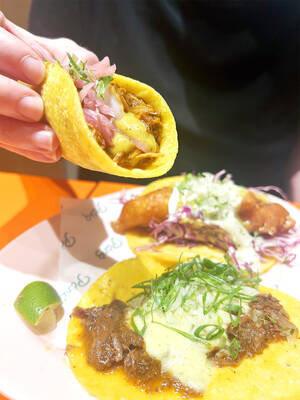
This year’s Michelin Gourmand Bib sported 16 new entries in the 126-strong Taiwan directory. The fight for the best braised pork rice and the crispiest scallion pancake painstakingly continued, but what stood out in the lineup this year? Pang Taqueria (胖塔可利亞); Taiwan’s first Michelin-recommended Mexican restaurant. Chef Charles Chen (陳治宇) is a self-confessed Americophile, earning his chef whites at a fine-dining Latin-American fusion restaurant. But what makes this Xinyi (信義) spot stand head and shoulders above Taipei’s existing Mexican offerings? The authenticity. The produce. The care. AUTHENTIC EATS In my time on the island, I have caved too many times to

In a stark demonstration of how award-winning breakthroughs can come from the most unlikely directions, researchers have won an Ig Nobel prize for discovering that mammals can breathe through their anuses. After a series of tests on mice, rats and pigs, Japanese scientists found the animals absorb oxygen delivered through the rectum, work that underpins a clinical trial to see whether the procedure can treat respiratory failure. The team is among 10 recognized in this year’s Ig Nobel awards (see below for more), the irreverent accolades given for achievements that “first make people laugh, and then make them think.” They are not


 RSS
RSS