


The politically turbulent decade of the 1980s, with the close of the KMT's authoritarian regime, released an immense energy into Taiwan's art world. No sooner had martial law been lifted in July 1987 and Chiang Ching-kuo (蔣經國) died in January 1988, and the accumulated "social forces" of the past two decades swept through almost every area of Taiwanese society.
Visitors to the recent exhibit of "The Transitional Eighties -- Taiwan's Art Breaks New Ground" held by the Taipei Fine Arts Museum witness a sizzling decade of artwork full of experimental spirit and forceful social and political critique. In fact, some of the prominent artists, such as Yang Mao-lin (
As curator Chen Yen-ing (
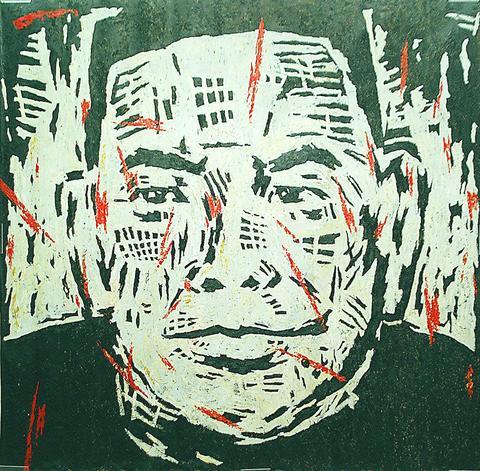
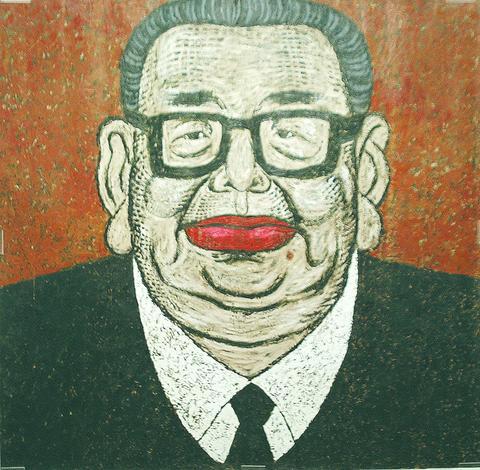
PHOTO COURTESY OF TFAM
These artists would found their own artistic circles, such as the 101 Painting Society (101藝術群) and the Taipei Painting Society (台北畫派), for intellectual discussions and social support. They tended to focus on exploring conceptual art and experimenting with various media. They were asking the basic question of "What is art?" and were determined to achieve their goal of "art for art's sake" through rational simplification of art expressions and paying close attention to color effects.
The latter group of artists were inclined to deal with meaningful international and domestic topics, such as the Three Mile Island nuclear accident in the US, the arrival of fast-food giant McDonald's in Taiwan, the appearance of the Sogo Department Store in Taipei and even the construction of long bridges and elevated highways in many cities in the 1980s.
From there, these artists would attempt to reflect on the humanities and would subsequently raise the issues of proper interaction between people and the environment, the alienation of modern urban living and the impact of consuming cultures on society, etc, in their artwork.
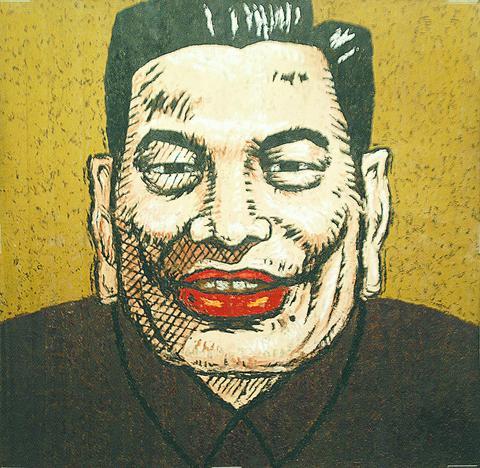
Shifting away from traditional Chinese art and culture, these young and avant-garde artists experimented boldly with subject matter and possible artistic forms, even including body art. For instance, body art advocate Chang Jian-fu (
The exhibition features about 100 works, including two-dimensional works, mixed media works, spatial installations and sculptures by some 50 Taiwanese artists working in the 1980s. Another curator Liao Tsun-ling (廖春鈴) concludes her observation by saying that the innovative expressions of art in the 1980s had a very strong impact on contemporary artistic development in Taiwan.
In particular, the sudden outburst of energetic creativity right after the end of authoritarian rule helped local artists gain confidence to go on experimenting with each their unique artwork. Out of this confidence, they prepared and were eventually ready to participate in large-scale international art exhibits in the late 1990s, showcasing Taiwan's newfound artistic identity around the world.
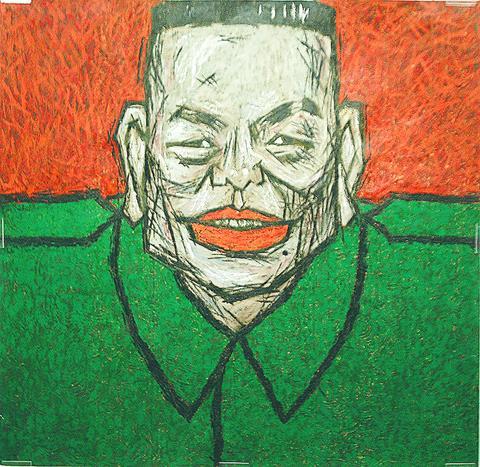
"The Transitional Eighties" runs through Sept. 5. Taipei Fine Arts Museum is located at 181 Zhongshan N Rd, Sec 3, Taipei (

Sept.16 to Sept. 22 The “anti-communist train” with then-president Chiang Kai-shek’s (蔣介石) face plastered on the engine puffed along the “sugar railway” (糖業鐵路) in May 1955, drawing enthusiastic crowds at 103 stops covering nearly 1,200km. An estimated 1.58 million spectators were treated to propaganda films, plays and received free sugar products. By this time, the state-run Taiwan Sugar Corporation (台糖, Taisugar) had managed to connect the previously separate east-west lines established by Japanese-era sugar factories, allowing the anti-communist train to travel easily from Taichung to Pingtung’s Donggang Township (東港). Last Sunday’s feature (Taiwan in Time: The sugar express) covered the inauguration of the

The corruption cases surrounding former Taipei Mayor and Taiwan People’s Party (TPP) head Ko Wen-je (柯文哲) are just one item in the endless cycle of noise and fuss obscuring Taiwan’s deep and urgent structural and social problems. Even the case itself, as James Baron observed in an excellent piece at the Diplomat last week, is only one manifestation of the greater problem of deep-rooted corruption in land development. Last week the government announced a program to permit 25,000 foreign university students, primarily from the Philippines, Indonesia and Malaysia, to work in Taiwan after graduation for 2-4 years. That number is a
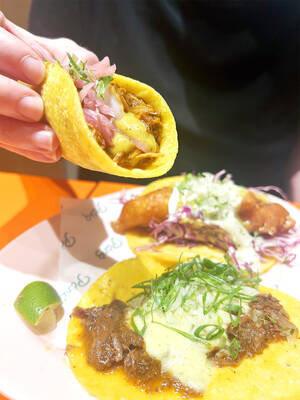
This year’s Michelin Gourmand Bib sported 16 new entries in the 126-strong Taiwan directory. The fight for the best braised pork rice and the crispiest scallion pancake painstakingly continued, but what stood out in the lineup this year? Pang Taqueria (胖塔可利亞); Taiwan’s first Michelin-recommended Mexican restaurant. Chef Charles Chen (陳治宇) is a self-confessed Americophile, earning his chef whites at a fine-dining Latin-American fusion restaurant. But what makes this Xinyi (信義) spot stand head and shoulders above Taipei’s existing Mexican offerings? The authenticity. The produce. The care. AUTHENTIC EATS In my time on the island, I have caved too many times to

In a stark demonstration of how award-winning breakthroughs can come from the most unlikely directions, researchers have won an Ig Nobel prize for discovering that mammals can breathe through their anuses. After a series of tests on mice, rats and pigs, Japanese scientists found the animals absorb oxygen delivered through the rectum, work that underpins a clinical trial to see whether the procedure can treat respiratory failure. The team is among 10 recognized in this year’s Ig Nobel awards (see below for more), the irreverent accolades given for achievements that “first make people laugh, and then make them think.” They are not


 RSS
RSS