


It's probably no coincidence that Luke Mably, the skinny English actor in The Prince and Me playing an undercover royal with a roguish streak who falls in love with an all-American farm girl, bears a conspicuous resemblance to Prince William. As titled bachelors go nowadays, no one can top the elder son of Diana, Princess of Wales, in the dewy heartthrob department. And with the real prince unavailable to Hollywood for exploitation, why not create a facsimile and bring him to America to discover what truly fine folks we are?
So what if Mably's character, Edvard Valdemar Dangaard, is the crown prince of Denmark, not of England? What's the difference anyway between Copenhagen and London, given that the prince and his parents speak perfect upper-class English, without a trace of a Danish accent?
PHOTOS COURTESY OF FOX MOVIES
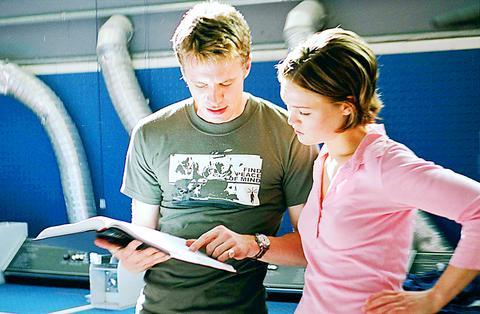
One day, the prince, or Eddie, as he renames himself, happens to watch a Girls Gone Wild! program set in Wisconsin and becomes so steamed up he decides to attend college there. Once ensconced in a dorm room at the University of Wisconsin with his obedient young secretary, Soren (Ben Miller), his first mistake is to make a pass at Paige Morgan (Julia Stiles), a student working as a barmaid. When she rebuffs him with a squirt of soda water in his face, she kicks into action the fighting spirit of a royal who has never heard the word no. Can true love be far behind?
PHOTOS COURTESY OF FOX MOVIES
As fate would have it, the lazy, spoiled prince is designated Paige's lab partner in an organic chemistry class and the two strike up an edgy friendship.
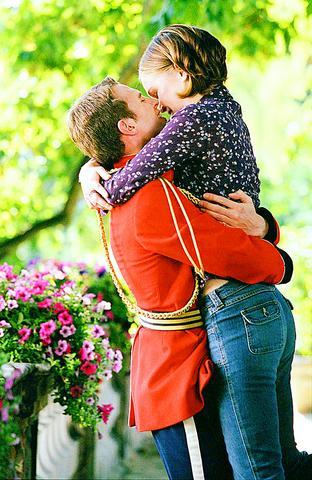
When she invites him home for Thanksgiving, love begins to blossom. Back at college, his true identity comes out when two nosy paparazzi track him to library stacks and snap shots of the sweethearts in an intimate clinch. The relationship hits a very brief glitch.
PHOTOS COURTESY OF FOX MOVIES
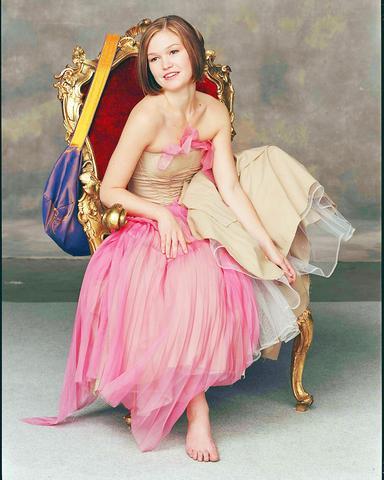
The Prince and Me, which opens today, is a cream puff with a melted marshmallow inside it. As the temperature rises, the whole gooey thing starts to melt. Stiles' farm girl-turned-princess-in-waiting is a model of integrity and decency, so unpretentious she seems anachronistic in the age of Britney, Christina and J Lo. And Stiles, an actress with the intelligence to lend a semblance of reality to the dumbest dialogue, at least makes Paige likable.
The oddly shaped movie, directed by Martha Coolidge, doesn't have the backbone to sustain any conflict for more than a few minutes before collapsing into kisses and fashion modeling. Paige travels to Copenhagen, where she is
literally swept off the street by her Prince Charming onto a horse and carried to the palace. In no time at all she melts the icy heart of the queen. Meanwhile, the ailing king prepares to hand the prince the crown.
Although the overlong movie seems to come to an end two-thirds of the way through, it feels obliged to trot out one last fake conflict to unravel. The final question it asks is whether a college girl as good and nice as Paige can stand to be the queen of Denmark. Or must she renounce her love and her jewels to study medicine and work for Doctors Without Borders? How noble can one farm girl be?

The problem with Marx’s famous remark that history repeats itself, first as tragedy, the second time as farce, is that the first time is usually farce as well. This week Chinese Nationalist Party (KMT) Chair Cheng Li-wun (鄭麗文) made a pilgrimage to the People’s Republic of China (PRC) “to confer, converse and otherwise hob-nob” with Chinese Communist Party (CCP) officials. The visit was an instant international media hit, with major media reporting almost entirely shorn of context. “Taiwan’s main opposition leader landed in China Tuesday for a rare visit aimed at cross-strait ‘peace’”, crowed Agence-France Presse (AFP) from Shanghai. Rare!

What is the importance within the Chinese Nationalist Party (KMT) of the meeting between Xi Jinping (習近平), the leader Chinese Communist Party (CCP), and Cheng Li-wun (鄭麗文), the leader of the KMT? Local media is an excellent guide to determine how important — or unimportant — a news event is to the public. Taiwan has a vast online media ecosystem, and if a news item is gaining traction among readers, editors shift resources in near real time to boost coverage to meet the demand and drive up traffic. Cheng’s China trip is among the top headlines, but by no means

Sunflower movement superstar Lin Fei-fan (林飛帆) once quipped that the Democratic Progressive Party (DPP) could nominate a watermelon to run for Tainan mayor and win. Conversely, the DPP could run a living saint for mayor in Taipei and still lose. In 2022, the DPP ran with the closest thing to a living saint they could find: former Minister of Health and Welfare Chen Shih-chung (陳時中). During the pandemic, his polling was astronomically high, with the approval of his performance reaching as high as 91 percent in one TVBS poll. He was such a phenomenon that people printed out pop-up cartoon

Apr. 13 to Apr. 19 From 17th-century royalty and Presbyterian missionaries to White Terror victims, cultural figures and industrialists, Nanshan Public Cemetery (南山公墓) sprawls across 95 hectares, guarding four centuries of Taiwan’s history. Current estimates show more than 60,000 graves, the earliest dating to 1642. Besides individual tombs, there are also hundreds of family plots, one of which is said to contain around 1,000 remains. As the cemetery occupies valuable land in the heart of Tainan, the government in 2018 began asking families to relocate the graves to make way for development. That


 RSS
RSS