


I'm a Barbie girl, in a Barbie world. Life is plastic. It's fantastic!"
Twenty years ago, Lin Ah-ching (
From 1967 to 1987, Taishan was home to the flagship factory of Mattel Ltd, producing Barbie dolls for the world. Each day the factory produced 50,000 to 60,000 doll heads. Lin was one of the 8,000 workers who worked in this small semi-industrial township.
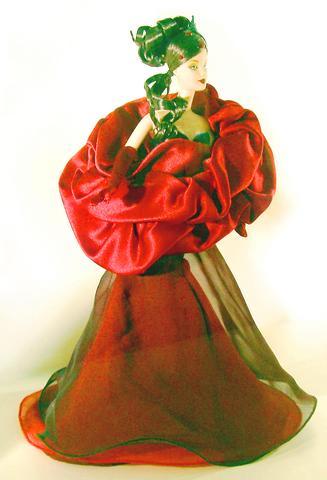
PHOTO: YU SEN-LUN, TAIPEI TIMES
Following the opening of Taiwan's first Doll Museum last month, the little-known past of Taishan has come into the spotlight again.
"Look, this part of her body is made by the revolving machine. And for the hair, we had to sew the hair circles then use ovens to make [the hair] curl," Lin said, pointing to a doll in the museum and recounting her 20 years of making Barbies.
Lin said she originally worked in a clothing factory in Taoyuan and in 1967, Mattel set up and she moved to Taishan to become one of the earliest employees in the factory.
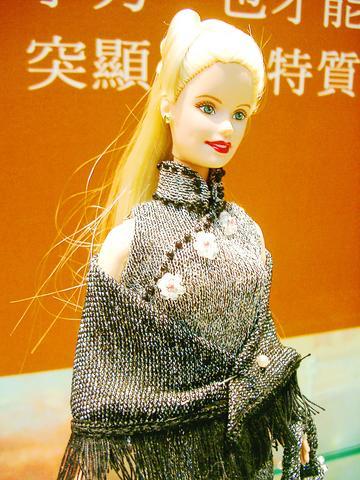
The business soon took off and peaked in the 1980s. The factory was divided into many departments that included body-shaping, spray-painting, hair-implants and sewing.
"For example,
Barbie's eyes, eyebrows, cheeks and lips, and also Ken's hair, are all made by spray paint," Lin said.
Teng Cheng-ming (
Mattel in Taiwan was a joint venture between Mattel and Hua-hsia Plastic (
"In the beginning, it was very primitive. There was no machine for us to curl the hair. We had to use chopsticks and wire to roll up the hair and use rice cookers to steam it. But you could not steam too much or it would damage and blur the paint for the doll's eyes," Lin said.
The factory became so busy, the work needed to be contracted out to workers outside of the factory. Thousands of housewives took up the piece-work jobs, doing knots, sewing buttons and laces, or putting on little shoes and earrings for the dolls.
Ku Tsuei-eh (
Ku said she if worked hard, she earned NT$360 a day. At that time, Lin Ah-ching's salary was NT$700 a month. A Barbie doll, however, cost NT$1,200. In today's NT dollars, that works out to more than the price of a Louis Vuitton bag.
Factory community
It was, therefore, common for the employees to take home a Barbie doll. "People would think you were weird if you didn't take one home," Lin said.
Some would hide the doll in their bell-bottomed pants. Others took hands and legs in their underwear to assemble at home.
This made the company hire security. "Whenever security showed up, workers would give signals to each other and some had to throw away the dolls out into the rice fields. Sometimes they threw them into people's houses," Ku said.
Of course, workers caught carrying a doll home were sacked immediately. Generally, according to Teng, also a labor-union member at Mattel, the company treated its employees fairly well.
"The company put in plenty of employee-welfare funds. We ate well and had parties in the factory. It was like a big family. We dated the girls and got married here," said Teng, whose wife was also a Mattel employee.
In 1984, employees were informed that the factory would move its operations to Indonesia and China and the factory closed in 1987. There were no disputes or fights from the labor side, as the union negotiated a severance fee with the management.
Each worker was paid between NT$100,000 and NT$200,000. But the local economy suffered.
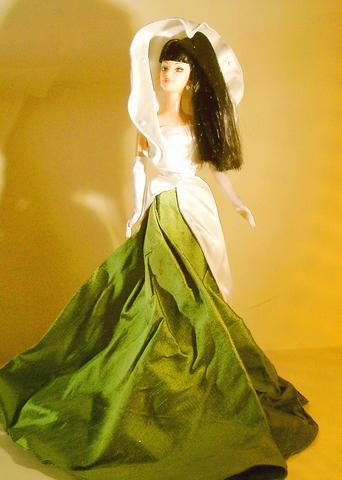
Ku Tsuei-eh now serves in the Taishan Township Office and Community Rebuilding Team. He was one of those behind the setting up of the doll museum. The museum now displays 400 differently clad Barbie dolls, as well as antiques and photos of the history of Mattel in Taiwan.
"The doll-making was a major part of Taishan Township. So we want to restore doll-making culture in this town," Ku said.
In the past five years of preparing the doll museum, the team set up workshops for Taishan residents to learn designing and making clothes for Barbie dolls. The workshop also invited old employees, such as Lin and Teng, to talk about their experiences.
Recounting her days at Mattel, Lin Ah-ching feels that living in Barbie's world was accidental but nice.
"It was all about making a living. I was never a big fan of dolls and I never had the luxury of collecting them. But I know how to make a perfect doll," she said.
For your information :
Taishan Doll Museum: 26, Lane 26 Fengchiang Road, Taishan, Taipei County (
Telephone: (02) 8531 1406

Sept.16 to Sept. 22 The “anti-communist train” with then-president Chiang Kai-shek’s (蔣介石) face plastered on the engine puffed along the “sugar railway” (糖業鐵路) in May 1955, drawing enthusiastic crowds at 103 stops covering nearly 1,200km. An estimated 1.58 million spectators were treated to propaganda films, plays and received free sugar products. By this time, the state-run Taiwan Sugar Corporation (台糖, Taisugar) had managed to connect the previously separate east-west lines established by Japanese-era sugar factories, allowing the anti-communist train to travel easily from Taichung to Pingtung’s Donggang Township (東港). Last Sunday’s feature (Taiwan in Time: The sugar express) covered the inauguration of the

The corruption cases surrounding former Taipei Mayor and Taiwan People’s Party (TPP) head Ko Wen-je (柯文哲) are just one item in the endless cycle of noise and fuss obscuring Taiwan’s deep and urgent structural and social problems. Even the case itself, as James Baron observed in an excellent piece at the Diplomat last week, is only one manifestation of the greater problem of deep-rooted corruption in land development. Last week the government announced a program to permit 25,000 foreign university students, primarily from the Philippines, Indonesia and Malaysia, to work in Taiwan after graduation for 2-4 years. That number is a
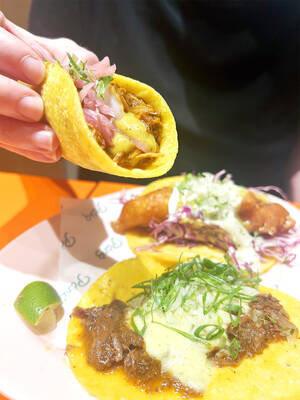
This year’s Michelin Gourmand Bib sported 16 new entries in the 126-strong Taiwan directory. The fight for the best braised pork rice and the crispiest scallion pancake painstakingly continued, but what stood out in the lineup this year? Pang Taqueria (胖塔可利亞); Taiwan’s first Michelin-recommended Mexican restaurant. Chef Charles Chen (陳治宇) is a self-confessed Americophile, earning his chef whites at a fine-dining Latin-American fusion restaurant. But what makes this Xinyi (信義) spot stand head and shoulders above Taipei’s existing Mexican offerings? The authenticity. The produce. The care. AUTHENTIC EATS In my time on the island, I have caved too many times to

In the aftermath of the 2020 general elections the Chinese Nationalist Party (KMT) was demoralized. The Democratic Progressive Party (DPP) had crushed them in a second landslide in a row, with their presidential candidate Tsai Ing-wen (蔡英文) winning more votes than any in Taiwan’s history. The KMT did pick up three legislative seats, but the DPP retained an outright majority. To take responsibility for that catastrophic loss, as is customary, party chairman Wu Den-yih (吳敦義) resigned. This would mark the end of an era of how the party operated and the beginning of a new effort at reform, first under


 RSS
RSS