


It was supposed to be a sideshow, a six-minute slice of traditional Irish culture given a glitzy makeover and squeezed into an interval during the 1994 Eurovision Song Contest.
But Riverdance stole the show on that spring night in Dublin and has since gone on to become one of the biggest showbusiness phenomena the world has ever seen.
Since the troupe first pranced across the Eurovision stage, clicking their heels and high-kicking to the sound of Irish fiddles and flutes, Riverdance has played over 6,000 times in more than 220 venues.
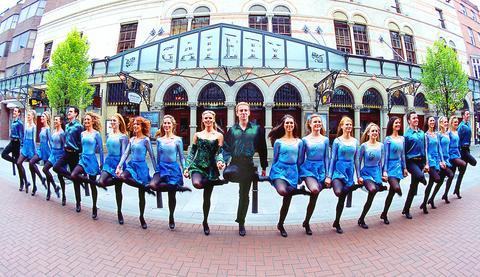
PHOTO: REUTERS
It has visited 27 countries from Mexico to Malaysia, played before more than 16 million people and been seen on television by 1.5 billion viewers -- 300 times the population of Ireland.
Sales of Riverdance merchandizing have netted more than US$35 million worldwide. There are more than 6 million Riverdance videos spread across the globe and 2 million CDs.
Next month, the river flows home to Dublin for a special 10th anniversary show in the intimate and ornate surroundings of the 19th century Gaiety Theatre.
It will be produced by Julian Erskine, who has worked with Riverdance almost since its conception and who still recalls the moment in 1994 when Irish dancing suddenly became sexy.
Star quality
Erskine was at the Gaiety on the night of the Eurovision Song Contest, working on a production of Sean O'Casey's classic Irish drama The Plough and the Stars. Eurovision was taking place at The Point, on the other side of the city.
"We were backstage, with half an eye on the television, when Riverdance came on," he said. "The room went quiet and everyone just stood and stared in amazement at what was happening on the screen.
"By the end of the performance, I was one of those wide-eyed innocents jumping up and down, shouting how wonderful it was."
Before the year was out, a Riverdance single had shot straight to number one in the Irish charts where it remained for 18 consecutive weeks -- a record which still stands.
In 1995 it crossed the Irish Sea to set a box office record of 151 sell-out shows at London's Hammersmith Apollo and the following year it conquered America, opening at New York's Radio City Music Hall in St Patrick's Week.
The rest of the world soon surrendered. Not even a fire at a venue in Madrid in 2001 could stem the tide -- although it did destroy much of the troupe's equipment.
But what is Riverdance all about, and why has it been so successful?
According to its promoters, it is about more than dancing: it is about the life of a river, and how rain falls from the sky, seeps into streams, flows into the sea and then evaporates into the clouds only to fall as rain again.
"The river ... symbolizes the life cycle, and echoes the Irish experience of emigration and renewal," the show's promoters say. It is about "people who had left their homeland and traveled across the sea".
`Blown away'
Whether you buy into that or dismiss it as half-baked Celtic mysticism, there is no doubt Riverdance has struck a chord with the Irish diaspora across the world.
Sinead McCafferty, lead female dancer in next month's show, was brought up in Canada while her male dance partner Conor Hayes was raised in Australia. Both were born in Ireland but emigrated with their parents as infants.
"Our whole world in Toronto was Irish," recalls McCafferty, who learned Irish dancing as a child but abandoned it to take up modeling. "We were the only ones in our family who left Belfast and our life in Canada revolved around Irish music and culture.
"When I saw Riverdance I was blown away by it. It inspired me to start dancing again."
Riverdance was perhaps the most extravagant expression of a new-found confidence which swept Ireland in the 1990s.
After decades of economic hardship and sectarian violence in Northern Ireland, it once again felt good to be Irish and to celebrate Irish culture.
Ten years on, and despite being dismissed by some critics as over-hyped Irish kitsch, the river shows no sign of drying up.
The song that won that 1994 Eurovision Song Contest -- Rock 'n' Roll Kids -- is long since forgotten.
So, when Eurovision is staged in Turkey this weekend, keep an eye out for the interval act.
It might just steal the show.

Sept.16 to Sept. 22 The “anti-communist train” with then-president Chiang Kai-shek’s (蔣介石) face plastered on the engine puffed along the “sugar railway” (糖業鐵路) in May 1955, drawing enthusiastic crowds at 103 stops covering nearly 1,200km. An estimated 1.58 million spectators were treated to propaganda films, plays and received free sugar products. By this time, the state-run Taiwan Sugar Corporation (台糖, Taisugar) had managed to connect the previously separate east-west lines established by Japanese-era sugar factories, allowing the anti-communist train to travel easily from Taichung to Pingtung’s Donggang Township (東港). Last Sunday’s feature (Taiwan in Time: The sugar express) covered the inauguration of the

The corruption cases surrounding former Taipei Mayor and Taiwan People’s Party (TPP) head Ko Wen-je (柯文哲) are just one item in the endless cycle of noise and fuss obscuring Taiwan’s deep and urgent structural and social problems. Even the case itself, as James Baron observed in an excellent piece at the Diplomat last week, is only one manifestation of the greater problem of deep-rooted corruption in land development. Last week the government announced a program to permit 25,000 foreign university students, primarily from the Philippines, Indonesia and Malaysia, to work in Taiwan after graduation for 2-4 years. That number is a

This year’s Michelin Gourmand Bib sported 16 new entries in the 126-strong Taiwan directory. The fight for the best braised pork rice and the crispiest scallion pancake painstakingly continued, but what stood out in the lineup this year? Pang Taqueria (胖塔可利亞); Taiwan’s first Michelin-recommended Mexican restaurant. Chef Charles Chen (陳治宇) is a self-confessed Americophile, earning his chef whites at a fine-dining Latin-American fusion restaurant. But what makes this Xinyi (信義) spot stand head and shoulders above Taipei’s existing Mexican offerings? The authenticity. The produce. The care. AUTHENTIC EATS In my time on the island, I have caved too many times to

In a stark demonstration of how award-winning breakthroughs can come from the most unlikely directions, researchers have won an Ig Nobel prize for discovering that mammals can breathe through their anuses. After a series of tests on mice, rats and pigs, Japanese scientists found the animals absorb oxygen delivered through the rectum, work that underpins a clinical trial to see whether the procedure can treat respiratory failure. The team is among 10 recognized in this year’s Ig Nobel awards (see below for more), the irreverent accolades given for achievements that “first make people laugh, and then make them think.” They are not


 RSS
RSS