


Some days are unforgettable, and so it is that Meisie Ndlovu and John Henshall both recall what they were doing 10 years ago on April 26, 1994, when South Africa won its freedom.
Henshall stood in the broiling sun in his all-white suburb, part of a 3.2km line of voters electing a first democratic president. Ndlovu stood in a line in her all-black town, listening to neighbors exult that democracy meant free food, forever, for everyone.

PHOTO:NY TIMES
Henshall was skeptical that black rule would be as bad as some neighbors feared. Ndlovu was skeptical that it would be as good as neighbors predicted.
"I didn't believe it," she said, laughing. "I said, `This government is going to be poor.' I said, `I am not educated, but I can think.'"
As it turned out, they were both right.
This is a tale about the Ndlovus, black and striving, and the Henshalls, white and coping, and what a decade of democracy has brought them and their country.
The two families are not acquainted. Indeed, they are separated, like most blacks and whites here, by huge racial and economic divides.
But if a lesson can be drawn from a decade of multiracial democracy, a transformation hailed for its almost miraculous absence of rancor, it is that families like these are far more alike today than before 1994 -- both in aspirations and fears.
The happy and the wary
For Ndlovu, a plump, round-faced woman with a quick laugh and unruly hair pulled in braids, there is no mistaking what 10 years of freedom have done. Just look at her toolshed.
Set behind her brick home just outside Soshanguve, a city of 146,000, the shed is 3m by 3m, a listing shambles of rusted corrugated iron and sheet metal, unexceptional but for this: Before it was a toolshed, the Ndlovu family lived there for five years.
Under apartheid, Ndlovu was an illiterate black domestic in a white household. Today she runs her own construction company, laying asphalt and building fences on freeway projects. Her three-bedroom home has new living-room furniture and a carved wood door.
Her old shack sits in the backyard, a dilapidated reminder of the past. Her 17-year-old daughter calls it "scary." Ndlovu refuses to tear it down. "I like that house," she said. "I suffered in that house."
There is also no mistaking what a decade has brought John and Liann -- Li for short -- Henshall. Just look at Kyalami Estate, the idyllic suburb they and their three children call home.
Sixteen kilometers north of Johannesburg, theirs is an American-style community, studded with tennis courts, parks, lakes and community centers, unexceptional but for this: It is enclosed by a 3m brick wall, crowned with an electric fence.
Eight kilometers west is the Diepsloot squatter camp, 11 years old and 86,000 impoverished people strong -- Ndlovu's toolshed, replicated by the thousands. The Henshalls, whites who prospered in a decade of black rule, feel for Diepsloot's residents. Not unreasonably, they fear them, too.
"We believe that if you employ your own police force and you live behind the right kind of wall, you stand a chance," said John Henshall, a bluff man with an embracing manner. "We're happy inside our walls."
Outside the walls, they are wary. Says Li: "How good can life be if you have to live in fear?"
Something to lose
A decade after apartheid, many analysts say South Africa has stepped back from the racial precipice. The real worry now, they say, is not the racial gap, but the gap between the haves, of any color, and the have-nots -- what President Thabo Mbeki calls two economies "without a connecting staircase."
South Africa's 4 million-plus whites still dominate an economy serving 45 million citizens. They claim nearly half of all income. Yet today they are joined by as many as 11 million blacks who are also solidly entrenched in the middle and upper classes.
More black children are in school; more black adults are literate; millions more blacks have clean water, electricity, toilets.
At the same time, a vast black underclass is swelling. Roughly half of South Africans are either poor or on the edge of poverty, economists say. Thirty to 40 percent are jobless. The UN says the living standard has fallen since 1990, mostly due to the devastation of AIDS.
Crime, among the world's worst, is terrifying for its strikingly gratuitous violence. Skilled workers still are leaving, but a much-feared exodus of whites never materialized.
For all its peaceful changes, this is not a land of lion-and-lamb peace. "Weary tolerance is one way to describe it," says Tom Lodge, an analyst at University of the Witwatersrand in Johannesburg. Some whites feel the sting of lost power; many blacks resent whites' continued privilege.
Still, a force stronger than their mistrust binds Ndlovu, who rose in 10 years to the head of little Meithlo Construction Co, and the Henshalls, who run a bustling forklift business out of their US$225,000 home. Unlike the have-nots, both of them have a stake in making this miracle work.
Or, as John Henshall wryly puts it: "Everyone has something to lose."
As democracy arrived, Henshall held his breath. But the family business prospered. Fearing the consequences of white flight and economic ruin, the new government bent over backward to keep white businesses alive. Few of their nightmare scenarios came to pass.
"The only problem we've suffered as white people," Henshall said, "has been major crime."
Ndlovu agrees that crime is the government's biggest challenge. Driving from her home one afternoon, she pointed to the silver cell phone under her dashboard. It is her fifth. Her workers stole the others. Her car radio is also gone.
"They come at night and steal the petrol," she said. "I find out in the morning when I try to go to work."
Still, Ndlovu has hopes. She wants to finish the ceiling in her home and to move from subcontracting to better-paying contracting. She wants a computer and a fax machine.
She would like to replace her no-account former husband. But she fears AIDS, so "I just keep myself busy with work," she said.
She believes "some whites have changed." But her church, her daughter's high school, her town -- in fact, her whole world -- is black, save the whites who monitor her work. She figures she is too old to see that change.
"The new generation is the one that is going to get the new world," she said. "They are going to work together. Not the old people. The young generation is the one who is going to know the truth."
John and Li Henshall have hopes, too, for a safer and more harmonious nation. They say Nelson Mandela's message of tolerance is firmly imprinted on their three children. "You say one thing negative about the blacks, they will shout you down -- `You are a racist!'" Li Henshall said. "It is actually quite good."
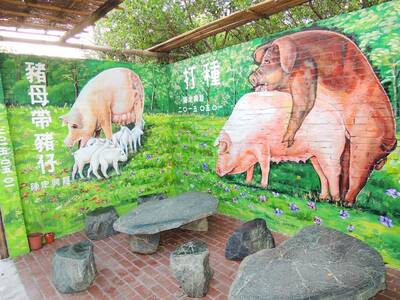
May 6 to May 12 Those who follow the Chinese-language news may have noticed the usage of the term zhuge (豬哥, literally ‘pig brother,’ a male pig raised for breeding purposes) in reports concerning the ongoing #Metoo scandal in the entertainment industry. The term’s modern connotations can range from womanizer or lecher to sexual predator, but it once referred to an important rural trade. Until the 1970s, it was a common sight to see a breeder herding a single “zhuge” down a rustic path with a bamboo whip, often traveling large distances over rugged terrain to service local families. Not only
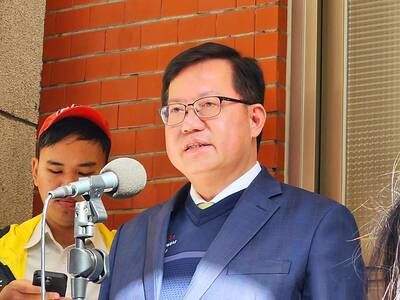
By far the most jarring of the new appointments for the incoming administration is that of Tseng Wen-tsan (鄭文燦) to head the Straits Exchange Foundation (SEF). That is a huge demotion for one of the most powerful figures in the Democratic Progressive Party (DPP). Tseng has one of the most impressive resumes in the party. He was very active during the Wild Lily Movement and his generation is now the one taking power. He has served in many of the requisite government, party and elected positions to build out a solid political profile. Elected as mayor of Taoyuan as part of the
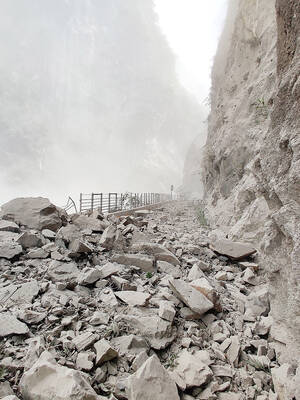
Moritz Mieg, 22, lay face down in the rubble, the ground shaking violently beneath him. Boulders crashed down around him, some stones hitting his back. “I just hoped that it would be one big hit and over, because I did not want to be hit nearly to death and then have to slowly die,” the student from Germany tells Taipei Times. MORNING WALK Early on April 3, Mieg set out on a scenic hike through Taroko Gorge in Hualien County (花蓮). It was a fine day for it. Little did he know that the complex intersection of tectonic plates Taiwan sits

Last week the Directorate-General of Budget, Accounting and Statistics (DGBAS) released a set of very strange numbers on Taiwan’s wealth distribution. Duly quoted in the Taipei Times, the report said that “The Gini coefficient for Taiwanese households… was 0.606 at the end of 2021, lower than Australia’s 0.611, the UK’s 0.620, Japan’s 0.678, France’s 0.676 and Germany’s 0.727, the agency said in a report.” The Gini coefficient is a measure of relative inequality, usually of wealth or income, though it can be used to evaluate other forms of inequality. However, for most nations it is a number from .25 to .50


 RSS
RSS