


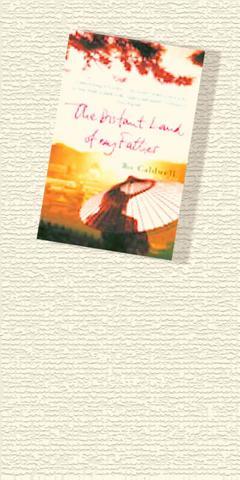
Shanghai in the 1930s has been the subject of several eminent modern novels, notably J.G.Ballard's Empire of the Sun, Christopher New's Shanghai and Kazuo Ishiguro's When We Were Orphans. Now another contender enters the lists, a genial if placid work by first-time novelist Bo Caldwell.
The time and place offer many dramatic elements -- one of the world's biggest trading centers, plus a mix of peoples from all over China, and foreign expatriates from every corner of the planet. Almost all, it can be safely assumed, were on the make, with a good number of all ethnicities more or less openly unscrupulous, and not a few actually criminal. It was the place in the world where East met West most conspicuously, in trade, in politics, and frequently, too, in erotic liaison.
Added to this is the highly charged political atmosphere of the 1930s -- Fascism at the throat of traditional European liberalism, Communism triumphant in Russia and making a bid for hearts and minds in China, and a newly emergent Japan on the rampage, already making inroads into China and soon to be threatening Shanghai itself.
Wind forward a few years and you have World War II, Japan briefly triumphant throughout Asia, followed by the Communist take-over in China. Shanghai was at the heart of all these things. In the space of 15 years it saw itself dominated by the Western powers, overrun by the Japanese, and then falling to the Communists. No wonder novelists and filmmakers have come running.
The Distant Land of my Father begins with an American family living in Shanghai's western suburb of Hungjao in 1937. Joseph Schoene, the son of missionaries in Shantung province, is a man grown rich in the import-export business, notably with the Japanese, and much else besides. His wife Genevieve and daughter Anna consequently live in great luxury. There is talk of the threat posed by the Communists and Japanese, but Joseph shrugs it off. He is living a charmed life -- why should he worry? Even though he has a finger in many pies, why should he be touched?
Then one Saturday, when he is showing Anna, still a child, around town, he is kidnapped by two men speaking Cantonese, hit over the head with the butt of a pistol, and dragged unconscious into the back of a car. At a stroke, paradise is lost, though Anna, the book's narrator, doesn't learn the complete truth until she reads her father's journals in California 24 years later.
Kidnappings were a Shanghai specialty if novels are to be believed. They not only feature in this book, but also in Christopher New's and Kazuo Ishiguro's. They are clearly an essential ingredient in this particular recipe.
When matters deteriorate even further, Genevieve and Anna leave the country for the US. The father eventually re-joins them, only to accept an invitation to return to China to act as a translator for Chiang Kai-shek's forces. After the war, mother and daughter return to Shanghai and the inevitable happens -- they find that Joseph is living with a Chinese partner. When he eventually shows up in Pasadena in the mid-1950s, after a spell in prison from 1951 to 1954 following the Communist takeover, they are reluctant to acknowledge him. Anna is by then newly married and expecting her first child, and the now aged Genevieve alerts her to the threat her father poses. The story of Anna's attempted reconciliation with her father, and with her own past, constitutes the novel's final phase.
This book, now in paperback, has been rather successful. For this reviewer, however, it proved hard to love. That it's popular in nature can't be considered a fault, but that it's hard to find an original note struck is more worrying. This is one of those novels where nothing in life in questioned -- no fashions dubbed absurd, no unusual political loyalties espoused, no particularly incisive judgments made. The author makes the narrator and her mother Catholics, but one wonders why. In the event, the fact doesn't count for much -- Caldwell is no Graham Greene or Evelyn Waugh.
It's a phenomenon of the age that such books frequently find millions of readers without ever eliciting much critical approval. For anyone who hopes to find a degree of mental stimulus in their reading, the pervasive lack of skepticism is what makes novels like this hard to warm to.
Nevertheless, many readers will judge this a smooth and engaging read. The history of the years 1937 to 1961 is dutifully and fully woven into the narrative, and the characters' lives are shown as having been molded by their voyage over these tumultuous seas. The narrator, though conventional, is by no means insensitive.
The Distant Land of my Father, in other words, is a family saga spanning the Pacific seaboard in the mid-20th century. It casts some light on American-Chinese relations during that era, but essentially is a story of family feelings, very much from the perspective of the women involved. Christmas, birthdays, presents, clothes and personal scents are the markers which punctuate the tale. Political events are taken as read, doctors' opinions are automatically believed and accepted, and the women respond to them both with sensitivity and passivity in roughly equal proportions.
Bo Caldwell has said that she based the story on the life of an uncle. Her grandparents, too, were missionaries in China at the beginning of the 20th century, and their lives will form the basis of this book's successor.
For those who enjoy this kind of extended family tale, to claim to have felt suffocated by the family hugs, the pervading coziness, and the general acceptance of the world as it appears, will be judged heretical, if not barbaric. I can only respond by saying that some comedy, some ideas, and more astringency generally, might have turned this book into a more compelling reading experience. For many readers, however, it may prove just the comforting balm they need. If I felt smothered, maybe that was just my problem.

Sept.16 to Sept. 22 The “anti-communist train” with then-president Chiang Kai-shek’s (蔣介石) face plastered on the engine puffed along the “sugar railway” (糖業鐵路) in May 1955, drawing enthusiastic crowds at 103 stops covering nearly 1,200km. An estimated 1.58 million spectators were treated to propaganda films, plays and received free sugar products. By this time, the state-run Taiwan Sugar Corporation (台糖, Taisugar) had managed to connect the previously separate east-west lines established by Japanese-era sugar factories, allowing the anti-communist train to travel easily from Taichung to Pingtung’s Donggang Township (東港). Last Sunday’s feature (Taiwan in Time: The sugar express) covered the inauguration of the

The corruption cases surrounding former Taipei Mayor and Taiwan People’s Party (TPP) head Ko Wen-je (柯文哲) are just one item in the endless cycle of noise and fuss obscuring Taiwan’s deep and urgent structural and social problems. Even the case itself, as James Baron observed in an excellent piece at the Diplomat last week, is only one manifestation of the greater problem of deep-rooted corruption in land development. Last week the government announced a program to permit 25,000 foreign university students, primarily from the Philippines, Indonesia and Malaysia, to work in Taiwan after graduation for 2-4 years. That number is a
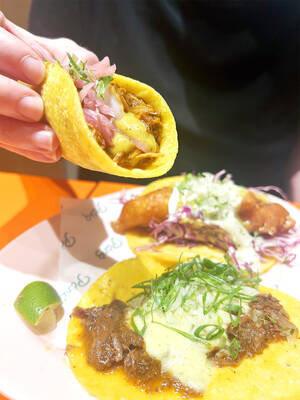
This year’s Michelin Gourmand Bib sported 16 new entries in the 126-strong Taiwan directory. The fight for the best braised pork rice and the crispiest scallion pancake painstakingly continued, but what stood out in the lineup this year? Pang Taqueria (胖塔可利亞); Taiwan’s first Michelin-recommended Mexican restaurant. Chef Charles Chen (陳治宇) is a self-confessed Americophile, earning his chef whites at a fine-dining Latin-American fusion restaurant. But what makes this Xinyi (信義) spot stand head and shoulders above Taipei’s existing Mexican offerings? The authenticity. The produce. The care. AUTHENTIC EATS In my time on the island, I have caved too many times to

In a stark demonstration of how award-winning breakthroughs can come from the most unlikely directions, researchers have won an Ig Nobel prize for discovering that mammals can breathe through their anuses. After a series of tests on mice, rats and pigs, Japanese scientists found the animals absorb oxygen delivered through the rectum, work that underpins a clinical trial to see whether the procedure can treat respiratory failure. The team is among 10 recognized in this year’s Ig Nobel awards (see below for more), the irreverent accolades given for achievements that “first make people laugh, and then make them think.” They are not


 RSS
RSS