


Established to promote women's rights in the sleepy rural counties of Yunlin and Chiayi, Sister Radio (
The trial period was so successful that Asia's sole female-oriented broadcast network run by women for women became a permanent 24-hour fixture on the FM dial on Women's Day, March 8, last year. The station's popularity is now at an all-time high and even reaches audiences it never intended to reach.
Since it began broadcasting on Web radio the station has built up a solid reputation nationwide and now attracts thousands of listeners of both sexes on a daily basis throughout Taiwan.
The brainchild of ex-DPP lawmaker and longtime women's rights activist Wang Li-ping (
From the beginning, the station endeavored to capture a target audience of female listeners. According to the bleach-blonde and mohawked Wang, the station's main aim was (and still is) to bring women's issues and gender awareness to the forefront in rural areas, where such concerns once enjoyed little, if any media coverage. At the same time the station readily provides information for women suffering from spousal/family abuse, to those in need of help with regard to education and other matters.
There are plenty of resources available for women relating to gender issues in the cities, but very little in the country. Women in Taipei and Kaohsiung can pop into any one of dozens of bookstores and associations to find information, but there are very few bookstores here and the libaries offer nothing at all in the way of resources," said Denise Liang (
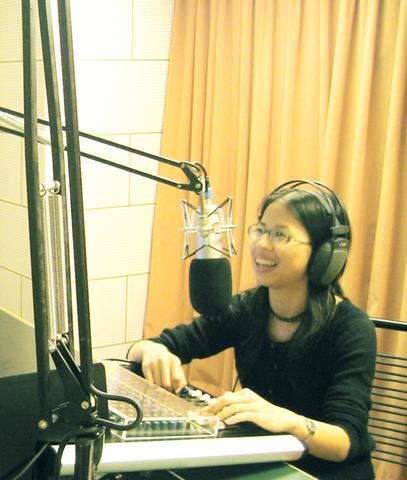
PHOTO: GAVIN PHIPPS, TAIPEI TIMES
As well as acting as a sorting house for information, the station works in close conjunction with women's organizations like the Yunlin County Color Purple Women's Association (
The station's format during the trial period proved remarkably popular and was one that the station management hoped to see continue, but Sister Radio was forced to alter it slightly after running into a couple of unforeseen, and somewhat bizarre obstacles.
Located in the heart of pirate radio station country, Sister Radio was forced to alter the language of many of its broadcasts early last year in order to distance itself from the many illegal "fake medicine-selling underground radio stations" (
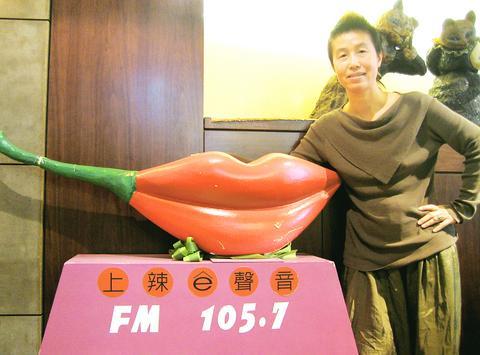
PHOTO: GAVIN PHIPPS, TAIPEI TIMES
However odd it may seem, especially considering that Taiwanese is the most commonly used language in the Yunlin/Chiayi area, the prolific number of pirate radio stations operating in the region meant that the station had to revert to the use of Mandarin in order to gain credibility.
"It sounds stupid, but listeners really thought that we were a pirate radio station because our programs were in Taiwanese," said Liang. "We changed the format and suddenly people began to think of us as a genuine radio station. It's an odd turn of events, but there you are."
While radio station staff realize that by broadcasting principally in Mandarin they are distancing themselves from a large section of their original target audience, there is very little that can be done about it. A recent report states that the county's pirate radio problem is spiraling out of control. There are more than 10 pirate radio stations operating at any given time in the county, double the number of legal stations.
One of the oddest problems faced by the radio station in its fledgling days, however, stemmed from a misunderstanding surrounding its name and logo, which is a pair of red lips in the shape of a chili pepper. Sending the wrong message to some, the station became a target for large numbers of unwanted male callers.
Liang, or Little Witch (
"I think because of our name and the logo these people thought we were somehow related to the 0204 sex related chat-lines. I'd get numerous calls while on air from men asking if I'd be their friend and go on a date with them," she said. "It was embarrassing to begin with because the station was new and we were trying to make a name for ourselves."
The station still uses its spicy lips logo, but according to Liang, such calls have become more infrequent in the past year.
"We got used to it after a time and getting rid of them became second nature. We'd politely tell them that they were live on air and that they'd made a mistake. They'd hang-up quite quickly after that."
Initially aiming its programming toward a target audience of 30-year-old-plus females the station has slowly begun to adapt its shows in order to attract a younger audience. The introduction of music programs focusing on classical, pop, traditional and even dance music -- as well as the addition of male hosts in recent months -- has enabled the station to branch out and expand its core audience. Listening figures now point to an audience that ranges from 20- to 40-years-old and covers both sexes.
The station is also broadcasting several programs relating to gay and lesbian issues.
According to Liang, before the station began airing programs such as Lez Radio (
"Since we've been running the programs people have written in to say how much they appreciate them and they say we have given them the courage to speak out and search for their identity," said Liang. "In rural areas like this homosexuals have felt alone for a long time. Many felt that there was no way they would ever find a program to listen to that aimed at issues affecting them."
While the station continues to thrive and fill a much-needed niche, station management is already looking to the future. And when problems surrounding broadband broadcasting are finally ironed out in Taiwan it is hoped that the Sister Radio will reach even people and spread its feminist, gay and lesbian messages of good will to an even wider audience.

Last week, Viola Zhou published a marvelous deep dive into the culture clash between Taiwanese boss mentality and American labor practices at the Taiwan Semiconductor (TSMC) plant in Arizona in Rest of World. “The American engineers complained of rigid, counterproductive hierarchies at the company,” while the Taiwanese said American workers aren’t dedicated. The article is a delight, but what it is depicting is the clash between a work culture that offers employee autonomy and at least nods at work-life balance, and one that runs on hierarchical discipline enforced by chickenshit. And it runs on chickenshit because chickenshit is a cultural

By far the most jarring of the new appointments for the incoming administration is that of Tseng Wen-tsan (鄭文燦) to head the Straits Exchange Foundation (SEF). That is a huge demotion for one of the most powerful figures in the Democratic Progressive Party (DPP). Tseng has one of the most impressive resumes in the party. He was very active during the Wild Lily Movement and his generation is now the one taking power. He has served in many of the requisite government, party and elected positions to build out a solid political profile. Elected as mayor of Taoyuan as part of the

Moritz Mieg, 22, lay face down in the rubble, the ground shaking violently beneath him. Boulders crashed down around him, some stones hitting his back. “I just hoped that it would be one big hit and over, because I did not want to be hit nearly to death and then have to slowly die,” the student from Germany tells Taipei Times. MORNING WALK Early on April 3, Mieg set out on a scenic hike through Taroko Gorge in Hualien County (花蓮). It was a fine day for it. Little did he know that the complex intersection of tectonic plates Taiwan sits

When picturing Tainan, what typically comes to mind is charming alleyways, Japanese architecture and world-class cuisine. But look beyond the fray, through stained glass windows and sliding bookcases, and there exists a thriving speakeasy subculture, where innovative mixologists ply their trade, serving exquisite concoctions and unique flavor profiles to rival any city in Taiwan. Speakeasies hail from the prohibition era of 1920s America. When alcohol was outlawed, people took their business to hidden establishments; requiring patrons to use hushed tones — speak easy — to conceal their illegal activities. Nowadays legal, speakeasy bars are simply hidden bars, often found behind bookcases


 RSS
RSS