


It's hard to overstate the significance of Mei Lanfang's (
But his fame wasn't limited to his homeland. As the first artist to introduce Peking opera to an overseas audience, he gained acclaim from some of the giants of Western drama. His influence spread to nearly every aspect of the art and his style came to be known as the "Mei school" of Peking opera. Years after his death, the Beijing Opera Company took Mei's name for its own and his house was made into a museum. It is featured on tourist maps of Beijing.
Born to a family of Peking opera performers, Mei began studying the art form at eight and made his stage debut at the ripe age of 11.
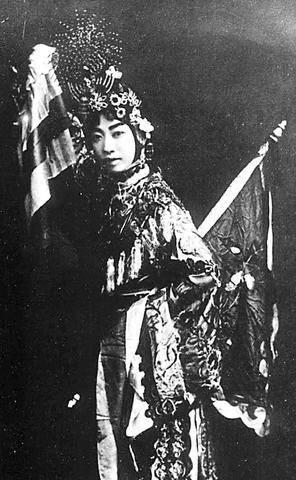
But Mei's talent did not come naturally. Later in his life, he recalled his first opera teacher telling him that he would never accomplish much in the profession because of his lackluster eyes. To overcome this, Mei said, he would stare intently at candle flames in the dark to follow their movements and raised pigeons to watch them soar into the clouds, all so that his eyes would "brighten." The training worked and he became famous by his twentieth birthday.
He became so adept at playing chingyi roles (青衣), which idealize feminine beauty and grace, and the dan roles (旦) of female warriors and vivacious young women, that the importance of these roles was forever changed. One story retells a time when he pretended to assault his wife. He later apologized to her and explained that he needed to understand a woman' s reaction to fear because his director was unsatisfied with a part of his performance.
He revolutionized stage make-up and costumes, systemized and enriched characters' gestures, expressions and poses and wrote several plays which he choreographed himself.
He twice toured the Soviet Union and Japan and, in 1930, played for audiences in the US, including Constantin Stanislavsky, the father of "method acting," who praised Mei's performance.
At the outbreak of the Sino-Japanese war, he returned to Shanghai but kept a beard and moustache and refused to perform for the Japanese occupiers. He resumed his stage career in 1946 and continued playing female roles until his death in 1961.

Sept.16 to Sept. 22 The “anti-communist train” with then-president Chiang Kai-shek’s (蔣介石) face plastered on the engine puffed along the “sugar railway” (糖業鐵路) in May 1955, drawing enthusiastic crowds at 103 stops covering nearly 1,200km. An estimated 1.58 million spectators were treated to propaganda films, plays and received free sugar products. By this time, the state-run Taiwan Sugar Corporation (台糖, Taisugar) had managed to connect the previously separate east-west lines established by Japanese-era sugar factories, allowing the anti-communist train to travel easily from Taichung to Pingtung’s Donggang Township (東港). Last Sunday’s feature (Taiwan in Time: The sugar express) covered the inauguration of the

The corruption cases surrounding former Taipei Mayor and Taiwan People’s Party (TPP) head Ko Wen-je (柯文哲) are just one item in the endless cycle of noise and fuss obscuring Taiwan’s deep and urgent structural and social problems. Even the case itself, as James Baron observed in an excellent piece at the Diplomat last week, is only one manifestation of the greater problem of deep-rooted corruption in land development. Last week the government announced a program to permit 25,000 foreign university students, primarily from the Philippines, Indonesia and Malaysia, to work in Taiwan after graduation for 2-4 years. That number is a
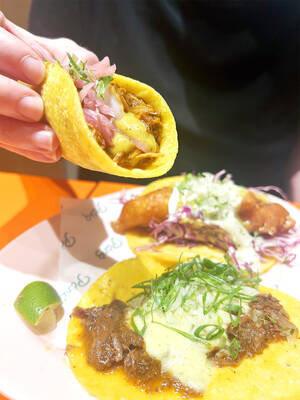
This year’s Michelin Gourmand Bib sported 16 new entries in the 126-strong Taiwan directory. The fight for the best braised pork rice and the crispiest scallion pancake painstakingly continued, but what stood out in the lineup this year? Pang Taqueria (胖塔可利亞); Taiwan’s first Michelin-recommended Mexican restaurant. Chef Charles Chen (陳治宇) is a self-confessed Americophile, earning his chef whites at a fine-dining Latin-American fusion restaurant. But what makes this Xinyi (信義) spot stand head and shoulders above Taipei’s existing Mexican offerings? The authenticity. The produce. The care. AUTHENTIC EATS In my time on the island, I have caved too many times to

In a stark demonstration of how award-winning breakthroughs can come from the most unlikely directions, researchers have won an Ig Nobel prize for discovering that mammals can breathe through their anuses. After a series of tests on mice, rats and pigs, Japanese scientists found the animals absorb oxygen delivered through the rectum, work that underpins a clinical trial to see whether the procedure can treat respiratory failure. The team is among 10 recognized in this year’s Ig Nobel awards (see below for more), the irreverent accolades given for achievements that “first make people laugh, and then make them think.” They are not


 RSS
RSS