


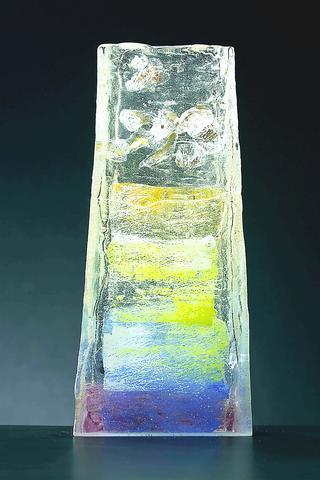
An exhibition and two-day seminars in Taipei earlier this month by Australian glass artists Gerry King, Pamela Stadus and Roger Buddle have stimulated nationwide interest in modern glass art, especially in local artistic circles and among government officials who have been organizing a two-month-long cultural event celebrating this elegant art form.
The exhibition also serves to remind Taiwan's artists that they must keep taking bold steps forward to explore creative ideas and artistic designs. If modern glass making in Australia is able to progress in such a splendid way within a period of approximately 30 years, Taiwan -- blessed with around 100 years of tradition in glassware -- should find no difficulty making an impression on the international stage.
The oldest glass objects that have been found are beads produced around 4,000 years ago in Egypt. Though Taiwan's glass industry, based in Hsinchu, is only a century old, it manufactures various glass items for export and local consumption. At the height of the glassware export trade in the 1980s, there were about 100 large-scale factories in Hsinchu.
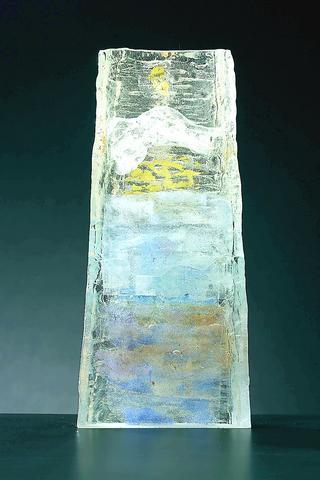
PHOTO COURTESY OF NATIONAL TAIWAN CRAFT RESEARCH INSTITUTE
Now, less than a dozen, that employ more than 10 people, remain. Chen Tien-li (
"Right after Taiwan opened its doors for cross-strait visits in the late 1980s, there was a massive migration of Taiwanese traditional craft industries [to China] in search of cheap labor. This has contributed greatly to the sudden and drastic decline in export volumes and has dealt a serious blow to the livelihood of craftsmen in the craft industry as a whole," Chen said.
Problems related to the decline and demise of traditional glass factories, however, were in-built as well. Factories tended to be vast in size, manufacture in large quantities and thus consumed enormous amounts of capital. For the sake of saving energy and other costs, a factory smelting furnace, which was heated up to 1350℃ to 1450℃ to maintain the liquid state of the glass, could cope with tonnes of glass a day. But, melted glass had to be used on the same day, or go to waste. It therefore became practically impossible for individual artists to sustain private glassware studios or workshops prior to the early 1960s.
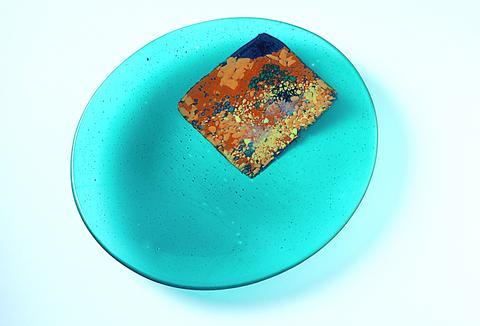
PHOTO COURTESY OF NATIONAL TAIWAN CRAFT RESEARCH INSTITUTE
The glassware industry landscape only changed when Harvey Littleton, a University of Wisconsin professor and ceramic artist, and Dominick Labino, a chemist, organized two glass-blowing workshops at the Teledo Museum of Art, Ohio in 1962. The pair showed that an individual artist could work with molten glass in a studio environment. Under Littleton's guidance, world-class glass artists such as Dale Chihuly and Marvin Lipofsky made their marks. Other graduates from Littleton's classes also created workshops and spread the new-found technology to artists in America and then around the world.
The US' Lakeview museum celebrates the revolutionary Studio Glass Art Movement of the 1960s and takes up the modern glass production story. "As those pioneers moved increasingly beyond the sphere of craft they also shifted from producing purely functional wares towards artistic and sculptural pieces. Today, artists trained in all media, including sculpture and painting, are exploiting the qualities of glass in new expressive ways."
Since this time, glass craft production has largely been freed from large-scale industrial settings and has been able to tap into techniques unknown to artists in the old days. More importantly, this novel technology offers an unprecedented opportunity for individual artists all over the world to explore glass as a medium for artistic creation, now that they are able to use smaller, studio-sized furnaces.
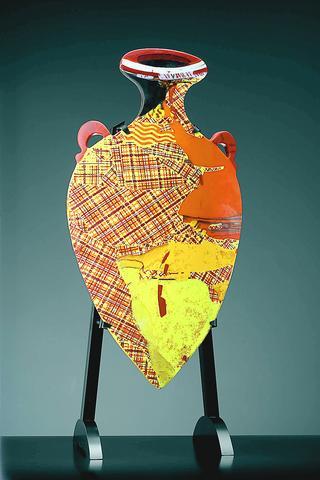
PHOTO COURTESY OF NATIONAL TAIWAN CRAFT RESEARCH INSTITUTE
In 1988, a Taiwanese movie-director-turned-glass-artist Heinrich Wang (
The phenomenal success of Wang and his associate Yang Hui-shan (
Y. S. Wang (
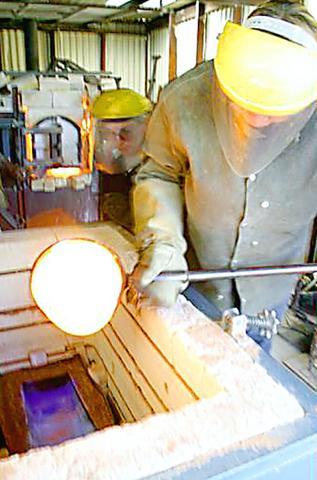
PHOTO COURTESY OF NATIONAL TAIWAN CRAFT RESEARCH INSTITUTE
"The ability to produce world-class designs in glass art by local artists will lift Taipei's status and allow it to compete shoulder to shoulder with Prague, Venice and Seattle within the next decade," Wang said, adding his staff's abilities compare favorably with international standards in the sphere of glassware design.
Leadership, modernity and idealism are the three qualities held dearly by Tittot. Its success and emphasis on modern artistic designs have created a ripple effect that has spread to other media and is leading Taiwan's cultural enterprises to a new and bright horizon.
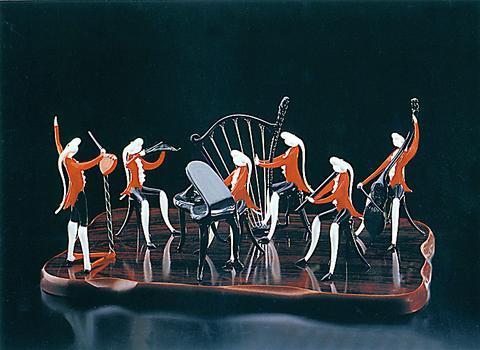
PHOTO COURTESY OF HSINCHU MUNICIPAL GLASS MUSEUM
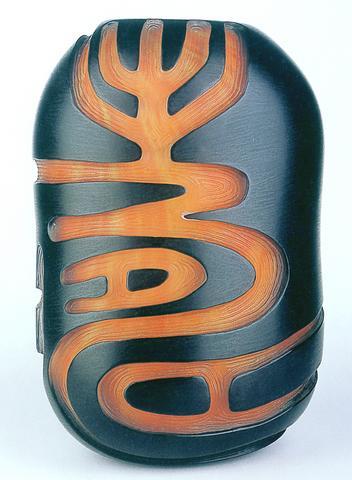
PHOTO COURTESY OF SUNNY WANG

Sept.16 to Sept. 22 The “anti-communist train” with then-president Chiang Kai-shek’s (蔣介石) face plastered on the engine puffed along the “sugar railway” (糖業鐵路) in May 1955, drawing enthusiastic crowds at 103 stops covering nearly 1,200km. An estimated 1.58 million spectators were treated to propaganda films, plays and received free sugar products. By this time, the state-run Taiwan Sugar Corporation (台糖, Taisugar) had managed to connect the previously separate east-west lines established by Japanese-era sugar factories, allowing the anti-communist train to travel easily from Taichung to Pingtung’s Donggang Township (東港). Last Sunday’s feature (Taiwan in Time: The sugar express) covered the inauguration of the

The corruption cases surrounding former Taipei Mayor and Taiwan People’s Party (TPP) head Ko Wen-je (柯文哲) are just one item in the endless cycle of noise and fuss obscuring Taiwan’s deep and urgent structural and social problems. Even the case itself, as James Baron observed in an excellent piece at the Diplomat last week, is only one manifestation of the greater problem of deep-rooted corruption in land development. Last week the government announced a program to permit 25,000 foreign university students, primarily from the Philippines, Indonesia and Malaysia, to work in Taiwan after graduation for 2-4 years. That number is a
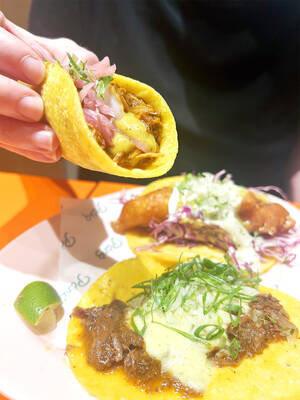
This year’s Michelin Gourmand Bib sported 16 new entries in the 126-strong Taiwan directory. The fight for the best braised pork rice and the crispiest scallion pancake painstakingly continued, but what stood out in the lineup this year? Pang Taqueria (胖塔可利亞); Taiwan’s first Michelin-recommended Mexican restaurant. Chef Charles Chen (陳治宇) is a self-confessed Americophile, earning his chef whites at a fine-dining Latin-American fusion restaurant. But what makes this Xinyi (信義) spot stand head and shoulders above Taipei’s existing Mexican offerings? The authenticity. The produce. The care. AUTHENTIC EATS In my time on the island, I have caved too many times to

In a stark demonstration of how award-winning breakthroughs can come from the most unlikely directions, researchers have won an Ig Nobel prize for discovering that mammals can breathe through their anuses. After a series of tests on mice, rats and pigs, Japanese scientists found the animals absorb oxygen delivered through the rectum, work that underpins a clinical trial to see whether the procedure can treat respiratory failure. The team is among 10 recognized in this year’s Ig Nobel awards (see below for more), the irreverent accolades given for achievements that “first make people laugh, and then make them think.” They are not


 RSS
RSS