


In the West people can buy designer accessories, health insurance or even psychological treatment for their dogs. In the Arab world, Muslims frown on keeping dogs as pets. But trained falcons frequently receive treatment most European dogs could only dream of.
In a spotless operating room in the Abu Dhabi desert, a falcon sounds like she is screaming murder. But she is in good hands. After inhaling an anaesthetic, she will get a check-up from Dr. Margit Muller, one of the foremost falcon veterinarians in the world.
Muller explains, This complete check-up includes a blood test, fecal test, endoscopy, vaccination, cutting the nails and talons and everything."
All this state-of-the-art treatment costs about US$120. Muller says the fees at the Abu Dhabi Falcon Hospital are so moderate because the facility is well supported by the government.
The falcons that are cared for here can easily cost US$10,000 to US$100,000 each. They are valued because they are integral to the 2,000-year-old tradition of falcon hunting.
In the sport, falcons take off from their masters' arms to chase and attack their prey.
The hunter will then follow, by camel or car, to collect the prey and reward the falcon with a bit of meat. Although hunters no longer depend on hunting with falcons to survive, modern hunters are willing to go to extreme lengths to keep the tradition alive.
Majid al-Mansouri is the executive secretary of the United Arab Emirates Environmental Research and Wildlife Development Agency. He also serves as the chief executive of the Emirates Falconers Club. According to al-Mansouri, The only thing linking us back to the desert is this sport. "When I was a kid, I used to go on a daily basis because we would go to our farms or to the camel areas, but today the only thing that gets me out of my office is this."
The long-necked, long-legged desert houbara bustard (Chlamydotis u. macqueenii) is the falcon's primary prey. It migrates from breeding grounds in Mongolia across Central Asia to the Arabian peninsula.
In decades past, hunters from the UAE went to Pakistan or Iran every winter to hunt houbara. Since the collapse of the Soviet Union, Kazakstan, Uzbekistan and Turkmenistan have also opened up for hunters.
"People have started going to deeper areas, and reached areas where people couldn't reach in the past, that was like the core source or breeding zone of houbara," Al-Mansouri says.
This increased access, coupled with four-wheel-drive cars and better technologies like falcon tracking devices, has combined to drive the desert houbara almost to extinction.
Falconers and the UAE government have responded with money toward conservation programs, education and the new falconers club al-Mansouri oversees. Their efforts are even receiving praise in the ravaged houbara hunting grounds.
Ejaz Ahmed is the deputy director general of the Worldwide Fund for Nature in Pakistan.
"I think as far as the UAE government is concerned," he says, "They have been acting quite responsibly, in the sense that they have been integrating various conservation activities."
One of those activities has been to ban captured wild falcons in the UAE. Instead, hunters are buying captive bred falcons.
Now nearly 70 per cent of the 5,000 hunting falcons in the UAE are captive bred. But the government has been less successful in cracking down on the illegal smuggling into the UAE of houbaras caught from the wild.
Houbaras are in demand because falcon trainers use them for their falcons to practice on. Al-Mansouri says this could contribute to extinction.
"We estimated that more that 7,000 houbara come to the Arabian peninsula just from Pakistan."
"So imagine Iraq, Iran, Afghanistan, all these countries where people smuggle houbara from. We are talking about big numbers, more than 10,000 per year to the Arabian peninsula."
The UAE government has spent millions of dollars and 12 years developing a houbara breeding program, and this year six captive bred houbaras will be released into the wild for the first time. In addition to the US$6.5 million the government spends each year for this program, the president is trying to set an example.
Sheikh Zayed bin Sultan al-Nahyan, the UAE's president has been an active falconer, and for the last nine years has sponsored the release of wild falcons confiscated from smugglers or donated by wealthy sheiks.
"It's not only that we want to hunt, but to preserve a culture," Al-Mansouri says.

Sept.16 to Sept. 22 The “anti-communist train” with then-president Chiang Kai-shek’s (蔣介石) face plastered on the engine puffed along the “sugar railway” (糖業鐵路) in May 1955, drawing enthusiastic crowds at 103 stops covering nearly 1,200km. An estimated 1.58 million spectators were treated to propaganda films, plays and received free sugar products. By this time, the state-run Taiwan Sugar Corporation (台糖, Taisugar) had managed to connect the previously separate east-west lines established by Japanese-era sugar factories, allowing the anti-communist train to travel easily from Taichung to Pingtung’s Donggang Township (東港). Last Sunday’s feature (Taiwan in Time: The sugar express) covered the inauguration of the

The corruption cases surrounding former Taipei Mayor and Taiwan People’s Party (TPP) head Ko Wen-je (柯文哲) are just one item in the endless cycle of noise and fuss obscuring Taiwan’s deep and urgent structural and social problems. Even the case itself, as James Baron observed in an excellent piece at the Diplomat last week, is only one manifestation of the greater problem of deep-rooted corruption in land development. Last week the government announced a program to permit 25,000 foreign university students, primarily from the Philippines, Indonesia and Malaysia, to work in Taiwan after graduation for 2-4 years. That number is a
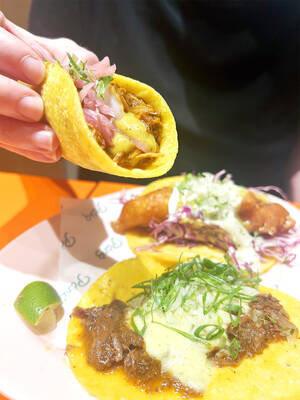
This year’s Michelin Gourmand Bib sported 16 new entries in the 126-strong Taiwan directory. The fight for the best braised pork rice and the crispiest scallion pancake painstakingly continued, but what stood out in the lineup this year? Pang Taqueria (胖塔可利亞); Taiwan’s first Michelin-recommended Mexican restaurant. Chef Charles Chen (陳治宇) is a self-confessed Americophile, earning his chef whites at a fine-dining Latin-American fusion restaurant. But what makes this Xinyi (信義) spot stand head and shoulders above Taipei’s existing Mexican offerings? The authenticity. The produce. The care. AUTHENTIC EATS In my time on the island, I have caved too many times to

In a stark demonstration of how award-winning breakthroughs can come from the most unlikely directions, researchers have won an Ig Nobel prize for discovering that mammals can breathe through their anuses. After a series of tests on mice, rats and pigs, Japanese scientists found the animals absorb oxygen delivered through the rectum, work that underpins a clinical trial to see whether the procedure can treat respiratory failure. The team is among 10 recognized in this year’s Ig Nobel awards (see below for more), the irreverent accolades given for achievements that “first make people laugh, and then make them think.” They are not


 RSS
RSS