


Jiancheng Circle market's latest incarnation is a light red brick, steel-and-tinted glass structure in the middle of a major roundabout. Situated in Datong, one of Taipei's oldest-settled areas, the building symbolizes modernity, wealth and ties with the past.
Its history is that of Taipei written small: from being the first stand of a fruit vendor, to being a last stand for the Japanese, to being a food market and now in its evolved form, on the circular intersection of Nanjing West Road, Chongqing North Road, Tianshui Road and Ningxia Road.
Formally opened two weeks ago, Jiancheng Circle Food Court swirls round two concentric floors that include a food market with 20 food stalls, a Chinese opera and art space, a garden on the rooftop, a preserved reservoir from the end of the Japanese colonial period (1895 to 1945) and memory cabinets.
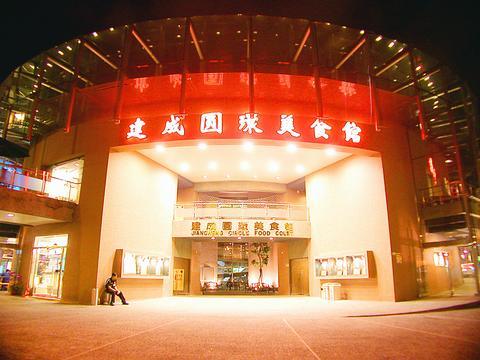
PHOTO: JULES QUARTLY, TAIPEI TIMES
The story goes that the first person to realize the site's potential was a fruit vendor, about 100 years ago, who passed through the area carrying his heavy load after a bad day at the market. He paused to rest but when he did someone asked to buy his fruit. He sold out and was inevitably joined by others. The unregulated market kept growing and in a scene that is still familiar today, a game of cat-and-mouse with the police ensued, who tried to move the vendors on and maintain a thoroughfare. At the end of World War II the Japanese formed a defensive circle round the area.
By the late 1940s the market had established itself and was basically a collection of shacks set off from the roads by iron railings that sold "small eats" such as oyster omelettes, pig heart in gravy, fish ball soup, soup made from intestines and other staple dishes at the time. In the 1960s there was the same hodge-podge of unregulated market space, crammed into the circle, but bounded by advertising hoardings. In the 1980s the market was put under one roof. Fires in 1993 and 1999 and the market's deterioration prompted the Taipei City Government to revitalize it.
In doing so it set respected local architect Lee Tsu-yuan (
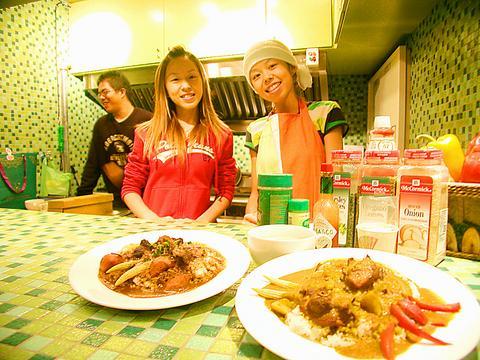
PHOTO: JULES QUARTLY, TAIPEI TIMES
The symbolism of Jiancheng Circle as a central meeting point has been maintained but updated. Nearby Ningxia night market caters to serious eaters, while Yuan Guang provides a more elegant environment to make a date or show around someone from out of town. It is one of the city's new faces.
"It's pretty, very pretty indeed," said Tseng Mao-sung (
Of the 100 food vendors who operated from the market before it was knocked down in 2001, some have come back but others could not wait and collectively took a reported NT$50 million in compensation. Some vendors are still moving in, like Hsiao Chien-chung (
"I started when I was 15 and now I have this place, which took a lot of hard work to get. But the rent is reasonable and it is nice, so I am quite happy."
Yuan Guang is open from 11am to 11pm every day and there is some information in English and Japanese on a public computer about the history of the market and building.
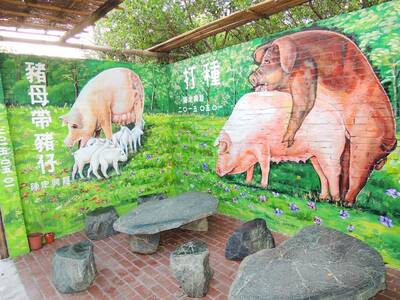
May 6 to May 12 Those who follow the Chinese-language news may have noticed the usage of the term zhuge (豬哥, literally ‘pig brother,’ a male pig raised for breeding purposes) in reports concerning the ongoing #Metoo scandal in the entertainment industry. The term’s modern connotations can range from womanizer or lecher to sexual predator, but it once referred to an important rural trade. Until the 1970s, it was a common sight to see a breeder herding a single “zhuge” down a rustic path with a bamboo whip, often traveling large distances over rugged terrain to service local families. Not only
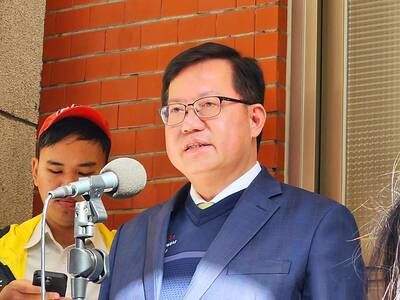
By far the most jarring of the new appointments for the incoming administration is that of Tseng Wen-tsan (鄭文燦) to head the Straits Exchange Foundation (SEF). That is a huge demotion for one of the most powerful figures in the Democratic Progressive Party (DPP). Tseng has one of the most impressive resumes in the party. He was very active during the Wild Lily Movement and his generation is now the one taking power. He has served in many of the requisite government, party and elected positions to build out a solid political profile. Elected as mayor of Taoyuan as part of the
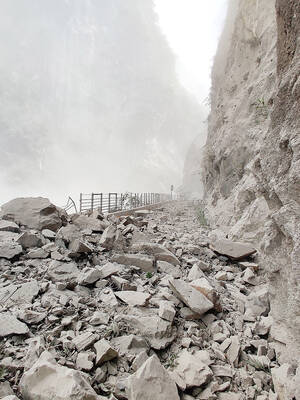
Moritz Mieg, 22, lay face down in the rubble, the ground shaking violently beneath him. Boulders crashed down around him, some stones hitting his back. “I just hoped that it would be one big hit and over, because I did not want to be hit nearly to death and then have to slowly die,” the student from Germany tells Taipei Times. MORNING WALK Early on April 3, Mieg set out on a scenic hike through Taroko Gorge in Hualien County (花蓮). It was a fine day for it. Little did he know that the complex intersection of tectonic plates Taiwan sits

Last week the Directorate-General of Budget, Accounting and Statistics (DGBAS) released a set of very strange numbers on Taiwan’s wealth distribution. Duly quoted in the Taipei Times, the report said that “The Gini coefficient for Taiwanese households… was 0.606 at the end of 2021, lower than Australia’s 0.611, the UK’s 0.620, Japan’s 0.678, France’s 0.676 and Germany’s 0.727, the agency said in a report.” The Gini coefficient is a measure of relative inequality, usually of wealth or income, though it can be used to evaluate other forms of inequality. However, for most nations it is a number from .25 to .50


 RSS
RSS