


The closing instalment of the Museum of Contemporary Art's (台北當代藝術館) TAT: Taiwanese Artists Today (搞破壞台灣藝術家個展) series presents a double exhibition from two 1970s artists, who often take a more playful attitude to artistic creation than their predecessors.
Adrift, (
Wang's No. 50 is a continuation of her series of large plastic airbags made specifically to fill gallery spaces. The whole east wing of the museum is taken up by one white translucent airbag. Visitors may crawl into its crack or wade through it to experience the volume of air inside. The work, Wang said in an introduction to the show, means to provoke viewers to return to the primal state of human interaction with the world, in which they heavily rely on their senses to explore their surroundings.
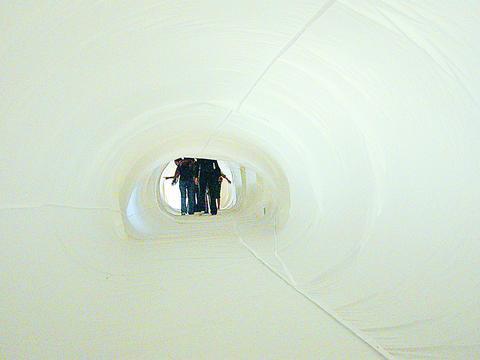
PHOTO COURTESY OF MUSEUM OFCONTEMPORARY ART
The way to understanding the work lies not in the head, but in our intrinsic sensory perceptions, she said. "I've made a work which is what you see and what you touch. That's it," Wang said.
By stripping her works of any external references or compli-cated messages about society at large, Wang effectively provokes thought on an often neglected subject, with a simple yet beautiful work.
The title EX-TT-03 means nothing to Huang Shih-chie except as a file number. With no set plans in mind, Huang sets out to create his kinetic installations from piecing together several electronic gadgets. He sees himself as a mad scientist in his laboratory.
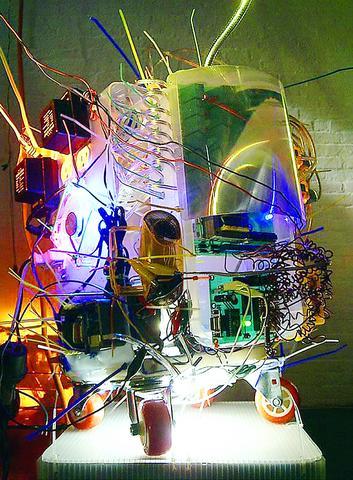
PHOTO COURTESY OF MUSEUM OF CONTEMPORARY ART
On flights of fancy, he attaches circuits, tubes, lightbulbs, radios and whatever he happens to have on hand, to the rudimentary assemblage of chips and plastic. The results appear to be like robots, but they are products of impromptu experiments and accidents that Huang describes as otherworldly synthetic life forms, whose sensors enable them to interact with viewers as well as each other.
The New York-based artist visits his homeland once a year and this time he brought with him a big trunk full of random objects in order to create these robotic creatures for the show.
The bric-and-brac which Huang did not use is placed in lines connecting three galleries.
There are packages, fans, bundles of ropes, machinery parts and a lot of plastic bottles, most of which were picked up on Huang's travels around the world and his visits to discount markets.
"I'm always intrigued by the shapes and functions of plastic bottles. I've always wondered what their peculiar shapes are for," Huang said.
Most interesting about Huang's tube-and-bottle life forms are their bewildering set of sensors. Although sensors are a common part of interactive works, the sensors of the two creatures in the first gallery, for instance, have quite unpredictable reactions as the viewer walks up to them, such as blinking their light bulbs or making whirling sounds.
Asked about these these "random" responses, Huang said: "That's what it's all about. It's fun."
"Adrift" and "EX-TT-03" will run through November at the Museum of Contemporary Art, Taipei, 39 Changan W Rd. (

Sept.16 to Sept. 22 The “anti-communist train” with then-president Chiang Kai-shek’s (蔣介石) face plastered on the engine puffed along the “sugar railway” (糖業鐵路) in May 1955, drawing enthusiastic crowds at 103 stops covering nearly 1,200km. An estimated 1.58 million spectators were treated to propaganda films, plays and received free sugar products. By this time, the state-run Taiwan Sugar Corporation (台糖, Taisugar) had managed to connect the previously separate east-west lines established by Japanese-era sugar factories, allowing the anti-communist train to travel easily from Taichung to Pingtung’s Donggang Township (東港). Last Sunday’s feature (Taiwan in Time: The sugar express) covered the inauguration of the

The corruption cases surrounding former Taipei Mayor and Taiwan People’s Party (TPP) head Ko Wen-je (柯文哲) are just one item in the endless cycle of noise and fuss obscuring Taiwan’s deep and urgent structural and social problems. Even the case itself, as James Baron observed in an excellent piece at the Diplomat last week, is only one manifestation of the greater problem of deep-rooted corruption in land development. Last week the government announced a program to permit 25,000 foreign university students, primarily from the Philippines, Indonesia and Malaysia, to work in Taiwan after graduation for 2-4 years. That number is a
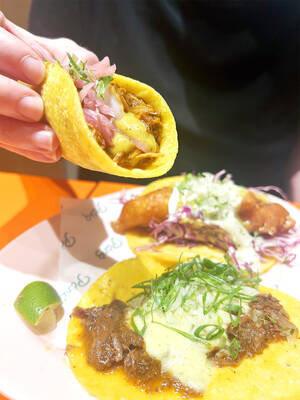
This year’s Michelin Gourmand Bib sported 16 new entries in the 126-strong Taiwan directory. The fight for the best braised pork rice and the crispiest scallion pancake painstakingly continued, but what stood out in the lineup this year? Pang Taqueria (胖塔可利亞); Taiwan’s first Michelin-recommended Mexican restaurant. Chef Charles Chen (陳治宇) is a self-confessed Americophile, earning his chef whites at a fine-dining Latin-American fusion restaurant. But what makes this Xinyi (信義) spot stand head and shoulders above Taipei’s existing Mexican offerings? The authenticity. The produce. The care. AUTHENTIC EATS In my time on the island, I have caved too many times to

In a stark demonstration of how award-winning breakthroughs can come from the most unlikely directions, researchers have won an Ig Nobel prize for discovering that mammals can breathe through their anuses. After a series of tests on mice, rats and pigs, Japanese scientists found the animals absorb oxygen delivered through the rectum, work that underpins a clinical trial to see whether the procedure can treat respiratory failure. The team is among 10 recognized in this year’s Ig Nobel awards (see below for more), the irreverent accolades given for achievements that “first make people laugh, and then make them think.” They are not


 RSS
RSS