


At the Bom Jesus farm in Brazil, a slave laborer was told to treat the cuts he got hacking down thorny undergrowth by rubbing them with salt and urinating on them and then to keep working.
The stories told by Valdeci Alves Ciqueira de Oliveira and 21 other workers found in a government raid on the farm left no doubt that Brazil's feudal slavery traditions are alive in pockets of its poverty-stricken northeast.
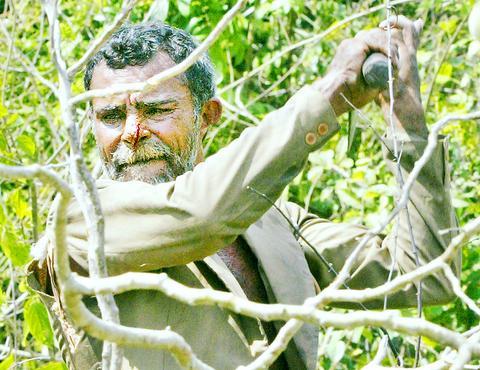
PHOTO: REUTERS
As government inspectors and armed federal police descended on the farm in Maranhao state, the bedraggled workers emerged one by one from the bush which they had been slashing to turn into cattle pasture.
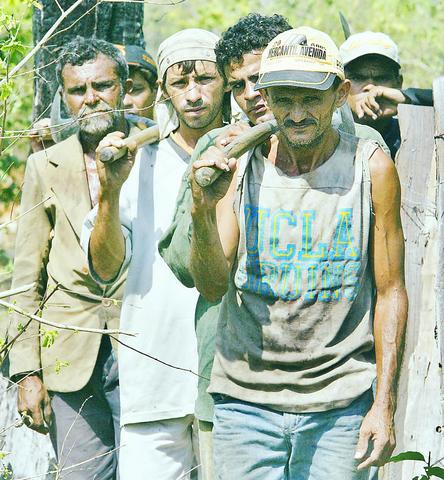
PHOTO: REUTERS
Brazil's government estimates there are 25,000 indentured servants in this country, which imported more African slaves than any other before abolishing the practice in 1888. They are lured into their predicament with the promise of jobs on isolated farms and once there find themselves unable to pay off debts amassed for tools, clothing and sundries.
The inspectors who arrived at Bom Jesus belong to one of five federal government teams that scour Brazil's vast, isolated interior to liberate peasants working in slave-like conditions, relying on human rights groups for tips.
So far this year, they have freed 3,160 workers, compared to 2,156 in all of last year. President Luiz Inacio Lula da Silva, himself from a northeastern state where the practice formerly existed, has pledged to eradicate slavery for good.
At Bom Jesus, like other farms including one in Bahia state where a record 800 workers were liberated in August, there are no chains or whips. But the laborers know and fear the man who has turned them into indentured slaves.
The cat
"He is evil," said Francisco Borges de Souza, a 47-year-old slave laborer, sweating heavily and bleeding from his nose as he clutched his scythe with a deformed hand. The temperature was easily 400C.
Borges was talking about the man known to farm workers in Brazil's lawless ranching frontiers as the "gato," or cat -- a sort of foreman, often armed, who is contracted by a farmer to provide laborers to do work like clearing fields or setting fences. And then he exploits them.
"The cat doesn't let anybody leave without paying their debts," said Ciqueira de Oliveira, 46. "Nobody ever settles their account here."
The cat was not there when the inspectors arrived. But his presence was clear in the squalid makeshift shelter of wooden poles and plastic canvas where the workers live in a dusty, sun-scorched gully.
On the earthen floor near their grimy food -- dry beans, rice and fly-infested pig fat -- sat two wooden boxes. They contained tools, cigarettes, boots, soap, sweets and other items that offer the men some normality in their miserable lives.
The workers have to pay for everything, at inflated prices, except meals and lodging. If they have a day off, they pay for their meals too.
"They were treated like animals," said Fabio Leal Cardoso, a government prosecutor on the team.
"This we can really describe as being like slavery," said Claudia Marcia Brito, who heads it.
The inspectors meticulously interviewed every worker. Most had received no pay for up to six months and many put their thumb print on the declaration because they cannot write.
Won't sleep in a mansion
The inspectors returned to their trucks and drove 5km down a dirt track to the farm house to see farmer Marcos Antonio Araujo Braga. Two armed federal police agents stayed with him while the inspectors talked to the workers.
Although Braga hired the cat to manage the workers, he is responsible for what happens on his property, Brito said.
On Braga's patio, two dachshunds played and his wife offered cool water to the inspectors.
Braga was told he had broken the law and must pay the workers arrears of up to US$700 each, a small fortune for Maranhao's dirt-poor peasants. He also faced a large fine.
The owner said he offered to let workers sleep in a farm house but they refused. He said there were no documents on their employment because "most of them are illiterate."
"You can give a house or a mansion to those people and they will still sleep in a hammock," he said. "Those people are used to bad food, but even so I killed a cow and gave it to them. Thank God, this farm Bom Jesus is more than just a name."
Braga said the information provided by the workers was not true but promised to improve their conditions.
The inspectors say eradicating slavery is not just about raiding farms, but of changing cultures which have existed in Brazil's isolated regions for centuries. It often goes hand in hand with Amazon deforestation and lawlessness.
"You have to remember that things have been like this for 300 years and then suddenly the state turns up with an apparatus," said prosecutor Leal Cardoso. "Things don't change overnight."

Taiwan’s English education system is being pulled apart by three opposing forces. Bilingual Nation 2030 pulls students toward English and global communication. Artificial Intelligence (AI) readiness pulls them toward digital judgment, verification and AI-mediated work. But Taiwan’s old exam culture pulls them back toward memorization, grammar drills, timed reading and correct answers. If the education system keeps using old exams to define success, it risks producing graduates who are neither genuinely bilingual nor genuinely AI-ready, but trained for tasks machines can already perform. The first force is Bilingual Nation 2030. Launched in 2018, the policy aimed to “help Taiwan’s workforce connect

It seems every few days one bumps into one of those “real man” comments in which Taiwan is urged to “face reality” or similar, and “make a deal,” with the speaker implying that soon it will be too late. “Deal” advocates always present themselves as having a superior grip on reality, and the manly ability to make the “hard choice.” Their testosterone-laden language often echoes that of Taiwan sellout advocates. Note that such commentary always specifies a process (“make a deal, work with, make progress”), never the end state of what occupation by a violent authoritarian colonialist state will entail. In

June 1 to June 7 "If all Taiwanese were as afraid of dying as you, then what would happen?” Physician Shih Chiang-nan (施江南) reportedly said this to his wife Chen Chiao-tung (陳焦桐) after she urged him to stop intervening on behalf of Taiwanese soldiers stranded overseas after serving in the Japanese Army during World War II. Shih had clashed with high-ranking officials over the issue, engaged in several heated arguments with Taiwan governor-general Chen Yi (陳儀) and allegedly shouted at general Ko Yuan-fen (柯遠芬), chief of staff of the Taiwan Garrison Command, over

“Taiwan’s Opposition Leader Comes to US With a Message Straight Out of Beijing” read a May 31 headline in the Wall Street Journal. Top US administration officials and members of Congress almost certainly read the WSJ, and if there was a bullet point takeaway that people in Washington should absorb ahead of Chinese Nationalist Party (KMT) Chair Cheng Li-wun’s (鄭麗文) arrival in DC on June 9, that headline is it. The last few columns have discussed this very topic, and the timing is not coincidental. While those top officials likely do not read the Taipei Times, judging by the number


 RSS
RSS