


Thanks to the popularity of South Korean TV dramas and pop stars, more South Korean restaurants are emerging on Taipei's gourmet map. But among all those trendy barbecue places it is not easy to find an authentic Korean restaurant. Kyung-ju House is among the few.
It is the place to enjoy the authentic Bi-bim Pap, or stone bowl mix rice, and the famous Korean-style cold noodles. According to owner Yin Tsai-lien (
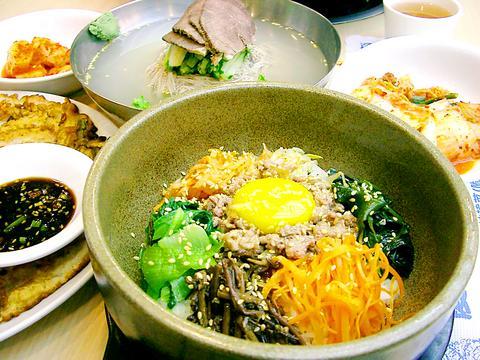
PHOTO: YU SEN-LUN, TAIPEI TIMES
Traditionally in Korean families the wife used to eat the left-over food after everyone else had finished their dinners. She got to mix the vegetables and a little meat in a rice bowl made of stone and heat it it by the fire. Bi-bim Pap nowadays is more sophisticated.
Yin first spreads sesame oil at the bottom of the stone bowl, then adds cooked rice, followed by bean sprouts, seaweed, carrot and beef on top. When the stone bowl is grilled and the rice at the bottom gets a bit crispy, she then puts an egg yolk on top, and finishes the dish.
As for cold noodles, there are two choices. The dry, cold noodles are a good choice for those seeking hot and strong tastes. The dish is red because the sauce is extracted from Korean chili powders, mixed with shredded vegetables, including onions, carrots and cucumbers. The Korean buckwheat noodles are thin, but chewy enough to test your teeth. When being served, the waiter comes and cuts the noodles in three parts with scissors so that you can eat.
The cold soup noodle dish really is cold. The stock is stewed with beef bones, onions, carrots and radishes for a whole day, and then refrigerated.
Yin Tsai-lien and her husband Chang Li-kuo (
"From kitchen utensils to food ingredients, we import largely from Korea," said manager Chang Ching-li (

Sept.16 to Sept. 22 The “anti-communist train” with then-president Chiang Kai-shek’s (蔣介石) face plastered on the engine puffed along the “sugar railway” (糖業鐵路) in May 1955, drawing enthusiastic crowds at 103 stops covering nearly 1,200km. An estimated 1.58 million spectators were treated to propaganda films, plays and received free sugar products. By this time, the state-run Taiwan Sugar Corporation (台糖, Taisugar) had managed to connect the previously separate east-west lines established by Japanese-era sugar factories, allowing the anti-communist train to travel easily from Taichung to Pingtung’s Donggang Township (東港). Last Sunday’s feature (Taiwan in Time: The sugar express) covered the inauguration of the

The corruption cases surrounding former Taipei Mayor and Taiwan People’s Party (TPP) head Ko Wen-je (柯文哲) are just one item in the endless cycle of noise and fuss obscuring Taiwan’s deep and urgent structural and social problems. Even the case itself, as James Baron observed in an excellent piece at the Diplomat last week, is only one manifestation of the greater problem of deep-rooted corruption in land development. Last week the government announced a program to permit 25,000 foreign university students, primarily from the Philippines, Indonesia and Malaysia, to work in Taiwan after graduation for 2-4 years. That number is a
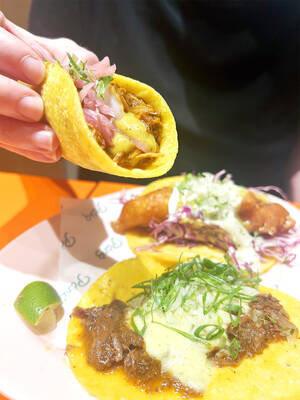
This year’s Michelin Gourmand Bib sported 16 new entries in the 126-strong Taiwan directory. The fight for the best braised pork rice and the crispiest scallion pancake painstakingly continued, but what stood out in the lineup this year? Pang Taqueria (胖塔可利亞); Taiwan’s first Michelin-recommended Mexican restaurant. Chef Charles Chen (陳治宇) is a self-confessed Americophile, earning his chef whites at a fine-dining Latin-American fusion restaurant. But what makes this Xinyi (信義) spot stand head and shoulders above Taipei’s existing Mexican offerings? The authenticity. The produce. The care. AUTHENTIC EATS In my time on the island, I have caved too many times to

In a stark demonstration of how award-winning breakthroughs can come from the most unlikely directions, researchers have won an Ig Nobel prize for discovering that mammals can breathe through their anuses. After a series of tests on mice, rats and pigs, Japanese scientists found the animals absorb oxygen delivered through the rectum, work that underpins a clinical trial to see whether the procedure can treat respiratory failure. The team is among 10 recognized in this year’s Ig Nobel awards (see below for more), the irreverent accolades given for achievements that “first make people laugh, and then make them think.” They are not


 RSS
RSS