


When the revised master plan for the rebuilding of the World Trade Center is released this month, it will include scores of changes to architect Daniel Libeskind's design, both major alterations and minor refinements, many of them never before seen in public.
The plan will retain its signature elements -- the recessed memorial area, the 541m spire that will be taller than the original towers, and a grand new transportation terminal. But other features will come into sharper focus, like a giant waterfall that has so far attracted scant attention and shrinking "urban parks" that in reality are little more than streets with flower beds.
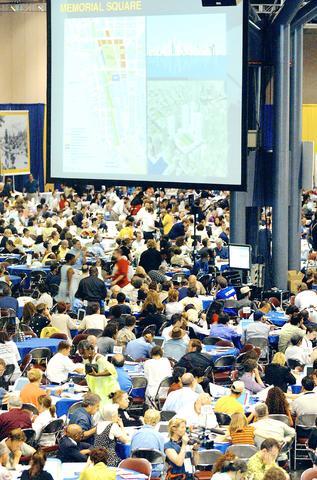
PHOTO: NY TIMES
The secretive evolution of the plan contrasts sharply with the continuing portrayal of the rebuilding process as one of the most open and inclusive civic building projects in memory. Government officials, architects, civic groups and developers still speak in awestruck tones about the town hall meeting in the summer of 2002, when more than 4,000 New Yorkers spent hours discussing, of all things, urban planning.
Ever since, the officials overseeing the rebuilding effort have congratulated themselves for their courage to go back to the drawing board after the public rejected the original six designs for the site. And they have cited that process for their defense of the Libeskind plan from mutations that would rob it of its singularity.
"It was the aggressive outreach to a broader public that resulted in the consensus behind this plan," Governor George E. Pataki said in an interview last month.
As much as the Libeskind plan evolved by the will of the public, however, it also turned on the political needs of Pataki, who was running for re-election last fall. The governor's decrees, like his early declaration under pressure from victims' families that the footprints of the towers be preserved as a memorial, sometimes created public opinion as much as reflected it.
Libeskind's plan, for all its ingenious originality, was just as prized for its flexibility. There also were financial considerations: The Port Authority of New York and New Jersey, the owner of the trade center, wanted to guarantee its revenues from the site, and its leaseholder, the developer Larry A. Silverstein, stood alone in his ability to pay for the rebuilding, thanks to his control of the twin towers' insurance money.
Though the new master plan could be further revised in the environmental impact review, by most accounts it will be superior to that of the World Trade Center design of the 1970s. It will reconnect neighborhoods that were split apart by the original project and provide a somber memorial to the victims of the 9-11 attack.
In the minds of some officials, though, it also seems reminiscent of a design rejected by the thousands of citizen planners who packed that July 2002 town hall meeting in the Jacob K. Javits Convention Center.
Months before that huge meeting, rebuilding officials knew that almost all the decisions about the site would be driven by the memorial to the victims of the Sept. 11 attack, leaving few options for its basic design.
In early 2002, Louis R. Tomson, the president of the Lower Manhattan Development Corp, and others advised Pataki that the most sensible plan was to re-establish Fulton and Greenwich Streets through the site. That would carve the property into quadrants, saving the largest section -- the southwest corner, where the towers had stood for some 30 years -- for a memorial.
When development officials unveiled the six original proposals, all of them had streets and pedestrian walkways running through the site, and four preserved the footprints of the towers for a memorial. It quickly became evident, however, that the Port Authority's goal of rebuilding all the lost office space was fundamentally incompatible with leaving so much open space.
"We all knew from the beginning that you can't take half of the site away and put the same bulk back," said Alexander Garvin, who was then the director of planning, design and development for the Lower Manhattan Development Corp.
To address the perceived shortcomings in the early proposals, in August 2002 the development corporation called for the world's most prominent architects to think grandly about the future of ground zero.
Port Authority officials were livid at the development corporation's attempt to establish its own design for what the authority saw as its site, so the call for entries deliberately stated: "This is not a design competition and will not result in the selection of a final plan."
Still, Kevin Rampe, who succeeded Tomson as president of the development corporation, said the project evolved into a full-blown competition because of "the prestige of the architects involved and what they did in exhibiting their plans."
"They ignored the rules and did what they did best," Rampe said. "I don't think any of them thought about whether it was a competition of ideas or a competition of plans."
In December, the agency unveiled nine plans from seven groups of architects at the World Financial Center's Winter Garden. First to present was Libeskind. When he finished, applause echoed through the Winter Garden. None of the eight plans that followed received as great a response.
It was not an accident that Libeskind was the first to present his design, officials said later. As the design teams met with rebuilding officials every two weeks during the competition, they said, it became clear that Libeskind's "Memory Foundations" was the plan to beat.
When the public weighed in, it favored Sir Norman Foster's "kissing towers," which evoked the original twin towers but left little room for a restored street grid. In the minds of the officials, however, the only feasible alternatives were the World Cultural Center, by the Think team, which included Rafael Vinoly and Frederic Schwartz, and a design by Peterson/Littenberg Architecture and Design. Peterson/Littenberg hurt its cause when Barbara Littenberg, one of the principals, criticized the design competition and rebuilding officials at a public forum, infuriating Tomson and others.
The competition was soon whittled down to Libeskind and Think. Yet the final decision was made less by consensus or by appeal to the public, than by fiat, born of indignation.
The two teams approached the final weeks of the competition in very different ways, which had significant bearing on their fortunes. The Think team spent nearly all of its time working on the elaborate engineering of its cultural towers, twin cylinders of scaffolding within which multiple buildings and viewing platforms would be suspended.
Libeskind, meanwhile, spent several days cloistered with Port Authority officials, working to satisfy their desires for underground parking and mechanical systems.
"The genius of Daniel Libeskind," said Seymour, the Port Authority official, "is that he worked hard with us to understand all the engineering and transportation elements on the site. He showed his flexibility."
When the two teams made presentations in late February to the officials who would choose the winner, nearly all of the Think team's time was spent explaining the engineering of its towers. Libeskind, however, reprised his stirring monologue portraying his design as the embodiment of America's hopes and dreams.
The day before the architects made their final pitches, a committee of development corporation directors had recommended that the Think team's design be chosen, and one committee member told media, "We don't expect anyone to overrule us." Aides say that comment incensed Pataki and caused him to favor Libeskind.
The Think design was favored by Daniel Doctoroff, the deputy mayor for economic development and rebuilding. But his boss, Mayor Michael R. Bloomberg, was dismayed by the cost of the towers, which without accounting for any office buildings was estimated at more than US$800 million, compared to US$330 million for the Libeskind plan.
Both the mayor and the governor also expressed a basic dislike for the Think design. Bloomberg compared it to industrial natural-gas storage tanks, and Pataki said it reminded him of a skeleton. Hours before a 10-member steering committee of officials from the Port Authority, the development corporation and the mayor's and governor's offices was to meet to choose a winner, the decision was already sealed.
Though they picked the design, neither Pataki nor Bloomberg was in a position to pay for its construction. That would fall to Silverstein, the developer and leaseholder, who was expecting billions of dollars in insurance payments for the destroyed towers.
Just before the competition had been narrowed to the two finalists, Silverstein sent a letter to rebuilding officials claiming that none of the proposed designs met his requirements.
After Libeskind was selected, Silverstein continued to push for his own priorities. This summer, Libeskind agreed that David M. Childs, who had designed the new 7 World Trade Center for Silverstein, would be the primary architect on the 541m Freedom Tower, which will dominate the Manhattan skyline.
Libeskind said that made sense because he has never built a skyscraper. But Silverstein went further, asking other architects about their interest in designing the remaining commercial buildings.
Already the Port Authority has hired another architect, Santiago Calatrava, to design the train station.
Libeskind says these are all normal accommodations that an architect has to make for any client on any project. "People are being educated by the process," Libeskind said. "They say to me, `You won, what's the problem?' But I tell them, `No, there's an investor who has a say in this.'"

Sept.16 to Sept. 22 The “anti-communist train” with then-president Chiang Kai-shek’s (蔣介石) face plastered on the engine puffed along the “sugar railway” (糖業鐵路) in May 1955, drawing enthusiastic crowds at 103 stops covering nearly 1,200km. An estimated 1.58 million spectators were treated to propaganda films, plays and received free sugar products. By this time, the state-run Taiwan Sugar Corporation (台糖, Taisugar) had managed to connect the previously separate east-west lines established by Japanese-era sugar factories, allowing the anti-communist train to travel easily from Taichung to Pingtung’s Donggang Township (東港). Last Sunday’s feature (Taiwan in Time: The sugar express) covered the inauguration of the

The corruption cases surrounding former Taipei Mayor and Taiwan People’s Party (TPP) head Ko Wen-je (柯文哲) are just one item in the endless cycle of noise and fuss obscuring Taiwan’s deep and urgent structural and social problems. Even the case itself, as James Baron observed in an excellent piece at the Diplomat last week, is only one manifestation of the greater problem of deep-rooted corruption in land development. Last week the government announced a program to permit 25,000 foreign university students, primarily from the Philippines, Indonesia and Malaysia, to work in Taiwan after graduation for 2-4 years. That number is a
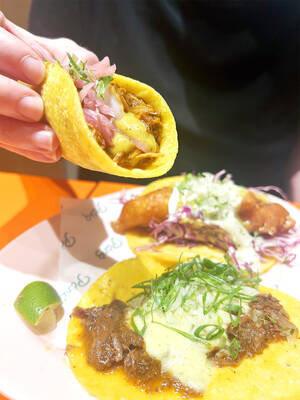
This year’s Michelin Gourmand Bib sported 16 new entries in the 126-strong Taiwan directory. The fight for the best braised pork rice and the crispiest scallion pancake painstakingly continued, but what stood out in the lineup this year? Pang Taqueria (胖塔可利亞); Taiwan’s first Michelin-recommended Mexican restaurant. Chef Charles Chen (陳治宇) is a self-confessed Americophile, earning his chef whites at a fine-dining Latin-American fusion restaurant. But what makes this Xinyi (信義) spot stand head and shoulders above Taipei’s existing Mexican offerings? The authenticity. The produce. The care. AUTHENTIC EATS In my time on the island, I have caved too many times to

In the aftermath of the 2020 general elections the Chinese Nationalist Party (KMT) was demoralized. The Democratic Progressive Party (DPP) had crushed them in a second landslide in a row, with their presidential candidate Tsai Ing-wen (蔡英文) winning more votes than any in Taiwan’s history. The KMT did pick up three legislative seats, but the DPP retained an outright majority. To take responsibility for that catastrophic loss, as is customary, party chairman Wu Den-yih (吳敦義) resigned. This would mark the end of an era of how the party operated and the beginning of a new effort at reform, first under


 RSS
RSS