


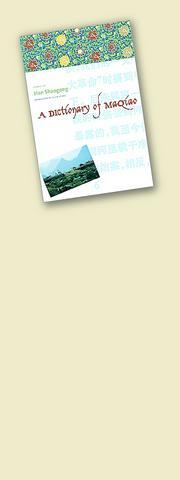
This is a serious, ground-breaking and finally brilliant novel by one of China's leading authors. Laid out in the form of a dictionary of the dialect spoken in a minute part of southern China, A Dictionary of Maqiao quickly develops into a story of the lives of a group of so-called "educated youth" dispatched to such remote regions during China's Cultural Revolution.
Much of it is in fact the story of Han Shaogong's own experience. The result is a masterpiece, and at the same time a clarion call in defense of the local and particular as against the international and the uniform.
For Han to call it a "dictionary" is to stretch the term, to put it mildly. Each word, rather, acts as a stimulus to provoke seemingly random thoughts on the subject referred to, a process aided by the words not being in Western alphabetical order. So you begin with "River," then a particular river, then a term used to describe the local rustic population -- and before you know where you are you are listening to a tale of how a group of urban youth once tried to cheat a ferryman of his fare, and on another occasion threw a gun they shouldn't have possessed down into the mud, and so on. After only a few pages an array of characters has been established, and their interactions begin to constitute the material of an almost conventional story.
This method, as the translator Julia Lovell comments, actually harks back to the traditional Chinese literary form of the "jottings" (biji) essay -- loosely connected thoughts prompted by a particular idea or quotation. There are European precedents too. The penultimate section of Joyce's Ulysses is one example in English, as are all the many long fictions, such as Don Quixote or Gargantua and Pantagruel, that proceed by episodes, digressions, and animadversions irregularly inserted on any subject under the sun.
A Dictionary of Maqiao conjures up once again the world of remote upland China made familiar in so many other novels written by former "educated youth" about their experiences. Rain falls for days on end, winds howl, people find shelter from evil spirits in thatched huts and have long been conditioned to eating the most abominable horrors. Yet today the former urban evacuees remain ambivalent, continuing to feel that their tame life back in the cities has never attained quite the same level of memorability.
The meeting of two such different forms of sensibility lies at the heart of the novel's method. The migrants tend not to have much religious belief, have more or less ingested Maoist orthodoxy, however grudgingly, and approach problems with a generally rational outlook.
The locals, by contrast, embody as weird a collection of attitudes as you could imagine. Imported novelties such as dangerous agricultural pesticides and Communist Party hierarchies are treated with equal wonder and puzzlement. Their patched-up, hand-to-mouth world had had its own bizarre coherence, and these new intrusions, which the city youth understand and accept, give rise to comic contortions of resentment and adaptation in the peasants.
An example of the episodic technique is the entry under the headword "This him." This refers to a Maqiao word meaning "someone here, standing in front of you," and distinct from another word meaning "someone not here, someone far away."
Han, however, raises his definition to an intense pitch of emotion by using it as a pretext to describe an incident involving an ultra-humble character, Yanzao. He is someone who is given all the most menial tasks, things even more disgusting than the norm in that deprived and forsaken village. Han returns after many years and asks after him. That evening he shows up from many miles away, carrying a huge log on his shoulder. In the event they barely talk.
Han feels disgusted at Yanzao's swollen gums, the bulging veins in his neck, his grunts and his sour country smell. After half an hour they part, but as Yanzao leaves, Han catches sight of a tear in the corner of his eye. Among all the pressures of city literary life, he writes, whether sleeping or awake, he can't forget that tear. It's the difference between the Maqiao words for the man who's far away, and the one who's real, present, and standing crying in front of you. It's the difference between an abstract idea of backward peoples, and the reality of their poverty, their need, and their inability to escape who they are.
In an important Afterword, Han comments on how differences of language define people, giving character to not only regions but also to generations. The people of Hainan Island, he points out, have what is perhaps the largest fish-related vocabulary in the world. Yet when he asked one market salesman to identify an item in Mandarin, all the Hainan man could come up with was "big sea fish."
Not only was the fish's identity blurred and diminished by the man having to speak Mandarin, Han asserts -- so was the speaker's.
When it first appeared in Chinese in Taiwan, this book won the China Times Best Novel award, and has elsewhere been cited as one of the Top 100 works of 20th century Chinese fiction. It was first published in English last month.
It would be a pity if, at a time when foreign-language films as well as translated books are reportedly becoming harder and harder to sell to the American public, this magnificent fictional work was left gathering dust on bookstore shelves. It's that rare pleasure, something that is both of high quality and yet at the same time readable and enjoyable. The translation is everywhere excellent - -- fluent, colloquial where appropriate, without being excessively so, learned in places, and without any hint anywhere of "translationese."
This is a wonderful book, surely destined for classic status. When you start it you think it's just the working out of a clever idea. But in the event the depths it touches are extraordinary.

Sept.16 to Sept. 22 The “anti-communist train” with then-president Chiang Kai-shek’s (蔣介石) face plastered on the engine puffed along the “sugar railway” (糖業鐵路) in May 1955, drawing enthusiastic crowds at 103 stops covering nearly 1,200km. An estimated 1.58 million spectators were treated to propaganda films, plays and received free sugar products. By this time, the state-run Taiwan Sugar Corporation (台糖, Taisugar) had managed to connect the previously separate east-west lines established by Japanese-era sugar factories, allowing the anti-communist train to travel easily from Taichung to Pingtung’s Donggang Township (東港). Last Sunday’s feature (Taiwan in Time: The sugar express) covered the inauguration of the

The corruption cases surrounding former Taipei Mayor and Taiwan People’s Party (TPP) head Ko Wen-je (柯文哲) are just one item in the endless cycle of noise and fuss obscuring Taiwan’s deep and urgent structural and social problems. Even the case itself, as James Baron observed in an excellent piece at the Diplomat last week, is only one manifestation of the greater problem of deep-rooted corruption in land development. Last week the government announced a program to permit 25,000 foreign university students, primarily from the Philippines, Indonesia and Malaysia, to work in Taiwan after graduation for 2-4 years. That number is a
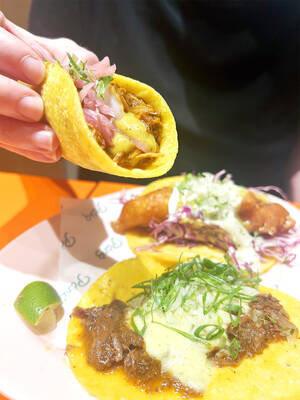
This year’s Michelin Gourmand Bib sported 16 new entries in the 126-strong Taiwan directory. The fight for the best braised pork rice and the crispiest scallion pancake painstakingly continued, but what stood out in the lineup this year? Pang Taqueria (胖塔可利亞); Taiwan’s first Michelin-recommended Mexican restaurant. Chef Charles Chen (陳治宇) is a self-confessed Americophile, earning his chef whites at a fine-dining Latin-American fusion restaurant. But what makes this Xinyi (信義) spot stand head and shoulders above Taipei’s existing Mexican offerings? The authenticity. The produce. The care. AUTHENTIC EATS In my time on the island, I have caved too many times to

Many Taiwanese have a favorable opinion of Japan, in part because Taiwan’s former colonial master is seen as having contributed a great deal to the development of local industries, transportation networks and institutions of education. Of course, the island’s people were never asked if they wanted to be ruled by Tokyo or participate in its modernization plans. From their arrival in 1895 until at least 1902, the Japanese faced widespread and violent antagonism. Things then calmed down, relatively speaking. Even so, between 1907 and 1916 there were eleven anti-Japanese revolts. A map in the National Museum of Taiwan History (國立臺灣歷史博物館)


 RSS
RSS