


Originality is not usually something you expect from a remake. But in a field that includes such pointless recent updates of not-quite-classic older movies as Bedazzled, Sweet November and The Truth About Charlie, The In-Laws stands out. Not for its freshness or novelty, mind you, but for its utter, nearly systematic lack of imagination. It's as if the director, Andrew Fleming, and the screenwriters, Nat Mauldin and Ed Solomon, set out to make a movie that would be mediocre in every respect. If so, they have completely succeeded.
Even the music is lifted from other, better movies. A noisy chase sequence early on is accompanied by Paul McCartney singing Live and Let Die. Later a wedding-day washout unspools over Raindrops Keep Fallin' on My Head, by which time your eyes may indeed be turning red, with boredom and irritation.
These selections are too feeble and obvious to qualify as neat pop-culture allusions, any more than the appearance of KC and the Sunshine Band constitutes a knowing wink at 1970s disco. The intention seems to be to comfort audiences by giving them nothing they haven't seen before or nothing they would object to dozing in front of after the meal on a transcontinental flight.
This goes for the jokes as well, which turn on such moldy comic apercus as the weirdness of Asian cuisine (a whole stuffed python is served at a Vietnamese restaurant) and the existence of homosexuality, especially in prison. Since this is a wedding movie, there is also the obligatory drunken, sexually indiscreet bridesmaid and the crackpot spiritualist ex-wife (Candice Bergen), who shows up at the big event with a Buddhist monk in tow.
Bergen plays a New Age variation on the brittle upper-crustiness that has been her stock in trade of late. Her role though is very much an afterthought. The prospective newlyweds, Melissa and Marc (Lindsay Sloane and Ryan Reynolds), are as cute as a pair of puppies, but they are similarly marginal to the picture's main concern, which is the oil-and-water odd couple formed by their dads, a neurotic podiatrist and an erratic CIA operative.
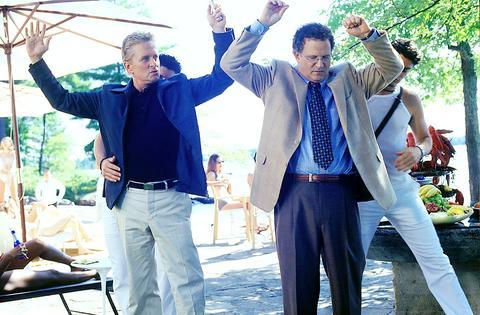
These roles, originated by Alan Arkin and Peter Falk in Arthur Hiller's 1979 movie of the same name, are played here by Albert Brooks and Michael Douglas. Brooks is Jerry Peyser, the podiatrist, for whom obsessive worry is less a personality trait than a worldview. His first meeting with Steve Tobias (Douglas) goes badly awry over that stuffed snake, and various international-espionage types converge on the two dads in the men's room. Before long Steve has dragged Jerry to France (via Barbra Streisand's private jet, though without Streisand), where they meet a mincing arms dealer whose foot fetish blossoms into a wild crush on Jerry.

PHOTOS: FOX
Some amusing bits are stuffed into the hectic plot, which involves the coincidence of petty domestic crises with the potential sale of a stray Russian nuclear submarine (bound ultimately for Lake Michigan). Most of them arrive courtesy of Brooks, who appears at one point wearing a red thong bathing suit. Apart from that, his slow sputtering takes and his incomparable ability to slide from stricken anxiety to full-blown panic are reliably enjoyable, and he at least tries to make a character out of the bundle of tics and one-liners the script has given him.
The same cannot be said of Douglas, whose lack of conviction is, in the end, more suitable to the drab, dutiful spirit of the movie. He never gives more than what is minimally required to any scene, whether it calls for macho bluster or choked-up parental contrition. The original was no masterpiece, but at least Falk, with his loopy, scruffy intensity, gave the character (then named Vincent Ricardo) a hint of soulfulness and made the improbability of such a guy being entrusted with government secrets part of the joke.
Hiller's In-Laws was silly, but in an idiosyncratic way that makes it worth catching when it shows up on cable. That is the new version's destination, too, of course, and it will lose nothing in the transition to the small screen, since it is shot with all the action safely in the center of the frame, and designed to be forgotten in plenty of time for the next remake.

Sept.16 to Sept. 22 The “anti-communist train” with then-president Chiang Kai-shek’s (蔣介石) face plastered on the engine puffed along the “sugar railway” (糖業鐵路) in May 1955, drawing enthusiastic crowds at 103 stops covering nearly 1,200km. An estimated 1.58 million spectators were treated to propaganda films, plays and received free sugar products. By this time, the state-run Taiwan Sugar Corporation (台糖, Taisugar) had managed to connect the previously separate east-west lines established by Japanese-era sugar factories, allowing the anti-communist train to travel easily from Taichung to Pingtung’s Donggang Township (東港). Last Sunday’s feature (Taiwan in Time: The sugar express) covered the inauguration of the

The corruption cases surrounding former Taipei Mayor and Taiwan People’s Party (TPP) head Ko Wen-je (柯文哲) are just one item in the endless cycle of noise and fuss obscuring Taiwan’s deep and urgent structural and social problems. Even the case itself, as James Baron observed in an excellent piece at the Diplomat last week, is only one manifestation of the greater problem of deep-rooted corruption in land development. Last week the government announced a program to permit 25,000 foreign university students, primarily from the Philippines, Indonesia and Malaysia, to work in Taiwan after graduation for 2-4 years. That number is a

This year’s Michelin Gourmand Bib sported 16 new entries in the 126-strong Taiwan directory. The fight for the best braised pork rice and the crispiest scallion pancake painstakingly continued, but what stood out in the lineup this year? Pang Taqueria (胖塔可利亞); Taiwan’s first Michelin-recommended Mexican restaurant. Chef Charles Chen (陳治宇) is a self-confessed Americophile, earning his chef whites at a fine-dining Latin-American fusion restaurant. But what makes this Xinyi (信義) spot stand head and shoulders above Taipei’s existing Mexican offerings? The authenticity. The produce. The care. AUTHENTIC EATS In my time on the island, I have caved too many times to

Many Taiwanese have a favorable opinion of Japan, in part because Taiwan’s former colonial master is seen as having contributed a great deal to the development of local industries, transportation networks and institutions of education. Of course, the island’s people were never asked if they wanted to be ruled by Tokyo or participate in its modernization plans. From their arrival in 1895 until at least 1902, the Japanese faced widespread and violent antagonism. Things then calmed down, relatively speaking. Even so, between 1907 and 1916 there were eleven anti-Japanese revolts. A map in the National Museum of Taiwan History (國立臺灣歷史博物館)


 RSS
RSS