


Just a few years ago, hip-hop was alien to the pop culture of Taiwan but it has quickly become mainstream, so much so that some big name artists have begun to absorb it into their music.
Rappers like Dog G have started to make a big impression around the country because of his outspokenness and willingness to deal with the problems that confront today's youth, especially anti-establishment ideas.
"I love to let people know what I feel about the society through rapping," said Dog G, a 185cm, 125kg Taiwanese rapper whose stage name Da Zhi (
A former judoka who almost made it to the Asian Games and is now in his sixth year of college, Dog G, with an oversize jersey, a light-blue truck cap and baggy jeans sat on a sofa at Starbucks. He told Taipei Times, that what counts most for hip-hoppers is authentically speaking their true feelings toward the whole world.
Adding some local flavor, Dog G has garnered credit from a huge number of hip-hop addicts. One of them is Warren Shen (
A member of a hip-hop dancing group, Shen is doing quite well here in Taiwan. But when he was roaming hip-hop bars in Shibuya, he was totally stunned by the "unbelievable" hip-hoppers' rap and dancing he saw on display.
"I can only say sayonara, but I was overwhelmingly touched by their beats, swings and above all, genuineness," Shen said.
By using traditional Japanese instruments, hip-hop artists were not "entertainers," but "soul channels," Shen said.
Hip-hop in Japan was summed up by Shen with two words: "delicate and creative."
Japan has developed its own unique hip-hop culture, Shen said, and in Taiwan, by depicting everyday life here and brandishing a local anti-establishment tang, Dog G has started his hip-hop career with Taiwanese gusto.
The 24-year-old son of a policeman and a primary school teacher in Tainan, where he was born, Dog G believes his hometown is the cradle for street culture and the mecca of hip-hop in this country.
It's too bad that people think Taipei is the hub for "hip-hop evolution," Dog G explained, insisting that Tainan, where he runs a hip-hop clothing shop with a studio teaching people street dance and graffiti, is now "chock-full with incredible hip-hoppers."
As Dog G is working hard to show his local flavor, however, a young hip-hop critic, who described himself as a "hip-hop fundamentalist," has a different view.
"The root of hip-hop culture here is unfortunately distorted," said Hsu Yi-jay (徐裕傑), a hip-hop maven who runs a small hip-hop record store inside a cramped alley in downtown Taipei. Although there is not a label specializing at producing home-grown hip-hop records, Hsu said, people can easily find hip-hop flavors on albums of many singers, including as Coco Lee (李玟) or Jay Chou (周杰倫).
Shortee to his friends, Hsu said although hip-hop is now a popular term, few people really understand the essence of it.
Rap, a great way to express one's hip-hop style, is only one category of hip-hop culture, which is a broader concept of lifestyle, Shortee said. He added that rap cannot stand for all of hip-hop.
"If you ask people here what hip-hop is, I can guarantee that the answers would be something about rap music," grumbled Shortee in his small store, Da Project Records, where he displays over 500 hip-hop CDs and LPs.
Deriving from Jamaican-style reggae, hip-hop is now one of major music genres worldwide, particularly in the US, which is teeming with hip-hop artists.
A prominent writer on African-American culture, Nelson George says hip-hop is not only symbolic of black culture, but also a great outlet for people to voice their ideas and thoughts about serious and simple things like everyday trifles. George's best-seller Hip Hop America is a masterpiece for people who are captivated by hip-hop.
In hip-hop-mad US, even white rappers have gained unprecedented popularity. Eminem, the contentious American white rapper, known for his sensationalist scold on his mother and sarcasm toward some female pop singers, was even praised by Seamus Heaney, a Nobel Prize-winning poet, for his "verbal energy", which has "sent a voltage around a generation."
Back in Taiwan, Dog G, a buddy of Shortee's and the vanguard of hip-hop in Taiwan, is now famous for his Taiwanese rap and local-style performance.
Already making a big splash with his first album, She Can Lian Hua (
With several hip-hop studios available in major cities here, Shortee said, there are veteran hip-hoppers teaching people how to dance, be a microphone controller, score graffiti and how to deejay, all of which constitute the main elements of hip-hop.
A former intern at the Mackay Memorial Hospital in Tamshui, the young hip-hop aficionado has fallen in love with hip-hop music since he was in high school.
"I don't really care what people think of me, because for me, hip-hop is the king," said the 157cm, 50kg Shortee, adding that being a hip-hop agent would be 100 percent cooler than a wealthy doctor.
Shortee has been sparing no effort to popularize hip-hop to everyone from high-schoolers -- who can speak nothing but "Yo, Whassup? -- to professional deejays who make a living by performing hip-hop at local stars' concerts, like Energy, the hit boy group, and pubs such as VS and Spin in Taipei.
"I like Dog G's music quite a lot," said Shortee, "mainly because of the cool beats and his poignant words." But, for Shortee who is an idealist for hip-hop, Dog G is not so great in terms of real hip-hop spirit. "As a hip-hop artist, Dog G should not be promoted like that," Shortee said.
In the US, an example taken by Shortee, hip-hop artists usually are underground entertainers, which is emblematic of the real hip-hop spirit.
There are two approaches to the hip-hop business, according to Shortee, who also acts as an agent for the import of hip-hop magazines, records and accessories to Taiwan.
"To do hip-hop showbiz, Plan A is to treat your artist like other pop stars, strenuously exposing them to the limelight," said Shortee.
Shortee nevertheless prefers Plan B, which he said, is what most hip-hoppers do in places where hip-hop has gained respect. "This less capitalist strategy is to make your hip-hop artists recognized by word of mouth," said Shortee, who is planning to publish a hip-hop biweekly, possibly named "Word," in September, and to release his first album late this year.
"I like Dog G's music quite a lot," said Shortee, "mainly because of the cool beats and his poignant words." But, for Shortee, a hip-hop idealist, Dog G is not so great in terms of real hip-hop spirit. "As a hip-hop artist, Dog G should not be promoted like that [in a highly commercial manner]," Shortee said.
Despite the argument, the big, young rapper does have an aspiration. "I will go back to Tainan, my ultimate hip-hop base, for graduate school," said Dog G, who wants to write a book called "Hip Hop Taiwan" in Tainan to promote hip-hop.
For graduate school? "Yeah, I wanna be a PE teacher in future, maybe giving lectures by rapping" he said with a big, smile.

Sept.16 to Sept. 22 The “anti-communist train” with then-president Chiang Kai-shek’s (蔣介石) face plastered on the engine puffed along the “sugar railway” (糖業鐵路) in May 1955, drawing enthusiastic crowds at 103 stops covering nearly 1,200km. An estimated 1.58 million spectators were treated to propaganda films, plays and received free sugar products. By this time, the state-run Taiwan Sugar Corporation (台糖, Taisugar) had managed to connect the previously separate east-west lines established by Japanese-era sugar factories, allowing the anti-communist train to travel easily from Taichung to Pingtung’s Donggang Township (東港). Last Sunday’s feature (Taiwan in Time: The sugar express) covered the inauguration of the

The corruption cases surrounding former Taipei Mayor and Taiwan People’s Party (TPP) head Ko Wen-je (柯文哲) are just one item in the endless cycle of noise and fuss obscuring Taiwan’s deep and urgent structural and social problems. Even the case itself, as James Baron observed in an excellent piece at the Diplomat last week, is only one manifestation of the greater problem of deep-rooted corruption in land development. Last week the government announced a program to permit 25,000 foreign university students, primarily from the Philippines, Indonesia and Malaysia, to work in Taiwan after graduation for 2-4 years. That number is a
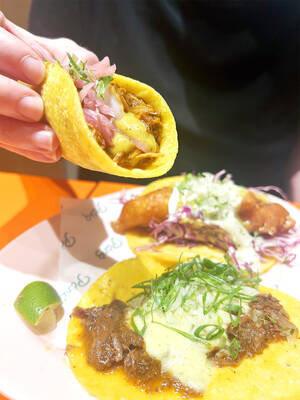
This year’s Michelin Gourmand Bib sported 16 new entries in the 126-strong Taiwan directory. The fight for the best braised pork rice and the crispiest scallion pancake painstakingly continued, but what stood out in the lineup this year? Pang Taqueria (胖塔可利亞); Taiwan’s first Michelin-recommended Mexican restaurant. Chef Charles Chen (陳治宇) is a self-confessed Americophile, earning his chef whites at a fine-dining Latin-American fusion restaurant. But what makes this Xinyi (信義) spot stand head and shoulders above Taipei’s existing Mexican offerings? The authenticity. The produce. The care. AUTHENTIC EATS In my time on the island, I have caved too many times to

In a stark demonstration of how award-winning breakthroughs can come from the most unlikely directions, researchers have won an Ig Nobel prize for discovering that mammals can breathe through their anuses. After a series of tests on mice, rats and pigs, Japanese scientists found the animals absorb oxygen delivered through the rectum, work that underpins a clinical trial to see whether the procedure can treat respiratory failure. The team is among 10 recognized in this year’s Ig Nobel awards (see below for more), the irreverent accolades given for achievements that “first make people laugh, and then make them think.” They are not


 RSS
RSS