


The stumbles of authority have always been a great source of pleasure, and not only for children. Although we turn to experts for knowledge and wisdom, it is often encouraging to find out they are just as confused as the rest of us. It is especially delightful to see their pretensions deflated, as when we learn that those who dispense advice about the right way to live are personally miserable or -- even better -- make others around them suffer.
Ann Hulbert's absorbing history of child-advice experts, Raising America, provides many satisfactions of this sort. Carefully researched and gracefully written, the book tells the story of the leading popular child-rearing gurus and their ideas during the last 100 years. Though her method is chiefly biographical -- she devotes much attention to the vexations of the experts' own families -- Hulbert sets her protagonists against the wider intellectual and cultural background of their times.
The virtues of this book are considerable. Covering developments in child psychology and related fields, she handles theory as deftly as personal narrative, all in a cogent, fair-minded, and often subtly nuanced fashion.
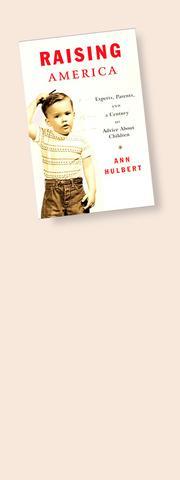
This is a book about popular advisers and their ideas, not the actual practices parents have followed; as Hulbert says, she does not concern herself with how expert advice may have influenced parents. And while she delineates the major controversies about child rearing, she does not discuss the achievements of pediatrics and psychology. As a result, without ever dismissing the experts, she leaves the distinct impression that their advice amounts to a confused muddle.
When Hulbert's story begins around 1900, reformers see great hope of social progress if mothers will only rely on science rather than Grandma for guidance in feeding and caring for their babies. The trouble is that the reformers expect more of science than it can give, and much expert advice is no more than prejudice in medical guise.
When her story ends in our own time, it seems science has made no progress in resolving the most fundamental choices about child rearing. Waves of interest in Freud, Piaget and neurological development have risen and fallen, apparently leaving little solid practical counsel in their wake. Rather than achieving consensus based on research, the field of child advice is riddled with ideological divisions, and preachers compete with pediatricians and psychologists in peddling brand-name parenting strategies.
Hulbert's central theme is one of "unexpected continuity": a persistent tension between hard and soft approaches to rearing children. In each period, she finds one leading advocate of a strict, parent-centered philosophy and a competing expert calling for a gentler, child-centered approach. A single pediatric expert presided only in the years just after World War II, when Benjamin Spock published his Common Sense Book of Baby and Child Care, but the soft Spock took a harder line in a revised edition in 1957 and was eventually countered by the tough-minded psychoanalyst Bruno
Bettelheim.
Although the pairing of hard and soft advisers works nicely as a narrative device, it is difficult to know what to make of it. A historian who pointed to an "unexpected continuity" in ideology during the last century because of the persistence of political thinkers from both left and right would be missing the immense shifts over that time. Because Hulbert sidesteps the question of influence, the mere recurrence of advisers with different approaches does not show that Americans have been equally divided between the two poles. Spock, for example, had a far greater impact than Bettelheim.
The details provided by Hulbert suggest a different reading of the history than the one she offers. At least until the last quarter century, child rearing probably moved in a softer, more child-centered direction, but experts have steadily had to acknowledge more uncertainty about some basic questions of parenting.
By 1950 leading figures like Erik Erikson and Spock were already presenting their advice with less scientific bravura than their predecessors had, and more recent decades have brought a further chastening of claims about alternative approaches to parenting as evidence has mounted in favor of other influences, particularly heredity and peers.
Today there is a great deal more confidence than there was in the past, however, not only about infant nutrition and other areas of pediatrics, but also about many behavioral and learning problems. Just as I would prefer a doctor with today's science to one with the knowledge of a century ago, so I am glad to have been a parent with the information about children available during the last two decades instead of the popular knowledge of 1900.
Fundamental controversies remain, but that is partly because much of the advisory literature concerns matters on which there was never any reason to expect scientific research to yield a consensus, like how to instill children with good moral character.
Hulbert does not pretend to know any better than the prominent advisers what to tell parents. Her advice at the end of the book is that those inclined to be soft or hard consult the literature on the other side. It is too bad that after so much work she was unable to reach more definitive conclusions. But, then, as a mother herself, perhaps she knows that telling readers what path to take in life may not have the intended effect anyway.

Sept.16 to Sept. 22 The “anti-communist train” with then-president Chiang Kai-shek’s (蔣介石) face plastered on the engine puffed along the “sugar railway” (糖業鐵路) in May 1955, drawing enthusiastic crowds at 103 stops covering nearly 1,200km. An estimated 1.58 million spectators were treated to propaganda films, plays and received free sugar products. By this time, the state-run Taiwan Sugar Corporation (台糖, Taisugar) had managed to connect the previously separate east-west lines established by Japanese-era sugar factories, allowing the anti-communist train to travel easily from Taichung to Pingtung’s Donggang Township (東港). Last Sunday’s feature (Taiwan in Time: The sugar express) covered the inauguration of the

The corruption cases surrounding former Taipei Mayor and Taiwan People’s Party (TPP) head Ko Wen-je (柯文哲) are just one item in the endless cycle of noise and fuss obscuring Taiwan’s deep and urgent structural and social problems. Even the case itself, as James Baron observed in an excellent piece at the Diplomat last week, is only one manifestation of the greater problem of deep-rooted corruption in land development. Last week the government announced a program to permit 25,000 foreign university students, primarily from the Philippines, Indonesia and Malaysia, to work in Taiwan after graduation for 2-4 years. That number is a
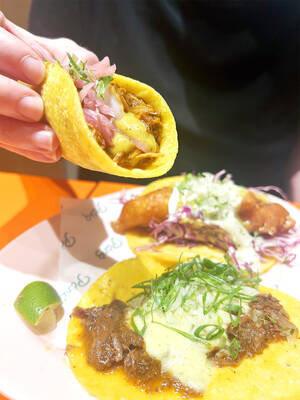
This year’s Michelin Gourmand Bib sported 16 new entries in the 126-strong Taiwan directory. The fight for the best braised pork rice and the crispiest scallion pancake painstakingly continued, but what stood out in the lineup this year? Pang Taqueria (胖塔可利亞); Taiwan’s first Michelin-recommended Mexican restaurant. Chef Charles Chen (陳治宇) is a self-confessed Americophile, earning his chef whites at a fine-dining Latin-American fusion restaurant. But what makes this Xinyi (信義) spot stand head and shoulders above Taipei’s existing Mexican offerings? The authenticity. The produce. The care. AUTHENTIC EATS In my time on the island, I have caved too many times to

In a stark demonstration of how award-winning breakthroughs can come from the most unlikely directions, researchers have won an Ig Nobel prize for discovering that mammals can breathe through their anuses. After a series of tests on mice, rats and pigs, Japanese scientists found the animals absorb oxygen delivered through the rectum, work that underpins a clinical trial to see whether the procedure can treat respiratory failure. The team is among 10 recognized in this year’s Ig Nobel awards (see below for more), the irreverent accolades given for achievements that “first make people laugh, and then make them think.” They are not


 RSS
RSS