

The last time we reviewed Papa Giovanni's was in April of 2000 when there were rumors that Papa and family had opened a bakery adjacent the restaurant.
We returned this time on rumors that the bakery has closed and on more troubling reports of disgruntled patrons.
Because the Taipei Times has praised Papa and staff in past reviews, the news of unhappy clientele was ? well, news. Forumosa.com, an Internet site popular with Taiwan's expatriate community, has dozens of postings regarding Papa Giovanni's under its "restaurants, bars and clubs" forum.
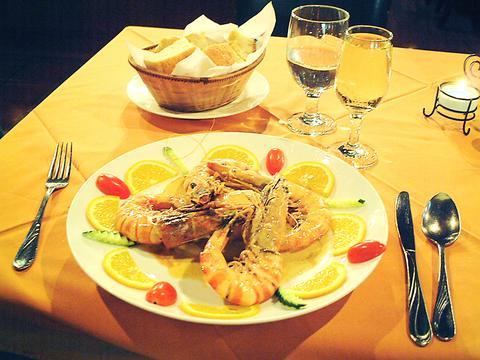
PHOTO: DAVID MOMPHARD, TAIPEI TIMES
The postings almost unanimously decry the restaurant's poor service, high prices and Papa's "attitude." One post said he left the restaurant with "the distinct impression that it could only have been due to direst economic necessity that the owner stooped to allow me into his establishment."
But on my visit there Tuesday night I watched members of the Giovanni family walk most every patron to the door to say goodnight. I saw the wait staff attentively filling water glasses and clearing plates. Papa himself took my order and ended every sentence with "sir."
As far as I could determine during this single visit -- which was unannounced -- the rumors of Papa's despise are greatly exaggerated. Of the complaints I've read or been told, I share only one: the prices are too high. My order of a small caesar salad, king prawns in bourbon sauce, a glass of house white wine and tiramisu cost over NT$1,500. The small caesar alone -- which I ordered on Papa's suggestion -- cost NT$320. It had no romaine lettuce, no croutons, very little parmesan and not the slightest hint of anchovy.
The king prawns were indeed kingly and the bourbon sauce was delicious, but at NT$680 for four you'd have to be a king to order them a second time. You can find equally large and fresh prawns in most of Taipei's night markets for half the price -- with the caveat being that they're covered in mayonnaise, not bourbon sauce. No whines regarding the house white wine (NT$180); I should have had a second glass instead of the tiramisu (NT$180).
Talking with Papa on my way out, I asked what became of the bakery. He explained that he closed it because, as everything was baked after hours, he couldn't control the quality. He also hinted that there may not have been a market for his European-styled products. "Chinese people, they like soft breads," he said.
As for the complaints about him and his restaurant, he said he was unaware of the online postings and didn't seem overly concerned. "People sometimes don't like something."
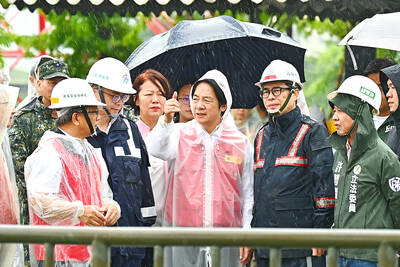
The flooding in Kaohsiung after the recent torrential rains has become an issue for mayoral candidates of both major parties. Chinese Nationalist Party (KMT) Kaohsiung mayoral candidate Ko Chih-en (柯志恩) brought in hydraulic-engineering professor Lee Hong-yuan (李鴻源), who called for comprehensive flood control measures on the Dianbao Creek (典寶溪), according to local media. Ko attacked the Democratic Progressive Party (DPP) for being behind on flood control measures, but as the city administration observed, there are many weaknesses in how the government can mitigate extreme rainfall. Nor is the river entirely under the management of the city. The low-lying Dianbao River
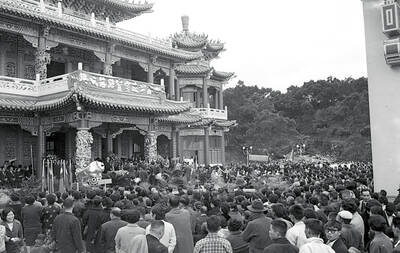
Aug. 31 to Sept. 6 More than 3 million people visited Taipei’s Zhinan Temple (指南宮) in 1973, making it Taiwan’s second-most visited scenic area that year. Built in 1891, the temple had been a tourist destination since the Japanese colonial period, when visitors had to initially take a ferry across the Jingmei River before climbing a winding trail up Houshan (猴山). Its popularity was reflected in popular media. The 1932 tune New Song of the Black Cat and Black Dog (新烏貓烏狗歌) depicted two lovers who prayed at the temple for their marriage. The man
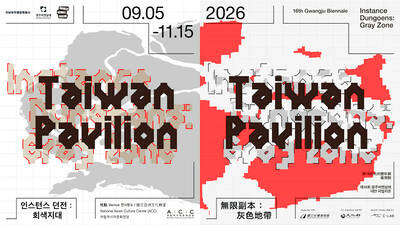
The name “Taiwan” is to appear at South Korea’s Gwangju Biennale when it opens on Saturday, after months of objections from Taiwanese artists and government agencies over an attempted name change. China Pavilion personnel halted installation and left the venue on Friday, after China’s Ambassador to South Korea Dai Bing (戴兵) objected to the restoration of the “Taiwan Pavilion” name. As of Monday, the Chinese side was reportedly preparing to withdraw, although its formal withdrawal had not been completed. The pavilion dispute began on June 10, when the ministry and participating artists said organizers had changed “Taiwan Pavilion” to “NTMoFA Pavilion,” referring
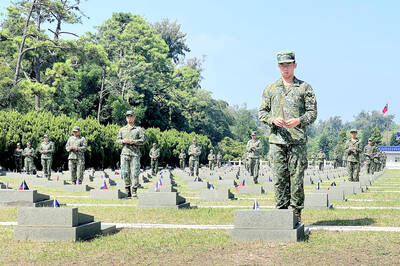
Every year on the anniversary of the 1958 Kinmen 823 Artillery Bombardment — a central episode in what has become known as the Second Taiwan Strait Crisis — carefully crafted speeches reveal the underlying ideological divide over sovereignty between the Taiwan-centric, pan-green Democratic Progressive Party (DPP) and the pan-blue Chinese Nationalist Party (KMT) stance that Taiwan is ultimately a province of China. The pan-blue side has the added complication that some are hardcore Republic of China (ROC) nationalists, while others are more accommodating of and willing to work with the People’s Republic of China (PRC) to varying degrees. Different accounts give


 RSS
RSS