


If you think whipped cream, caramel syrup or chocolate sprinkles are legitimate coffee condiments, don't read this article; you're not worthy of owning an espresso machine. If you've been eyeing one of these fine machines so that you can make your own Mocha Frappuccinos instead of queuing at Starbucks you should stop eyeing now and save your money. You don't need an espresso machine to make a Frappuccino any more than you need a Ferrari to commute from Neihu.
Espresso is an art and time was when learning to become a barista was an apprenticeship akin to studying painting or music, not a part-time job for high school kids on summer vacation. Thank God, then, that technology has reduced the sophisticated science inherent in these machines to child's play. A pity that our collective palette has been dulled to the point where this is acceptable.

PHOTOS COURTESY OF MANUFACTURERS
There is much more to making excellent espresso and espresso-based drinks than having an expensive machine sitting on your kitchen counter. And while this article will focus on la macchina, there are three equally important aspects that Italians refer to collectively as machelli and which cannot be neglected, namely; la miscela (the blend of the coffee), la macinadosatore (the grind and amount of coffee) and la mano (you, the barista). While advances in the machines have reduced the importance of the barista, understanding and appreciation of the coffee itself remain a must. The essence of great espresso is crema, the mantle of foam that sits atop the liquid. A thick layer of crema which clings to the sides of the cup, when the latter is swirled, is the best indicator of excellent coffee, excellently roasted. If the crema is reddish-brown, it's of the highest quality. If it's golden hued, it's not.
Since few people roast their own coffee, you'll want to look for beans that are dark but which do not glisten with surface oils. These oils are an indication that the beans have been over roasted and will produce a bitter espresso, as is the case with French or Italian-roasted beans. While a bitter espresso may be -- to borrow a metaphor -- some people's cup of tea, it is actually a deception; French and Italian roasts can be made using inferior beans roasted until they sweat their natural oils and thus go stale more quickly. Remarkably, in a properly made espresso, maximum flavor is extracted from the bean while much of the caffeine and excess acids are left behind. This is the result of a combination of high pressure, small volume of water and the speed at which it is prepared -- factors which are largely handled by the machine.
Determining the type of machine that best fits your needs can be difficult, but there is a method to the madness. There are seven types of machines from which to choose. We will deal herein with only four types since the first three -- the moka, the stovetop and the steam models -- are good only on camping trips or for producing unnecessary frustration at home. The four remaining types are the piston, the semi-automatic pump, the automatic and the superautomatic.
Piston machines are easily identifiable; they're the chrome or brass-plated machines that look more like antiques than modern kitchen appliances. That's because they're more like antiques than modern kitchen appliances. Still, they make an excellent entry-level device for producing espresso. Because they are very hands-on, your skills as a barista will develop more quickly. Also, because they involve more work your appreciation of espresso will heighten -- or disappear completely, which accounts for the large number of these machines that can be found in garage sales.
Semi-automatic pump machines are by far the most popular type for home use. They contain most of the same features as the automatic machines -- including the wand on the side for steaming milk -- but differ in that the barista must manually shut off the pump depending on the length of pull. (The length is the amount of espresso poured into the cup.) The first coffee to come out of the machine is the best because it contains more of the bean's flavor. Most espressos are approximately one ounce -- any more and it is considered crema coffee -- any less and it is considered ristretto or restricted espresso. Automatic machines differ from their semi-automatic counterparts in that they account for the idiot factor essentially removing the role of the barista. The only tasks left to the operator are filling the portafilter with coffee, tamping it and banging the used grounds out of the portafilter when the espresso has been pulled.
Superautomatic models remove even these last few tasks. The barista has only to place a cup under the portafilter and press a button. The machine automatically fills the portafilter with coffee, tamps it and dispels the spend grounds. Some models even have a self-cleaning mode that decalcifies and rinses the machine.
Anyone who has priced an espresso machine knows that getting even a basic model can be prohibitively expensive. You can expect to spend around US$500 for an entry-level semi-automatic model. What's more, although they do less than their semi-automatic counterparts, piston machines are usually more expensive for being made of chrome or brass. Coupled with the high price of the machines is the fact that many manufacturers, in their zeal to create an affordable consumer model, skimp on the quality of their parts -- not a good idea for a device that works under high pressure. The result is an expensive kitchen appliance that does little more than take up counter space.
Of course, price is of little consequence to those for whom this diminutive elixir is more a passionate pursuit than a pleasurable pastime -- those for whom adding whipped cream or chocolate is an unconscionable aberration.

Sept.16 to Sept. 22 The “anti-communist train” with then-president Chiang Kai-shek’s (蔣介石) face plastered on the engine puffed along the “sugar railway” (糖業鐵路) in May 1955, drawing enthusiastic crowds at 103 stops covering nearly 1,200km. An estimated 1.58 million spectators were treated to propaganda films, plays and received free sugar products. By this time, the state-run Taiwan Sugar Corporation (台糖, Taisugar) had managed to connect the previously separate east-west lines established by Japanese-era sugar factories, allowing the anti-communist train to travel easily from Taichung to Pingtung’s Donggang Township (東港). Last Sunday’s feature (Taiwan in Time: The sugar express) covered the inauguration of the

The corruption cases surrounding former Taipei Mayor and Taiwan People’s Party (TPP) head Ko Wen-je (柯文哲) are just one item in the endless cycle of noise and fuss obscuring Taiwan’s deep and urgent structural and social problems. Even the case itself, as James Baron observed in an excellent piece at the Diplomat last week, is only one manifestation of the greater problem of deep-rooted corruption in land development. Last week the government announced a program to permit 25,000 foreign university students, primarily from the Philippines, Indonesia and Malaysia, to work in Taiwan after graduation for 2-4 years. That number is a
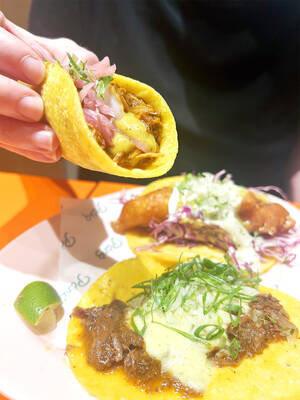
This year’s Michelin Gourmand Bib sported 16 new entries in the 126-strong Taiwan directory. The fight for the best braised pork rice and the crispiest scallion pancake painstakingly continued, but what stood out in the lineup this year? Pang Taqueria (胖塔可利亞); Taiwan’s first Michelin-recommended Mexican restaurant. Chef Charles Chen (陳治宇) is a self-confessed Americophile, earning his chef whites at a fine-dining Latin-American fusion restaurant. But what makes this Xinyi (信義) spot stand head and shoulders above Taipei’s existing Mexican offerings? The authenticity. The produce. The care. AUTHENTIC EATS In my time on the island, I have caved too many times to

In a stark demonstration of how award-winning breakthroughs can come from the most unlikely directions, researchers have won an Ig Nobel prize for discovering that mammals can breathe through their anuses. After a series of tests on mice, rats and pigs, Japanese scientists found the animals absorb oxygen delivered through the rectum, work that underpins a clinical trial to see whether the procedure can treat respiratory failure. The team is among 10 recognized in this year’s Ig Nobel awards (see below for more), the irreverent accolades given for achievements that “first make people laugh, and then make them think.” They are not


 RSS
RSS