


What is the essence of Taiwanese architecture? Columns carved with dragons? Auspicious animals on front gates? Elaborate tiled roofs? The answer to this question is a small, but not insignificant part of the answer to the larger question: What is unique about Taiwanese culture? As such, it is a question that architecture professionals in Taiwan ought to be interested in.
Some architects and scholars of architecture have sidestepped this question and chosen instead to experiment with vernacularism. They believe that designing buildings that satisfy the needs of local residents with local materials, rather than designing buildings based on preconceived notions of a traditional Taiwanese form, is more relevant to the search for a local style of architecture.
Youngsun Culture and Education Foundation (
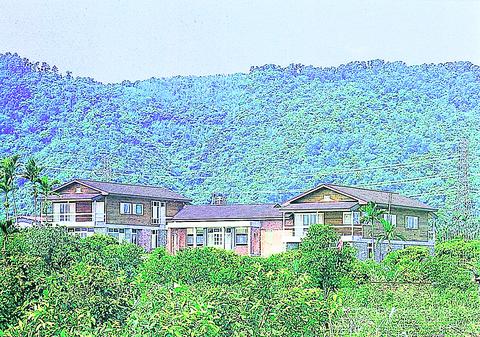
PHOTO COURTESY OF YOUNGSUN
Having received encouraging responses from home-owners, academia and the media, the foundation launched the project again in 2001. The seven resulting buildings are now documented in a book entitled, A Quiet Landscape Revolution (
"Ilan House was born out of a cooperative effort between the Ilan County Government and Youngsun. At the time, many traditional buildings were being renovated. After the renovations, what were once houses with courtyards (
In his book, Lin includes documentation on the lives and personalities of the property-owners who participated in the project, along with their ideas of what their ideal house should be like. A family that loved nature had their future house designed with a long promenade where they could "listen to the sound of the rain." A devout Christian family hoped for a large living room where they could play host to their many friends from church.
"The execution of Ilan House included a good deal of communication between the architects and landowners. The houses were almost custom-made," Lin said.
Besides being "custom-made" for individuals, the houses were also custom-made for the environment of Ilan. Guidelines stipulated that designs should be able to resist strong typhoons, the northeast monsoon, frequent rains as well as high amounts of groundwater.
This was the first group of houses in Ilan that stressed compatibility with the natural surroundings. "Houses that look local on the outside have been built before, but none really aimed to respond to the specifics of their surroundings," said Wu Guang-tin (
It' s not surprising that Ilan's residents became pioneers of vernacular architecture considering the area's strong stand on environmental and development issues. In the 1980s, when most local governments were encouraging business investment, Ilan County vocally opposed the construction of the No. 6 Naphtha Cracker Plant due to environmental concerns. In the 1990s, Ilan County opposed the construction of the 4th Nuclear Power Plant and voted against it in a referendum in 1998.
"No need to emigrate to New Zealand. Just live in Ilan," was the confident slogan of current Premier Yu Hsi-kun during his term as Ilan County commissioner in the 1990s.
"Ilan is a unique case. They realized early on the importance of preserving the natural landscape and a healthy environment. It's also unique in that the county government's environmental and regional development policies have been consistent for over 20 years." Wu said.
Former county commissioner Chen Ding-nan (陳定南) instituted conservation plans for the Dongshan River (冬山河) and Wulaokeng Scenic Areas (武荖坑) in 1982. Yu, the next county commissioner, followed Chen's example but put more emphasis on living spaces. While a 1991 study by National Taiwan University estimated the county's maximum population should be capped at 1.46 million, Yu decided that the number should not exceed 1 million. Development and construction regulations were then amended to limit the density of buildings accordingly.
While most people in Taiwan resign themselves to living in cramped match-box apartments or badly built villas with outlandish names, Ilan residents seem to have more creative ideas about where they want to live.
"In the project, I saw people who really cared about their living environments and were actually willing to create the environment they wanted," said Lin Chi-hong (林志宏), an architect with "Ilan House."
Lin designed a two-story residence for Lee Chang-hsi (李長溪), a retired Chinese medicine doctor whose wife is in the same trade. The house integrated a Chinese herb garden, a small pond and a room for worshipping. Considering his old age, Lee asked for convertible structures for his study and garage so that they can become herbal labs when he's no longer around.
"In the process of intensive communication with landowners, architects heard their life stories and [became aware of] their needs as individuals," Lin Fang-yi said.
The typical architectural education in Taiwan, which trains students to design buildings according to their types -- schools, residence, offices -- no longer applied with Ilan House. Some of the buildings were designed with additional uses in mind, with sections for a community library or seaweed farms.
In Chitan Community (
Ten architects are currently designing houses for eight land-owners. "It's common practice here that architects design buildings according to their whims. What they consider suitable may not suit the actual tenants. Our goal is a new architectural culture where architects and property-owners interact more," said Lin Chian-cheng (
No other group has tried to follow Ilan House's footsteps. "It's not easy to change people's materialistic ideas about real estate. New architectural concepts take time to mature and gain acceptance," said Lin Chi-hong, who's also part of the Chitan House project.
"Another reason there is only one [similar] project is that Ilan House was not profitable for architects," Lin said. The average private house takes an architect a couple of months to design. Designing an `Ilan house' takes over a year and requires far more work, including negotiation with landowners and making models and presentations. Lin's design for Lee's house took 18 months [to complete].
This work is also less profitable. With private villas, for example, architects take five percent of the total construction fee. This may be in the range of NT$200,000 to NT$400,000 in the countryside and several times the amount downtown. Given that its houses took longer to design, Ilan House's offer of county government subsidies of NT$300,000 per building seems meager in comparison.
"Most of the involved architects were around 40, a young age for architects. They agreed strongly with the concept and were willing to give it a try," Lin said.
Next time, the organizer hopes there will be more variety among these buildings. "Apartments are a more common form of housing in Taiwan but so far all the Ilan houses are stand-alone residences. If we had an example of an [apartment], we could make more of an impact on Taiwan's architecture," Wu said, adding that the current economic recession is also to blame for the failure of similar projects to materialize.
The fact that each "Ilan house" was custom-made to satisfy users' specific needs makes an "Ilan apartment" even harder to conceive of. However, Wu believes it could happen if coordinated with the Council for Cultural Affairs' Community Building and Master Planning Project. "It would be easier for residents of the same community to reach a consensus and get enough resources for the housing," Wu said.
Citing Thomas Moore's Utopia, Wu expressed optimism for the future of architecture after the success of Ilan House. "The utopia symbolizes humanity's quest for a better world. Ilan House sent out a message to people living in similar environments. They may well start to think and talk about what kind of buildings they want in that environment and what their common ideals are," Wu said.
An exhibition of drafts and models accompanying the release of A Quiet Landscape Revolution is now on show at National Taipei University of Technology, 1 Chunghsiao E. Rd., Sec. 3, Taipei (

The US war on Iran has illuminated the deep interdependence of Asia on flows of oil and related items as raw materials that become the basis of modern human civilization. Australians and New Zealanders had a wake up call. The crisis also emphasizes how the Philippines is a swatch of islands linked by jet fuel. These revelations have deep implications for an invasion of Taiwan. Much of the commentary on the Taiwan scenario has looked at the disruptions to world trade, which will be in the trillions. However, the Iran war offers additional specific lessons for a Taiwan scenario. An insightful
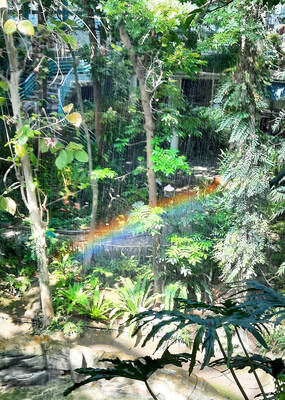
It’s only half the size of its more famous counterpart in Taipei, but the Botanical Garden of the National Museum of Nature Science (NMNS, 國立自然科學博物館植物園) is surely one of urban Taiwan’s most inviting green spaces. Covering 4.5 hectares immediately northeast of the government-run museum in Taichung’s North District (北區), the garden features more than 700 plant species, many of which are labeled in Chinese but not in English. Since its establishment in 1999, the site’s managers have done their best to replicate a number of native ecosystems, dividing the site into eight areas. The name of the Coral Atoll Zone might
Polling data often confirms what we expect, but sometimes it throws up surprises. When examined over time, some patterns appear that speak to something bigger going on. In this column, whenever possible, Formosa’s polls are used. Despite the sometimes cringeworthy antics of Formosa’s Chairman, Wu Tzu-Chia (吳子嘉), the data produced includes detailed breakdowns crucial for analysis. It has also been conducted monthly 11-12 times a year for many years with many of the same questions, allowing for analysis over time. When big shifts do occur between one month and the next it is usually in response to some event in
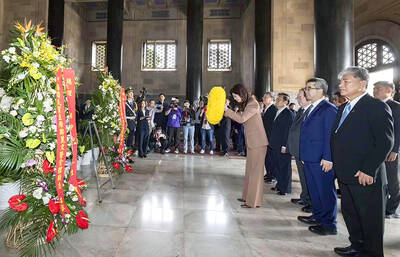
The problem with Marx’s famous remark that history repeats itself, first as tragedy, the second time as farce, is that the first time is usually farce as well. This week Chinese Nationalist Party (KMT) Chair Cheng Li-wun (鄭麗文) made a pilgrimage to the People’s Republic of China (PRC) “to confer, converse and otherwise hob-nob” with Chinese Communist Party (CCP) officials. The visit was an instant international media hit, with major media reporting almost entirely shorn of context. “Taiwan’s main opposition leader landed in China Tuesday for a rare visit aimed at cross-strait ‘peace’”, crowed Agence-France Presse (AFP) from Shanghai. Rare!


 RSS
RSS