


One of the most overlooked aspects of Taiwan's natural environment is its astounding number of bird species.
Taiwan lies at the midpoint of the migration routes for many birds flying sometimes as far south as Indonesia, Australia and New Zealand during the winter season or as far north as Siberia during the summer season. As a result, a great number of migrating birds land in Taiwan, including the outlying islands of Penghu, Kinmen, Matsu, Orchid Island, as well as dozens of small surrounding islets, for breeding during spring and summer.
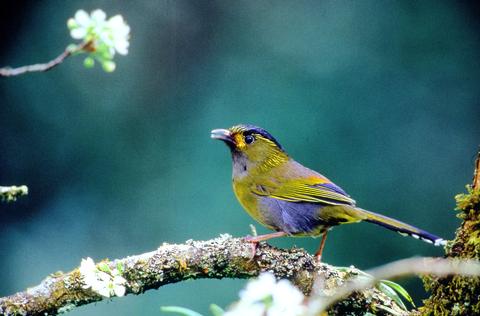
PHOTO: COURTESY OF ZAN WEN-HUI
One of the most important recent discoveries in bird watching was made in June last year, when a Chinese crested tern, once thought extinct, was spotted on an uninhabited island near Matsu. A year later, on June 6, the global organization Bird Life International sent Richard Thomas, an acclaimed expert in bird watching, to conduct a field survey of these birds in Taiwan.
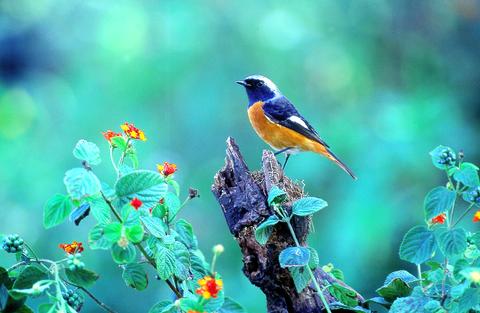
PHOTO COURTESY OF HUANG WEN-SHIN
The discovery made Taiwan the spotlight of the international conservation community, as it had been following the discovery of 130 black-faced spoonbills (
According to local bird-watching experts Wu Chun-shien (
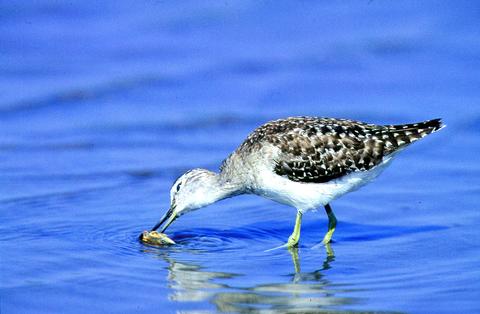
PHOTO: COURTESY OF HUANG WEN-SHIN
Varied topography attracts many birds
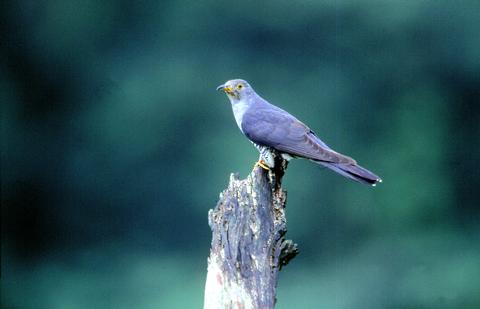
PHOTO: COURTESY OF HUANG WEN-SHIN
Taiwan's diverse topography provides the island with vast climatic differences, ranging from tropical and sub-tropical to temperate and cold zones on the more than 200 mountains over 3,000m. The temperature range provides ample food and nesting area for some 158 species of birds. Of these, 14 are Taiwan's so-called endemic species, or species found only in Taiwan.
Each year, Taiwan and its outlying islands offer food and temporary shelter to millions of an additional 290 wild bird species, which come to breed, or transit, or even arrive inadvertently during their seasonal migrations.
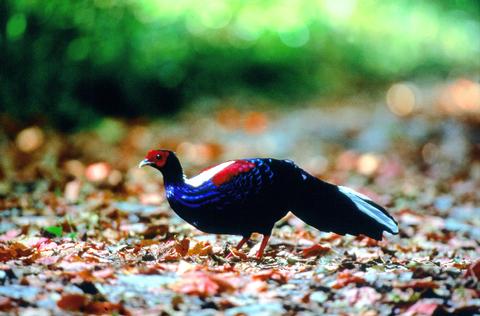
PHOTO: COURTESY OF CHEN TSAO-WANG
Lee Jiannan (
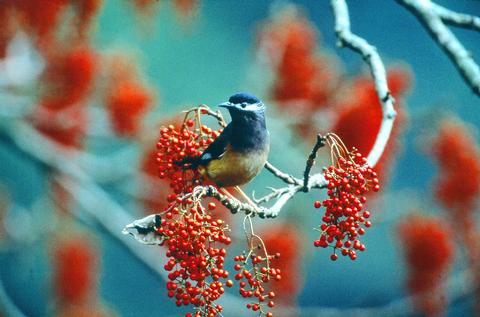
PHOTO: COURTESY OF CHEN TSAO-WANG
The winter-migratory birds total 104 species and account for 23 percent of the total number of birds species in Taiwan. Frequently-sighted birds of this kind include the wood sandpiper (鷹斑鷸), daurian redstart (黃尾鴝), grey heron (蒼鷺), green-winged teal (小水鴨) and black-faced spoonbill. These birds arrive in Taiwan in late September to November for winter shelter and return to northern China, Siberia or Alaska to breed in February or March as spring arrives. The black-faced spoonbills stay in the southwest coastal area of Taiwan for the entire winter and their number seems to be growing, to the relief of the international conservation community.
Summer-migratory birds, such as the Oriental cuckoo (筒鳥), large hawk cuckoo (鷹鵑), fairy pitta (八色鳥), cattle egret (牛背鷺), eastern collard pratincole (燕行鳥) and tern (燕鷗) are fewer in number and account for only 3 percent, though some studies claim only 1 percent, of birds. They migrate each year from the Philippines, Australia, New Zealand, Indonesia and other southern and equatorial areas in Asia in March or April to breed in Taiwan and leave again in September when daylight hours shorten. Interestingly, Kentish plovers (東方行鳥) are both summer and winter visitors to Taiwan, as different groups come for different seasonal periods.
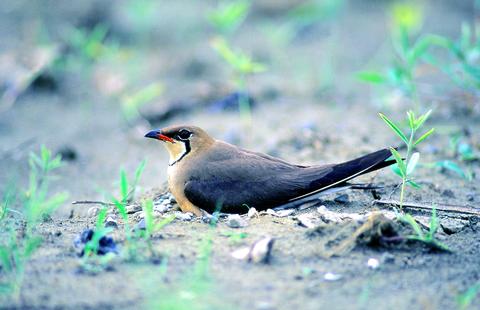
PHOTO: COURTESY OF SU KUEI-FU
There are 77 species of migratory birds that transit in Taiwan each year, comprising 17 percent of the total number of birds. During either spring or autumn, millions of these birds land in Taiwan to forage and for temporary shelter. Some birds in this category are the brown shrike (紅尾伯勞), the grey-faced buzzard eagle (灰面鵟鷹), the whiskered tern (黑腹燕鷗) and the white-winged black tern (白翅黑燕鷗). The grey-faced buzzard eagles sail into the southern tip of Taiwan in large flocks in late September or early October, filling the sky with their gorgeous wings and distinctive chirps.
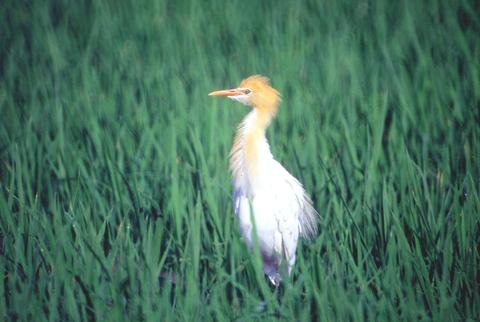
PHOTO: COURTESY OF HE REN-TE
Due to bad weather, storms or other causes, a large number of migratory birds become disoriented and land in Taiwan. These so called "vagrant" (迷鳥) often number as many as 90 different species and account for about 20 percent of the wild birds in Taiwan, including such species as the white-tailed sea eagle (白尾海鵰), the cinereous vulture (禿鷹) and the common crane (灰鶴). The appearance of these birds in Taiwan incites a lot of excitement in Taiwan's bird-watching community.
Coming from all around
A concern in Taiwan is the introduction of birds originally intended as pets or smuggled into Taiwan illegally and then released. Once these birds are in the wild, they pose a considerable threat to the natural habitat of native birds and risk tipping the country's ecological balance. Mynas (八哥類) and parrots (鸚鵡類) are the most commonly-captured birds of this type in Taiwan.
In East Asia, winter-migratory birds usually breed in Alaska, Siberia, northern China or Manchuria. In autumn, these birds travel to Taiwan along two major routes. Yen Chung-wei (顏重威) of the National Museum of Natural Sciences (國立自然科學博物館) pointed out one route called the Pacific route, which starts on the Kamchatka Peninsula, the Kuril Islands and Sakhalin Island and skirts the Japanese coast. It then passes through Okinawa and reaches Taiwan. Aquatic birds such as the violet-backed starling (小椋鳥), the blue rock thrush (藍磯鶇), the ruddy kingfisher (赤翡翠) and the grey-faced buzzard eagle all arrive in Taiwan following this route.
The second route is called the Chinese coastal route. Most of the wild birds in Siberia fly first to Manchuria, then cross the Yellow Sea or Korea and Japan to reach Taiwan. In addition to aquatic birds, some terrestrial birds such as the swallow, shrike, thrush, warbler (鶯) and bunting follow this route every year.
Taiwan's summer-migratory birds, such as the fairy pitta, the water cock (董雞), the roseate tern (紅燕鷗), the bridled tern (白眉燕鷗), the greater crested tern (鳳頭燕鷗) and the Chinese crested tern migrate from Vietnam, Cambodia and Thailand to breed in Taiwan. They travel along the coastal regions of Guangxi, Guangdong and Fujian provinces and arrive in Taiwan during the spring season.
Taiwan's east coast, which is dominated by mountains and has only a narrow stretch of land to accommodate birds, sees a relatively small number of terrestrial and water birds migrating from Japan in autumn. The west coast, in contrast, has wide intertidal zones, often as wide as 5km. The abundant food there provides for numerous land, wading and water birds.
What triggers wild birds to migrate each year is a question under constant discussion by the international bird-watching community. However, the general consensus seems to be that the phenomenon is closely related to the length of daylight during different seasons which causes physiological changes within the body of migratory birds.
Researchers do know, however, that before these birds lift off for breeding grounds or winter shelters, they consume large quantities of food to store up fat in preparation for their migration, therefore, conservation of the natural habitats for these birds is vitally important to maintain Taiwan's diversity of birds.

Sept.16 to Sept. 22 The “anti-communist train” with then-president Chiang Kai-shek’s (蔣介石) face plastered on the engine puffed along the “sugar railway” (糖業鐵路) in May 1955, drawing enthusiastic crowds at 103 stops covering nearly 1,200km. An estimated 1.58 million spectators were treated to propaganda films, plays and received free sugar products. By this time, the state-run Taiwan Sugar Corporation (台糖, Taisugar) had managed to connect the previously separate east-west lines established by Japanese-era sugar factories, allowing the anti-communist train to travel easily from Taichung to Pingtung’s Donggang Township (東港). Last Sunday’s feature (Taiwan in Time: The sugar express) covered the inauguration of the

The corruption cases surrounding former Taipei Mayor and Taiwan People’s Party (TPP) head Ko Wen-je (柯文哲) are just one item in the endless cycle of noise and fuss obscuring Taiwan’s deep and urgent structural and social problems. Even the case itself, as James Baron observed in an excellent piece at the Diplomat last week, is only one manifestation of the greater problem of deep-rooted corruption in land development. Last week the government announced a program to permit 25,000 foreign university students, primarily from the Philippines, Indonesia and Malaysia, to work in Taiwan after graduation for 2-4 years. That number is a

This year’s Michelin Gourmand Bib sported 16 new entries in the 126-strong Taiwan directory. The fight for the best braised pork rice and the crispiest scallion pancake painstakingly continued, but what stood out in the lineup this year? Pang Taqueria (胖塔可利亞); Taiwan’s first Michelin-recommended Mexican restaurant. Chef Charles Chen (陳治宇) is a self-confessed Americophile, earning his chef whites at a fine-dining Latin-American fusion restaurant. But what makes this Xinyi (信義) spot stand head and shoulders above Taipei’s existing Mexican offerings? The authenticity. The produce. The care. AUTHENTIC EATS In my time on the island, I have caved too many times to

In a stark demonstration of how award-winning breakthroughs can come from the most unlikely directions, researchers have won an Ig Nobel prize for discovering that mammals can breathe through their anuses. After a series of tests on mice, rats and pigs, Japanese scientists found the animals absorb oxygen delivered through the rectum, work that underpins a clinical trial to see whether the procedure can treat respiratory failure. The team is among 10 recognized in this year’s Ig Nobel awards (see below for more), the irreverent accolades given for achievements that “first make people laugh, and then make them think.” They are not


 RSS
RSS