

The cofounder of China’s SenseTime Group was visiting New York to encourage more collaboration with the US on artificial intelligence (AI) when he heard the news: US President Donald Trump’s administration had blacklisted his company. So much for more cooperation.
Xu Bing (徐冰), the 29-year-old cofounder, knew SenseTime was at risk given rising tensions between China and the US, but the timing took him by surprise.
He was spending a few days showing off his latest products and meeting other AI researchers earlier this month when the US Department of Commerce put his company and seven others on its “Entity List,” prohibiting US companies from providing crucial supplies like semiconductors.
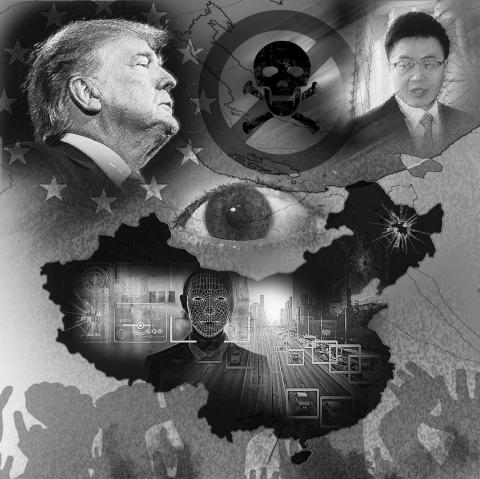
Illustration: Kevin Sheu
His phone flooded with calls and e-mails from worried employees and investors.
SenseTime is emblematic of the clash between the world’s two biggest economies. China is seeking to evolve economically by moving beyond manufacturing into the technology vanguard, with the explicit goal of dominating key fields like AI.
Trump’s administration is increasingly adamant about containing China’s rise, arguing that companies like Huawei Technologies Co steal intellectual property and threaten national security, while startups like SenseTime and Megvii Technology are complicit in human rights violations in Xinjiang.
The company’s founders are a bit stunned at getting caught in the crossfire. They are mostly academics who decided to commercialize their technology five years ago, drawing attention from both the US and Chinese governments because of the applications for surveillance.
Now they plan a shift away from hardware, which requires US chips, to focus on software for facial recognition and other applications. The founders think they could survive the existential threat.
“Long-term, the fundamentals of business are still most important, so that’s what we will focus on,” Xu said.
SenseTime, whose US$7.5 billion valuation is the highest for an AI startup in the world, is trying to reassure investors, employees and customers. The company said in a statement that it is “deeply disappointed” at the blacklisting decision and would seek relief. It emphasized it complies with all laws in local jurisdictions.
“These are real risks for tech companies in China,” said Crawford Del Prete, president of the market research firm IDC.
SenseTime has been preparing for the worst.
The company raised about US$2.5 billion last year from investors including Japan’s Softbank Group Corp and Singapore’s Temasek Holdings Pte, according to a person familiar with the matter. That forestalls the need for an initial public offering (IPO) any time soon.
Chinese surveillance giant Hangzhou Hikvision Digital Technology Co warned last week that it may lose customers in overseas markets because it was part of the US blacklisting.
Megvii, another AI startup that was blacklisted this month, is pressing ahead with its IPO plans, effectively testing whether investors would take on the risks of a blacklisting. (Megvii also says it has done nothing wrong and plans to fight the US ban.)
For SenseTime, the biggest challenge of the Trump move is that it would lose access to US semiconductors, particularly from Nvidia Corp. The chips are incorporated into AI cameras and other hardware that SenseTime sells to corporations and government agencies.
Without them, SenseTime would be able to market software that customers or resellers could then install on their own cameras or servers — but not the hardware itself. That would likely cut into growth, given that hardware accounts for about half its revenue. Software sales tend to be higher margin.
Sales are likely to triple this year to about US$900 million and even though growth is expected to flag, revenue may still double annually for the next three years, people familiar with the matter said.
“We’re very much prepared for the long game,” says Xu Li (徐立), chief executive officer of SenseTime and another cofounder.
All this is a far cry from the company’s debut in 2014. Xu Li was a doctoral student in computer science at the Chinese University of Hong Kong when he hit it off with a few other AI academics and they founded SenseTime.
It did not go smoothly. Xu Li spent most of his time recruiting academics rather than calling on customers. Skeptical salespeople fled. Finally, a venture investor warned Xu Li that he needed a business plan.
“You recruit PhDs and publish papers. You’re not making a company, you’re making a university,” Xu Li said the backer told him.
After nine months without any sales, Xu Li stumbled on an opportunity. Peer-to-peer lending was taking off in China, but fraud was so common that companies were desperate for help.
SenseTime devised a system to conduct face scans with motion — turn your head, wink, stick out your tongue — to prove users were real people. The first client paid 20 million yuan (US$2.8 million). Soon, companies were lining up for its services.
Next, smartphone maker Xiaomi Corp asked for support in creating customized photo albums for users. Then Bytedance Inc, the parent of viral short-video app TikTok, tapped SenseTime to build filters that beautify streamers by slimming faces and toning complexions in real time as they sing and dance.
Business really took off with security camera technology. China’s public security bureau owns about 30 million surveillance cameras, but only about 1 percent are so-called “smart cameras” that are able to analyze what they are recording.
It costs US$500 to US$3,000 to upgrade a device, depending on how many functions one wants — to identify faces, traffic, a fire or an explosion.
Providing software to upgrade government cameras accounts for about 35 percent of SenseTime’s revenue, people familiar with the matter said.
The rest of the company’s revenue comes from commercial clients such as property developers, shopping malls and mobile phone providers, they said. There were about 176 million video surveillance cameras monitoring China’s streets, buildings and public spaces in 2016, compared with 50 million in the US, according to IHS Markit.
The company emphasizes it does not do business directly with government agencies. However, the public security bureau could buy its software and products via third party providers. Its software is compatible with cameras made by Sony Corp, Samsung Electronics Co and Panasonic Corp.
Competition is tough. Some clients test SenseTime’s image recognition alongside Megvii’s software. China’s video surveillance equipment market, excluding home gear, is projected to grow annually by 14 percent to US$20.1 billion in 2023, IDC said.
“The application of AI has developed very fast,” said Francis Leung (梁伯韜), former chairman of CVC Greater China, who invested personally in SenseTime. “It’s beyond my expectations.”
SenseTime is developing similar camera technology for health care, education, logistics and driverless cars. It is also exploring other markets, which come with attendant complications.
In Hong Kong, where SenseTime has its headquarters, the precariousness of the present moment is evident. Protesters have rattled the city for months, provoking the local government by calling for more autonomy from China. The cofounders are predominantly from the mainland, but many are permanent residents of Hong Kong.
Xu Li has been pushing the company to develop its own AI chips and expand into Southeast Asia, Japan and South Korea. The idea is that, even if it loses access to US chips, China would over time develop equivalents via local champions like Huawei, Alibaba Group Holding Ltd or SenseTime itself.
He concedes Trump’s blacklisting has rattled some customers and employees. However, the process of building a business is similar to academic research — long and slow.
“Entrepreneurship is a marathon, not a sprint. We will continue thriving,” Xu Li said.
In 40 years of watching politics, I have never seen anything quite like Taipei mayoral candidate Puma Shen’s (沈伯洋) breed of politician. He has a presence that commands attention, and a combination of qualities that appear to be the result of powerful political currents. What is it that makes Shen different? Throughout the past decades of local elections, I have not seen anyone seriously discuss a long-term vision for urban planning, let alone with the kind of clarity and insight that Shen possesses that compels people to keep listening. He is an exceptional storyteller, with an ability to present a vision
Taiwanese writer Chu Yu-hsun (朱宥勳) this month spoke out about the difficulties of judging literary competitions when nearly 40 percent of the novel submissions he reviews appear to be generated by artificial intelligence (AI). He said he would refuse to serve as a judge for any literary award that does not explicitly prohibit the use of AI in creative writing. The use of AI in creative and academic work has become increasingly common. My son, who attends National Chengchi University, says he is exasperated after working to complete assignments on his own, only to receive lower grades than classmates who used
China prefers to win without firing a shot in its bid to strangle Taiwan’s strategic autonomy. Chinese military strategist Sun Tzu (孫子) would have approved. Its central tool at sea is the “cabbage strategy”: the Chinese People’s Liberation Army Navy (PLAN) layers fishing boats, maritime militia, coast guard cutters and warships around Taiwan’s contested waters in overlapping rings. Each layer normalizes daily coercion, narrows Taiwan’s freedom of movement and chips away at its maritime sovereignty — all while staying below the threshold of armed conflict. This is “gray zone” warfare at its most cost-effective — one of Beijing’s most promising
Freedom of expression is a precious gift from the times, civilization and history, Hong Kong writer Hon Lai-chu (韓麗珠) said on Wednesday last week when she received the Golden Tripod Award, the highest honor in Taiwan’s publishing industry, for her novel Flesh Mountain (祼山). “As a Hong Konger these days, I deeply feel that the freedom to write and publish should not be taken for granted,” she said. She said that for a reason. Hon, who rarely speaks publicly or accept interviews in Hong Kong because it could result in serious consequences, resigned from her long-running columnist post at the Chinese-language Hong


 RSS
RSS