


The principal of a prestigious school near Saint Petersburg summoned 16-year-old Leonid Shaidurov and 14-year-old Maxim Dautov in for a chat. Then he threatened them with expulsion, a criminal probe and being blacklisted from all Russian universities.
Their crime? Setting up an independent student union.
However, Shaidurov and Dautov, children of the social media era, did not take the threats lying down. Instead, they went public about their altercation with the principal in November.
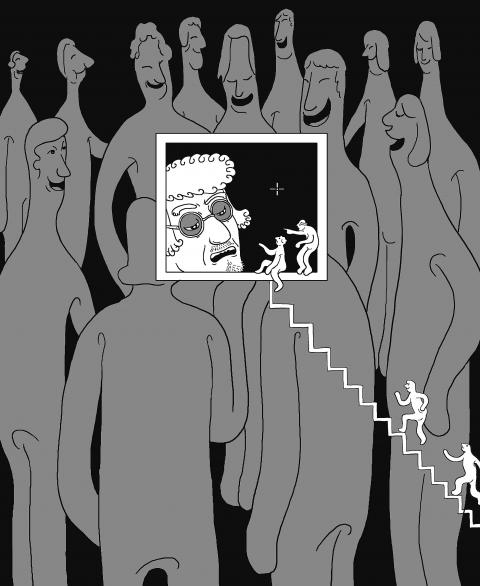
Illustration: Mountain People
The student union’s ranks swelled and education authorities in Saint Petersburg, Russia’s second-largest city, came out in support of the teenagers, not the principal.
Many other young Russians have had their first taste of political activism in street protests against corruption and the banning of rap music, protesting the authoritarian “status quo” that their parents have unhappily gotten used to.
Russian teenagers putting up a social media fight against the rigid, Soviet-like attitudes of some teachers was one of Russia’s political highlights of last year.
Shaidurov and Dautov came up with the idea after reading about Vladimir Lenin, Karl Marx and the US trade union movement. They realized that their own problems — strict and unnecessary testing, dress code restrictions — had resonated elsewhere and would make a rallying cause for a student union.
“At first, everyone was laughing at Leonid and me, because it was just the two of us,” Dautov said, wearing multiple rings and a “Revolutionary Workers Party” badge on his scarf.
Two separate groups of the new student union held their first meetings in mid-November at a soccer field near the sprawling concrete school.
Shaidurov, who led both meetings, was summoned to the principal’s office and told he had organized an “unsanctioned rally” that would be investigated by prosecutors. His and Dautov’s parents were later hauled over the coals.
Later on, police officers visited the school to conduct “a preventive discussion” to warn the students about the dangers of staging unsanctioned rallies and extremism, a widely defined term that Russian authorities have used to go after dissenters of all stripes.
At the next parent-teacher meeting, parents were told that their children had joined an “extremist organization” and would be blacklisted from entering college, said Shaidurov’s mother, Yelena, who teaches history at the school.
To the boys, this was only “pouring the oil onto the flame,” Dautov said.
They spread the word on social media about the pressure and their case was taken up by the media. The number of student union members swelled from 70 to 200.
Soon, the Saint Petersburg Department for Education said that students had the right to set up a union “as long as it doesn’t impede the educational process.”
The principal and the department would not respond to multiple requests for comment by The Associated Press.
Students elsewhere in Russia have started standing up, too.
A high-school student in the Urals city of Perm was turned away from class last month, because she dyed her hair pink, and was told not to return until she changed it back. She mounted a social media campaign.
Prosecutors went to check the school and found that the girl’s rights were breached. Later, the Perm education department banned schools from strict dress code rules.
In Komsomolsk-on-Amur in Russia’s Far East, a teacher has been suspended after a video of her pushing a teenager onto the ground and spanking him was posted online. Investigators have opened a criminal case.
Alexander Kondrashev, a teacher from Saint Petersburg who belongs to an independent teachers’ union, said that the power dynamics between teenagers growing up under Russian President Vladimir Putin and predominantly Soviet-educated teachers is starkly different from a generation earlier.
“It’s much harder for a teacher to control the situation with children these days,” he said. “First, children have a clearer idea of their rights and they are ready to stand up for them. And second, audio and video recordings have given them a significant information clout.”
The Saint Petersburg students claimed that the student union is not a political organization and were cagey about their own political views, saying: “This is where the problems might start.”
Like typical teenagers, they are annoyed with age restrictions: a Russian at 14 is not allowed to vote, drive or drink.
“It’s weird, because you can be sent to prison and contract TB [tuberculosis] at 14, but you can drink and smoke and express yourself fully only when you’re 18,” Dautov said.
The system that Shaidurov and Dautov have been fighting against replicates the Russian government power structure in miniature.
The principal is answerable only to superiors in the Russian Ministry of Education, while the students do not have much say in decisionmaking at school.
Shaidurov and Dautov’s school has its own student body, but it works hand in hand with the administration and lacks any powers.
“We even have a newspaper and a YouTube channel — allegedly for students — which is dead and no one watches it,” Dautov said, scoffing at that instead of discussing real issues that students face, from high workloads to image pressures, the existing body debates “what kind of Christmas tree to put up.”
Likewise, the often-strong reactions of teachers to anyone who undermines the existing power hierarchy mirror Russia’s overall power structure. Teachers, who are paid by regional and federal budgets, are also under constant pressure from authorities, including when they run election precincts.
“It’s a natural reaction of a person who himself is in fear. They’re scared of the state, feel vulnerable and unprotected,” Kondrashev said, referring to teachers lashing out at students in numerous Russian videos posted online.
Svetlana Agapitova, a government-appointed ombudswoman for children’s rights in Saint Petersburg, was one of the first officials who sided with the boys.
Adults should be proud that teenagers are taking an interest in political and economic topics, she said.
The conflict also stems from the average age of a Russian school teacher hovering at about 50, meaning that most were educated in the Soviet Union. Today’s schoolchildren, born in Putin’s era with instant access to information, are sincerely baffled by restrictions that have been in place for decades.
“It’s hard for older teachers to change their ways, because the authority of a teacher in school used to be indisputable,” Agapitova said. “And to launch a dialogue with a student and discuss something with them — not everyone can do it.”

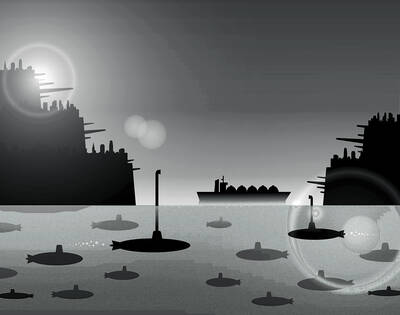
In the event of a war with China, Taiwan has some surprisingly tough defenses that could make it as difficult to tackle as a porcupine: A shoreline dotted with swamps, rocks and concrete barriers; conscription for all adult men; highways and airports that are built to double as hardened combat facilities. This porcupine has a soft underbelly, though, and the war in Iran is exposing it: energy. About 39,000 ships dock at Taiwan’s ports each year, more than the 30,000 that transit the Strait of Hormuz. About one-fifth of their inbound tonnage is coal, oil, refined fuels and liquefied natural gas (LNG),
On Monday, the day before Chinese Nationalist Party (KMT) Chairwoman Cheng Li-wun (鄭麗文) departed on her visit to China, the party released a promotional video titled “Only with peace can we ‘lie flat’” to highlight its desire to have peace across the Taiwan Strait. However, its use of the expression “lie flat” (tang ping, 躺平) drew sarcastic comments, with critics saying it sounded as if the party was “bowing down” to the Chinese Communist Party (CCP). Amid the controversy over the opposition parties blocking proposed defense budgets, Cheng departed for China after receiving an invitation from the CCP, with a meeting with
Chinese Nationalist Party (KMT) Chairwoman Cheng Li-wun (鄭麗文) is leading a delegation to China through Sunday. She is expected to meet with Chinese President Xi Jinping (習近平) in Beijing tomorrow. That date coincides with the anniversary of the signing of the Taiwan Relations Act (TRA), which marked a cornerstone of Taiwan-US relations. Staging their meeting on this date makes it clear that the Chinese Communist Party (CCP) intends to challenge the US and demonstrate its “authority” over Taiwan. Since the US severed official diplomatic relations with Taiwan in 1979, it has relied on the TRA as a legal basis for all
To counter the CCP’s escalating threats, Taiwan must build a national consensus and demonstrate the capability and the will to fight. The Chinese Communist Party (CCP) often leans on a seductive mantra to soften its threats, such as “Chinese do not kill Chinese.” The slogan is designed to frame territorial conquest (annexation) as a domestic family matter. A look at the historical ledger reveals a different truth. For the CCP, being labeled “family” has never been a guarantee of safety; it has been the primary prerequisite for state-sanctioned slaughter. From the forced starvation of 150,000 civilians at the Siege of Changchun


 RSS
RSS