


One morning in late March, campaigner Brij Khandelwal called the Agra police to report an attempted murder.
Days before, the high court in India’s Uttarakhand State had issued a landmark judgement declaring the Yamuna River — and another of India’s holiest waterways, the Ganges — “living entities.”
Khandelwal followed the logic.
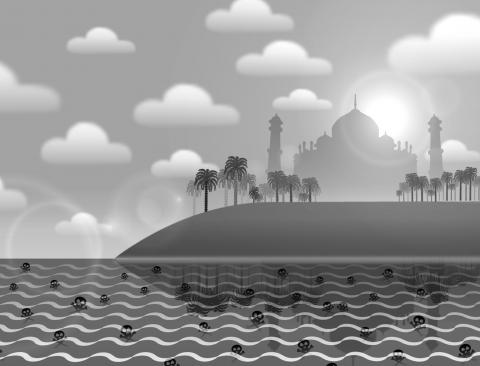
Illustration: Yusha
“Scientifically speaking, the Yamuna is ecologically dead,” he said.
His police report named a series of government officials he wanted charged with attempted poisoning.
“If the river is dead, someone has to be responsible for killing it,” he added.
In the 16th century, Babur, the first Mughal emperor, described the waters of the Yamuna as “better than nectar.” One of his successors built India’s most famous monument, the Taj Mahal, on its banks.
For the first 400km of its life, starting in the lower Himalayas, the river glistens blue and teems with life. Then it reaches Delhi.
In India’s crowded capital, the entire Yamuna is siphoned off for human and industrial use, and replenished with toxic chemicals and sewage from more than 20 drains. Those who enter the water emerge caked in dark, glutinous sludge. For vast stretches, only the most resilient bacteria survive.
The river that has sustained civilization in Delhi for at least 3,000 years — and the sole source of water for more than 60 million Indians today — has in the past three decades become the one of the dirtiest rivers on the planet.
“We have water records which show that, until the 1960s, the river was much better quality,” said Himanshu Thakkar, an engineer who coordinates the South Asia Network on Dams, Rivers and People, a network of rights groups. “There was much greater biodiversity. Fish were still being caught.”
RUNAWAY GROWTH
What happened next mirrors a larger Indian story, particularly since the nation’s markets were unshackled in the early 1990s: one of runaway economic growth fueled by vast, unchecked migration into cities, and the metastasizing of polluting industries that have soiled many of India’s waterways and made its air the most toxic in the world.
Delhi’s population has doubled since 1991. More than a quarter of its residents — up to 5 million people — live in illegal or unplanned settlements, their waste flowing directly into open sewers.
Twenty-two drains gush industrial effluent into the river, while the streams and rivulets that are supposed to feed in rainwater have long since been eroded or choked off by rubbish.
“We decreased the freshwater supply and increased the polluted water supply,” Thakkar said. “You don’t have to be a rocket scientist to predict what would happen.”
The damage is most stark at Wazirabad, just inside Delhi’s borders, where the river meets a barrage and comes to a sudden halt. On the other side, a major drain dumps nearly 1.9 billion liters of sewage into the riverbed each day. Dissolved oxygen levels in the water drop from about 13 milligrams per liter to zero.
Animal life cannot survive in these conditions, but human life on the riverbank is ceaseless — men and women immerse themselves in rituals, bathe and scrub hard at clothing and sheets.
Some, like Sikander Sheikh, make their living off the pollution.
The Bengali, who says he is 95, operates a tiny float on the river, lifting refuse from the surface that he sells on the weekend for a few dozen rupees.
“I can’t do any other work,” he said. “To do agricultural work, you need eyes. Mine are weak. In this work, I slowly float around all day looking for what I can sell.”
He lives on the banks of the river in a hut he built himself adorned with bric-a-brac fished from the water. Bouts of illness are frequent.
“I’ll go to the doctor, I’ll take medicines and then I’ll get better and again, I’ll come back and work,” he said.
Further up the Yamuna, near the city of Agra, residents in Patti Pachgai village complain of an epidemic of bone deformities and fluoride poisoning.
“The doctor has told me it’s the water,” said Tansingh, who became ill five years ago and never recovered.
“I can’t breathe much. When I inhale I feel stiff, my ribs ache. I can’t sit, move around, nothing,” the 40-year-old said.
UNTREATED SEWAGE
A 2015 study showed that towns within 2km of the Yamuna all showed at least four times the permissible level of fluoride in the water. Officials blame the billions of liters of untreated sewage pumped into the Yamuna, which they say is seeping into groundwater.
“The doctor has said to stop drinking this water and has suggested we buy bottles of filtered water,” Tansingh said. “Every time, how can we buy and drink it? It’s too expensive.”
In Mathura, another town along the river, thousands of Hindu devotees gather each year to mark the day they believe the goddess Yamuna appeared on Earth.
They bathe in the river and drink from it, the ecstasy obvious on many faces. Few are dissuaded by the sight of the water.
“Yes, the Yamuna is polluted, but it has the power to liberate us,” one priest said. “If you bathe in the Yamuna you will not go to hell.”
Jasminbhai traveled from Mumbai for the occasion.
“There’s no dirty water in the Yamuna,” he said. “People who believe that, I say they are lying.”
The Indian Supreme Court in February heard that 2,000 crore rupees (US$310 million) had been spent on cleaning the river since 1985.
“Delhi doesn’t have a lack of money,” Thakkar said. “It also has the highest sewage capacity treatment in the country. Nor is there a lack of attention from either political, judicial, or media quarters.”
The problem is that time and money are being invested in a dysfunctional system, he said.
Twenty state and federal government bodies squabble for control over different elements of the river. Ironically, for all that official attention, basic governance structures are still inadequate.
A plan to clean India’s largest river, the Ganges, spearheaded by Indian Prime Minister Narendra Modi, is similarly foundering for lack of effective governance.
“If you install new sewage treatment plants, you also need a system in place to ensure they will function,” Thakkar said.
He wants an independent board to oversee the river, one that can question officials and constantly review the cleanup.
“At the moment, nobody really knows how the treatment plants function and if they don’t function, there are no corrective measures. Nothing happens,” he said.
The decision to grant living entity status to the river this year was met with fanfare, but will do little to improve its state, Delhi-based environmental lawyer Ritwick Dutta said.
The court granted the Yamuna certain rights, but gave legal guardianship to senior members of the state bureaucracy.
That represents a clear conflict of interest, Dutta said.
“If a hydropower project comes up for consideration, whose side will the bureaucrat take? The river’s or the government’s?” Dutta said.
“It’s got symbolic value, but in reality, it may not mean much,” he said of the decision.
REVIVAL PLAN
The latest plan to clean the Yamuna, hatched two years ago by the Delhi government, does contain something novel: Rather than simply building more sewage plants, the scheme aims to reactivate the riverbank, including by building bike paths, low-cost housing, schools and parks.
It is the brainchild of a team lead by University of Virginia professor of architecture Pankaj Vir Gupta, who sees in the Yamuna’s dark reflection a deeper malaise originating in India’s colonial past.
“One hundred years ago, the Yamuna was the front facade of the Mughal city of Delhi,” he said. “It was the face of significant monuments like Humayun’s tomb, the Red Fort. It was the mirror to the city.
“Even as recently as 50 years ago, there were carts on the river,” he said. “There was active participation by the people of Delhi, who went fishing, boating and for recreational walks.”
Gupta said the problem started with the British architects Edwin Lutyens and Herbert Baker, who in the 1920s designed New Delhi, the city’s southern quarter, a European-inspired capital of wide boulevards, manicured gardens and stately government buildings.
The Yamuna, a temperamental waterway that subsides in the dry season, before swelling dramatically during the monsoon, did not fit the British planners’ rigidly ordered worldview, he said.
“Anything that was informal, ecologically, was not really part of the imperial plan for British India,” he said.
Unlike past iterations of the city, New Delhi was built without the Yamuna at its center.
“That started the unraveling of the relationship between city and river,” Gupta said.
It took something that was central to the livelihood and cultural and ritual experience of the citizenry, and made it into a negative space.
“You could argue the pollution problem is really a perception problem. The minute you remove something, ontologically, from the center of the city, its meaningfulness and significance goes away,” Gupta said.
Thakkar said the river’s condition will need to worsen before it improves.
“Look at the Thames of London,” he said. “It was dirty until the 1960s, when the smell of the river reached Parliament and the politicians couldn’t bear the stink.”
“We have not yet reached the stage where the stink of the Yamuna has reached Parliament. Possibly it never will — it’s an air-conditioned environment, but if it manages to reach even the parliament’s gates, then finally we might see something,” he said.
KMT Chairwoman Cheng Li-wun’s (鄭麗文) recent visit to Beijing and her upcoming visit to Washington will serve as a high-level test of her diplomatic mettle. In Beijing, Cheng was received with symbolic gestures, a warm reception, and high-level access. In Washington, she will receive far less pomp and far sharper questions about the KMT’s vision for the future of Taiwan. Her challenge will be to persuade Washington that the KMT’s engagement with China can coexist with strong deterrence. Cheng’s April 7-12 visit to mainland China coincided with an intense period of conflict in Iran. Despite the strategic significance of Cheng’s trip,
The closure of the Strait of Hormuz has sent the vast Asian chemicals industry into a tailspin. Deprived of the likes of Qatari natural gas and Saudi Arabian oil, the region’s fertilizer and plastics plants are slowing production or even shutting down. Everywhere except China, that is. In petrochemicals, China is unique. As well as a traditional industry that uses oil and gas as feedstock, it has parallel output that relies on its abundant domestic coal. Unsurprisingly, India and other regional powers want to copy and paste the Chinese method. This would not be easy — or climate friendly. The
Indonesian President Prabowo Subianto says he knows how to fix the problems facing Indonesia. Yet his economic mismanagement and authoritarian tendencies are steering the nation toward a familiar mix of currency instability and political chaos. The world’s fourth-most populous nation risks reversing the hard-won democratic and business reforms that came after the Asian Financial Crisis in 1997. At that time, the rupiah collapsed and the political upheaval that followed forced former president Haji Mohamed Suharto from power. Prabowo’s administration is ignoring similar warning signs. That disconnect was apparent in a national address on Wednesday, when Prabowo projected the swagger that has
“Of course you can choose not to be Taiwanese, just do not stay here,” chairwoman of Taipei 101 operator Taipei Financial Center Corp Janet Chia (賈永婕) said in an online interview with local entertainer Tai Chih-yuan (邰智源), triggering intense discussion on social media, with politicians across party lines weighing in. In the interview, which was aired on May 14, Chia and Tai’s discussion over a meal in Taipei 101 covered Chia’s career change from entertainer to chairwoman and US climber Alex Honnold’s free solo climb up the Taipei 101 building. During the interview, Chia said, “Being on this land, we


 RSS
RSS