


Carrying out his father’s dying wish to “turn Taiwanese independence into gradual unification with China,” President Ma Ying-jeou (馬英九) last year said that he wanted to hold a meeting between the leaders of the two “areas” to “stabilize” the so-called “1992 consensus” and create a permanent political framework that successive governments would be unable to alter.
During the 18th National Congress of the Chinese Communist Party (CCP), Beijing announced, with even less attempt at disguise, that China would “consolidate and deepen the political, economic, cultural and social foundations that underpin the peaceful development of the cross-strait relationship,” and “create more adequate conditions for peaceful unification.”
Without economic autonomy, there can be no political autonomy. At a time when the vast majority of Taiwanese were focused on and pinning their hopes on next month’s presidential election, Ma held a meeting with Chinese President Xi Jinping (習近平). Making use of Ma’s remaining time in office, the two leaders are colluding to push a four-pronged policy to annex Taiwan’s economy. They want to break the backbone of Taiwan’s economy and political system o create a permanent economic framework that cannot be altered following a change in government; and, ultimately, they intend to deprive Taiwan of its democracy.
The four prongs of the Ma-Xi plan of attack are as follows: open up Taiwan’s integrated circuit (IC) design industry to Chinese investment; allow Chinese private investors to trade Taiwanese stocks; permit “trusted friends” of China to operate Taiwanese media companies; and, sign the cross-strait trade in goods agreement. Once the plan is carried out, it will complete the economic integration of Taiwan and China. This article will explore each of these four areas in further detail.
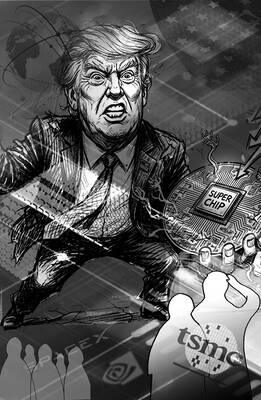
First, allowing Chinese investment in Taiwan’s IC design industry would enable Beijing to buy up a key sector of the Taiwanese economy that is also its most competitive.
Minister of Economic Affairs John Deng (鄧振中) said in a recent interview with the Financial Times that he is considering lifting the ban on Chinese investment in Taiwan’s IC design industry. Deng said he hoped to be able to complete this task before his time in office ends.
Last year, Taiwan’s IC design industry was valued at NT$576 billion (US$17.42 billion), accounting for 3 percent of GDP. It is also the nation’s most competitive industry. However, its distinguishing features — widely held public shares, fabless manufacturing, with key talent and experience as its core competencies — have made it a top target for mergers and acquisitions or poaching of talent by Chinese investors. All that is required is for the government to allow Chinese investment into the industry, bringing with it the negotiating power of the Holy Trinity of the Chinese government, a large base of Chinese clients and powerful Chinese shareholders.
There would be no need to poach talent, engage in industrial espionage or become board members of one of the target companies. All that would be needed is for a group from a company in Taiwan to be temporarily transferred to China, and a group from China to be sent to Taiwan on an “exchange visit,” and before long China’s IC design would have caught up with Taiwan’s.
The US recently vetoed Chinese state-owned chipmaker Tsinghua Unigroup’s bid to purchase US semiconductor manufacturer Micron Technology. In contrast, the Ma administration has paved the way for Tsinghua Unigroup to acquire MediaTek. This is not stupidity on the part of Ma, but rather a carefully laid plan to destroy Taiwan’s economic autonomy.
The second part of the plan is to allow Chinese private investors to purchase Taiwanese stocks to extend Beijing’s influence on the stock market. Financial Supervisory Commission (FSC) Vice Chairman Huang Tien-mu (黃天牧) recently told legislators that Chinese private investors would be able to purchase shares of Taiwanese companies as early as the end of next month.
If the transaction involved a currency swap — with Chinese investors exchanging the yuan for New Taiwan dollars to purchase Taiwanese shares — it would be included in the Qualified Domestic Institutional Investor (QDII) scheme, which is limited to US$500 million.
However, if the plan is to allow investment in Taiwanese equity funds or exchange traded funds, this would fall outside of the QDII cap, which would allow Chinese investors to purchase an additional US$500 million.
If currency swaps are not involved, so that private Chinese investors can directly use the yuan or the US dollar to invest in foreign currency funds, then the FSC’s plan is to impose no controls or limits on Chinese investment in Taiwan. This would further deepen the risk of linking up the Taiwanese and Chinese stock markets, as well as greatly increasing Chinese investors’ ability to cause trouble in Taiwan’s stock market. Such a move would also make it more difficult for the government to investigate cross-border investment fraud.
Third, the government plans to allow trusted friends of China to operate Taiwanese media companies China Network Systems (CNS) and Eastern Broadcasting. Far EasTone Telecommunications (FET) chairman Douglas Hsu (徐旭東) is using the company’s debt holdings to acquire CNS, under the name of Netherlands-based private equity fund NHPEA Chrome Holding. This would allow FET to obtain a controlling stake in one-quarter of Taiwan’s cable television market and give the company power to choose what television networks to carry. The Fair Trade Commission is to announce its decision on the matter on Jan. 13, ahead of the presidential election.
On Nov. 21, the Los Angeles Times reported that Dan Mintz, chief executive of DMG Entertainment, the US subsidiary of Chinese media company Dynamic Marketing Group, would spend US$600 million to purchase US buyout fund the Carlyle Group’s majority shareholding in Eastern Broadcasting.
Hsu and Mintz are both trusted friends of Beijing. Hsu’s Far Eastern Group requires a special approval from the Chinese government to be able to operate its cement, shipping and oil refinery businesses in China. In Hollywood, Mintz is known as “Mr China” for his monopoly over foreign-language film imports into China and his close relationship with China Filmgroup. DMG participated in the production of the 2009 Chinese Communist Party propaganda epic The Founding of a Republic.
Given the Chinese government’s strong motive for influencing and interfering in public opinion in Taiwan — and its ability to intimidate and control the private sector — it is impossible to believe that Hsu and Mintz, who operate within government-regulated industries in China, would be able to resist attempts by Beijing to interfere in free speech in Taiwan. It is therefore difficult to believe that either individual is qualified to operate independent Taiwanese media companies.
Fourth, the signing of the trade in goods agreement would bring about the integration of the two country’s economies. At a meeting in October between Mainland Affairs Council Minister Andrew Hsia (夏立言) and China’s Taiwan Affairs Office Minister Zhang Zhijun (張志軍), a target was set to complete negotiations on the agreement by the end of this year. On Nov. 24, Ma raised the stakes further by saying that he wants to complete the signing of the agreement, including approval by the Cabinet, before he leaves office. China’s Association for Relations Across the Taiwan Straits Chairman Chen Deming (陳德銘) has said the purpose of the agreement is to complete the “integration of the two economies on either side of the Taiwan Strait.”
China is demanding that Taiwan lift import restrictions on 1,510 types of industrial goods, 320 types of processed agricultural products and 707 types of agricultural products. The agreement is a serious assault on the safety of food products in Taiwan and an attack on the basic livelihood of Taiwanese farmers.
Ma is trying to persuade China to lower tariffs for Taiwan’s 10 largest corporations, which includes flat-panel producers, petrochemical giants and car manufacturers. However, this is simply further consolidation of a pledge of allegiance between the powerful capitalists on either side of the Taiwan Strait.
Democracy is not just about elections or referendums. The true essence of democracy lies in the scrutiny of key government policies by the legislature and the public. The Democratic Progressive Party must work together with civic groups to block the government’s charging forward with these four policy areas. If it does not, it might win the election, but it would lose Taiwan.
Lai Chung-chiang is convener of the Economic Democracy Union.
Translated by Edward Jones
The White House’s decision to take a 9.9 percent stake in Intel Corp is looking like very shrewd business indeed. Since the government bought in at US$20.47 a share last August, the US chipmaker’s surging stock price has delivered the US a US$43 billion return. One of the reasons the investment has so far proved so sound is that the White House has made sure of it. According to The Wall Street Journal, Howard personally pushed deals on Intel’s behalf with some of the most lucrative clients imaginable. They include Nvidia Corp, the company at the heart of the AI
In a Taiwanese university classroom, a lecturer asks in English: “Can anyone give me an example from Taiwan?” Students look down. No one answers. After class, one student writes on the course platform in Mandarin: “I understood the concept, but I didn’t know how to answer in English.” That moment highlights a key issue in Taiwan’s English-medium instruction (EMI) reform: It is not just about more English-taught courses, but whether students can learn, participate and belong. EMI expansion is part of the Bilingual 2030 policy and the Ministry of Education’s BEST Program, aiming to improve English ability, support EMI teaching
The Ministry of the Interior, working with the navy and coast guard, is organizing Taiwan’s first joint exercise simulating escort tankers carrying liquefied natural gas (LNG) and oil through a Chinese blockade. The drills simulate fuel transport along three maritime corridors leading toward Japan, the Philippines and the US. Deputy Minister of the Interior Sawyer Mars (馬士元) said that a blockade of the Taiwan Strait would amount to “almost a 100 percent blockade of the regional energy supply.” Minister of National Defense Wellington Koo said planning to counter a blockade is standard practice in Taipei. While the exercise is limited in
A single photograph can cut through a lot of noise, but it can also be used to misrepresent the truth. At the very least, it can concentrate the mind on something that requires further investigation. On Monday last week, Ma Ying-jeou Foundation CEO Tai Hsia-ling (戴遐齡) and former National Security Council secretary-general King Pu-tsung (金溥聰) held a news conference in which they showed a photograph of former foundation CEO Hsiao Hsu-tsen (蕭旭岑), now Chinese Nationalist Party (KMT) deputy chairman. In the image Hsiao is seated next to Xiamen Taiwan Businessmen Association chairman Han Ying-huan (韓螢煥). The two men were holding


 RSS
RSS