


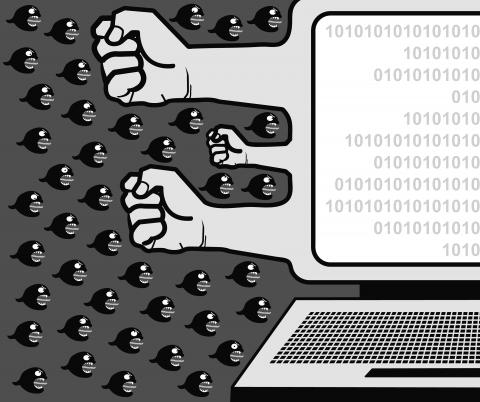
US research universities, among the most open and robust centers of information exchange in the world, are increasingly coming under cyberattack, most of it thought to be from China, with millions of hacking attempts weekly. Campuses are being forced to tighten security, constrict their culture of openness, and try to determine what has been stolen.
University officials concede that some of the hacking attempts have succeeded. They have declined to reveal specifics, other than those involving the theft of personal data like Social Security numbers. They acknowledge that they often do not learn of break-ins until much later, if ever, and that even after discovering the breaches they may not be able to tell what was taken.
“The attacks are increasing exponentially, and so is the sophistication, and I think it’s outpaced our ability to respond,” Educause cybersecurity program head Rodney Petersen said. Educause is a nonprofit alliance of schools and technology companies.
“So everyone’s investing a lot more resources in detecting this, so we learn of even more incidents we wouldn’t have known about before,” he said.
Detection was “probably our greatest area of concern, that the hackers’ ability to detect vulnerabilities and penetrate them without being detected has increased sharply,” said Tracy Mitrano, the director of information technology policy at Cornell University.
Like many of her counterparts, she said that while the largest number of attacks appeared to have originated in China, hackers have become adept at bouncing their work around the world.
Analysts can track where communications come from — a region, a service provider, sometimes even a user’s specific Internet address. However, hackers often route their penetration attempts through multiple computers, even multiple countries, and the targeted organizations rarely go to the effort and expense — often fruitless — of trying to trace the origins. US government officials, security experts, and university and corporate officials nonetheless say that China is clearly the leading source of efforts to steal information, but attributing individual attacks to specific people, groups or places is rare.
The increased threat of hacking has forced many universities to rethink the basic structure of their computer networks and their open style, though officials say they are resisting the temptation to create a fortress with high digital walls.
“A university environment is very different from a corporation or a government agency, because of the kind of openness and free flow of information you’re trying to promote,” Purdue University chief information security officer David Shaw said. “The researchers want to collaborate with others, inside and outside the university, and to share their discoveries.”
“Some universities no longer allow their professors to take laptops to certain countries, and that should be a standard practice,” said James Lewis, a senior fellow at the Center for Strategic and International Studies, a policy group in Washington. “There are some countries, including China, where the minute you connect to a network, everything will be copied, or something will be planted on your computer in hopes that you’ll take that computer back home and connect to your home network, and then they’re in there. Academics aren’t used to thinking that way.”
Bill Mellon of the University of Wisconsin said that when he set out to overhaul computer security recently, he was stunned by the sheer volume of hacking attempts.
“We get 90,000 to 100,000 attempts per day, from China alone, to penetrate our system,” said Mellon, the associate dean for research policy. “There are also a lot from Russia, and recently a lot from Vietnam, but it’s primarily China.”
Other universities report a similar number of attacks and say the figure is doubling every few years. What worries them most is the growing sophistication of the assaults.
For corporations, cyberattacks have become a major concern, as they find evidence of persistent hacking by well-organized groups around the world — often suspected of being state-sponsored — that are looking to steal information that has commercial, political or national security value. The New York Times disclosed in January that hackers with possible links to the Chinese military had penetrated its computer systems, apparently looking for the sources of material embarrassing to China’s leaders.
This kind of industrial espionage has become a sticking point in US-China relations, with the Obama administration complaining of organized cybertheft of trade secrets, and Chinese officials pointing to revelations of US spying.
Like major corporations, universities develop intellectual property that can turn into valuable products like prescription drugs or computer chips. University systems are harder to secure, with thousands of students and staff members logging in with their own computers.
Shaw said that he and many of his counterparts had accepted that the external shells of their systems must remain somewhat porous. The most sensitive data can be housed in the equivalent of smaller vaults that are harder to access and harder to move within, use data encryption, and sometimes are not even connected to the larger campus network, particularly when the work involves dangerous pathogens or research that could turn into weapons systems.
“It’s sort of the opposite of the corporate structure, which is often tougher to enter but easier to navigate,” said Paul Rivers, manager of system and network security at the University of California, Berkeley. “We treat the overall Berkeley network as just as hostile as the Internet outside.”
Berkeley’s cybersecurity budget, already in the millions of dollars, has doubled since last year, responding to what the associate vice chancellor and chief information officer Larry Conrad said were “millions of attempted break-ins every single week.”
“I’ve had no resistance to any increased investment in security that I’ve advocated so far,” said Shaw, who arrived at Purdue last year.
Mellon said his university was spending more than US$1 million to upgrade computer security in just one program, which works with infectious diseases.
Along with increased spending has come an array of policy changes, often after consultation with the FBI. Every research university contacted said it was in frequent contact with the bureau, which has programs specifically to advise universities on safeguarding data. The FBI did not respond to requests to discuss those efforts.
Not all of the potential threats are digital. In April, a researcher from China who was working at the University of Wisconsin’s medical school was arrested and charged with trying to steal a cancer-fighting compound and related data.
Last year, Mellon said, Wisconsin began telling faculty members not to take their laptops and cellphones abroad, for fear of hacking. Most universities have not gone that far, but many say they have become more vigilant about urging professors to follow federal rules that prohibit taking some kinds of sensitive data out of the country, or have imposed their own restrictions, tighter than the government’s. Still others require that employees returning from abroad have their computers scrubbed by professionals.
That kind of precaution has been standard for some corporations and government agencies for a few years, but it is newer to academia.
Information officers say they have also learned the hard way that when a software publisher like Oracle or Microsoft announces that it has discovered a security vulnerability and has developed a “patch” to correct it, systems need to apply the patch right away. As soon as such a hole is disclosed, hacker groups begin designing programs to take advantage of it, hoping to release new attacks before people and organizations get around to installing the patch.
“The time between when a vulnerability is announced and when we see attempts to exploit it has become extremely small,” Conrad said. “It’s days. Sometimes hours.”
The conflict in the Middle East has been disrupting financial markets, raising concerns about rising inflationary pressures and global economic growth. One market that some investors are particularly worried about has not been heavily covered in the news: the private credit market. Even before the joint US-Israeli attacks on Iran on Feb. 28, global capital markets had faced growing structural pressure — the deteriorating funding conditions in the private credit market. The private credit market is where companies borrow funds directly from nonbank financial institutions such as asset management companies, insurance companies and private lending platforms. Its popularity has risen since
On March 22, 2023, at the close of their meeting in Moscow, media microphones were allowed to record Chinese Communist Party (CCP) dictator Xi Jinping (習近平) telling Russia’s dictator Vladimir Putin, “Right now there are changes — the likes of which we haven’t seen for 100 years — and we are the ones driving these changes together.” Widely read as Xi’s oath to create a China-Russia-dominated world order, it can be considered a high point for the China-Russia-Iran-North Korea (CRINK) informal alliance, which also included the dictatorships of Venezuela and Cuba. China enables and assists Russia’s war against Ukraine and North Korea’s
An article published in the Dec. 12, 1949, edition of the Central Daily News (中央日報) bore a headline with the intimidating phrase: “You Cannot Escape.” The article was about the execution of seven “communist spies,” some say on the basis of forced confessions, at the end of the 713 Penghu Incident. Those were different times, born of political paranoia shortly after the Chinese Nationalist Party (KMT) relocated to Taiwan following defeat in China by the Chinese Communist Party (CCP). The phrase was a warning by the KMT regime to the local populace not to challenge its power or threaten national unity. The
The Iran war has exposed a fundamental vulnerability in the global energy system. The escalating confrontation between Iran, Israel and the US has begun to shake international energy markets, largely because Iran is disrupting shipping through the Strait of Hormuz. This narrow waterway carries roughly one-third of the world’s seaborne oil, making it one of the most strategically sensitive energy corridors in the world. Even the possibility of disruption has triggered sharp volatility in global oil prices. The duration and scope of the conflict remain uncertain, with senior US officials offering contradictory signals about how long military operations might continue.


 RSS
RSS