


When US President Barack Obama and Chinese President Xi Jinping (習近平) met for their “shirt-sleeves summit” in California last month, North Korea was a major topic of conversation. The subject was not new, but the tone had changed considerably.
More than two decades ago, the International Atomic Energy Agency (IAEA) caught North Korea violating its safeguards agreement and reprocessing plutonium.
After the North renounced the subsequent Agreed Framework, negotiated by former US president Bill Clinton’s administration in 2003, it expelled IAEA inspectors and withdrew from the Nuclear Non-Proliferation Treaty. It has since detonated three nuclear devices and conducted a variety of missile tests.
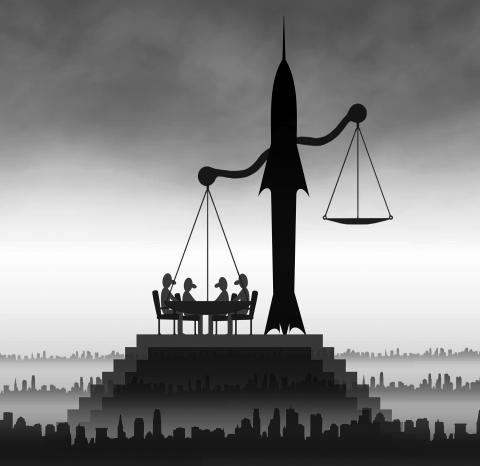
During those two decades, US and Chinese officials frequently discussed North Korea’s behavior, both privately and in public meetings. The Chinese consistently said that they did not want North Korea to develop nuclear weapons, but claimed that they had limited influence over the regime, despite being its major supplier of food and fuel.
The result was always a somewhat scripted exchange in which China and the US would accomplish little more than professing denuclearization as a goal they both shared.
China was sincere in expressing its desire for a non-nuclear Korean Peninsula, but the nuclear issue was not its primary concern. It also sought to prevent the collapse of the North Korean regime and the resulting potential for chaos on its border — not only flows of refugees, but also the possibility that South Korean or US troops could move into the North.
Torn between its two objectives, China placed a higher priority on preserving the Kim family dynasty. That choice gave rise to a seeming paradox: North Korea gained surprisingly powerful influence over China.
North Korea has “the power of weakness.” In certain bargaining situations, weakness and the threat of collapse can be a source of power.
To take an example from the financial world, if you owe a bank US$1,000, the bank has power over you; but if you owe the bank US$1 billion, you may have considerable bargaining power over the bank. China is, in this sense, North Korea’s over-exposed banker.
As a result, China has tried to persuade North Korea to follow its market-oriented example, but, with the regime of North Korean leader Kim Jong-un terrified that economic liberalization would eventually provoke demands for greater political freedom, China’s influence over the regime is limited.
As a Chinese official once told me in an unguarded moment, “North Korea has hijacked our foreign policy.”
North Korea has amplified its power by playing its weak hand audaciously. The North’s leaders know that superior South Korean and US military forces would win a full-scale military conflict. And yet, with 15,000 artillery tubes in the Demilitarized Zone, just 48km north of Seoul, they also know that they could wreak havoc on South Korea’s economy, whereas the North has relatively less to lose.
North Korea has long been adept at flaunting its willingness to take risks, provoking a crisis in 2010 by sinking a South Korean naval vessel and shelling a South Korean island. This spring, it conducted a nuclear test and a series of missile tests, accompanied by a stream of bellicose rhetoric.
Now it appears that China is beginning to lose patience. It has less confidence in the North’s inexperienced new ruler, Kim Jong-un, than it had in his father, Kim Jong-il. Chinese leaders are also beginning to recognize the risks that North Korea is imposing on China.
With more nuclear tests, a demand for nuclear weapons could grow in South Korea and Japan. Moreover, if this spring’s sharp rhetoric from the Kim regime is followed by provocations against South Korea like those that occurred in 2010, South Korea could respond forcefully, and China might be drawn in.
The signs of a change are intriguing. Following the “frank” discussion of North Korea by Xi and Obama, Xi hosted a summit with South Korean President Park Geun-hye, without first meeting with its official North Korean ally. Instead, two senior North Korean officials subsequently visited Beijing and were scolded for the North’s behavior.
By contrast, Xi and Park issued a joint statement proclaiming the importance of faithfully implementing UN Security Council resolutions that call for sanctions against North Korea, as well as a multilateral agreement in 2005 that obliges the North to exchange its nuclear-weapons programs for economic and diplomatic benefits. Both leaders urged a resumption of the six-party talks on denuclearization, which have been suspended since 2009.
What comes next is uncertain. North Korea has tempered its rhetoric and behavior, but the Kim regime has given no indication that it is willing to give up the nuclear-weapons program that it regards as vital to its security and prestige.
In the long run, economic and social change may help to resolve the situation. China’s dilemma remains that if it pushes too fast for reform, the Kim regime may collapse.
Faced with that prospect, the US and South Korea could take steps to reassure China that they would not exploit such a situation by moving their troops through North Korea to China’s border.
In the past, when the US has suggested quiet talks to discuss contingency planning in the case of regime collapse, China has been wary of offending and weakening North Korea. However, finding a formula to talk about such contingencies may be the next step for China as it seeks to overcome its quandary.
Joseph Nye is a professor at Harvard University.
Copyright: Project Syndicate
The Chinese Communist Party (CCP) challenges and ignores the international rules-based order by violating Taiwanese airspace using a high-flying drone: This incident is a multi-layered challenge, including a lawfare challenge against the First Island Chain, the US, and the world. The People’s Liberation Army (PLA) defines lawfare as “controlling the enemy through the law or using the law to constrain the enemy.” Chen Yu-cheng (陳育正), an associate professor at the Graduate Institute of China Military Affairs Studies, at Taiwan’s Fu Hsing Kang College (National Defense University), argues the PLA uses lawfare to create a precedent and a new de facto legal
In the first year of his second term, US President Donald Trump continued to shake the foundations of the liberal international order to realize his “America first” policy. However, amid an atmosphere of uncertainty and unpredictability, the Trump administration brought some clarity to its policy toward Taiwan. As expected, bilateral trade emerged as a major priority for the new Trump administration. To secure a favorable trade deal with Taiwan, it adopted a two-pronged strategy: First, Trump accused Taiwan of “stealing” chip business from the US, indicating that if Taipei did not address Washington’s concerns in this strategic sector, it could revisit its Taiwan
Chile has elected a new government that has the opportunity to take a fresh look at some key aspects of foreign economic policy, mainly a greater focus on Asia, including Taiwan. Still, in the great scheme of things, Chile is a small nation in Latin America, compared with giants such as Brazil and Mexico, or other major markets such as Colombia and Argentina. So why should Taiwan pay much attention to the new administration? Because the victory of Chilean president-elect Jose Antonio Kast, a right-of-center politician, can be seen as confirming that the continent is undergoing one of its periodic political shifts,
Taiwan’s long-term care system has fallen into a structural paradox. Staffing shortages have led to a situation in which almost 20 percent of the about 110,000 beds in the care system are vacant, but new patient admissions remain closed. Although the government’s “Long-term Care 3.0” program has increased subsidies and sought to integrate medical and elderly care systems, strict staff-to-patient ratios, a narrow labor pipeline and rising inflation-driven costs have left many small to medium-sized care centers struggling. With nearly 20,000 beds forced to remain empty as a consequence, the issue is not isolated management failures, but a far more


 RSS
RSS