


How did National Tsing Hua University student Chen Wei-ting (陳為廷) come to be called “Taiwan’s rudest student”? He has been threatened with a lawsuit for slander and the pro-blue camp Chinese-language United Daily News blasted him for failing to uphold the Confucian tradition of “honoring teachers.” How did an open legislative committee meeting come to be referred to by a well-known academic as a “cultural revolution” in which students denounced teachers, leading the legislature — the body that invited Chen to participate in the meeting — to amend its procedures? How did a university that boasts of liberal traditions and values and claims to encourage students to participate in public affairs end up clamping down on their activities? It is because they all fear the emergence of student power in the nation.
This year will be remembered as the year in which student power was born in Taiwan. In late March, more than 300 students staged an overnight sit-in to protest the forced demolition of houses in the Wenlin Yuan (文林苑) urban renewal project in Taipei’s Shilin District (士林). Although they were eventually evicted, the city government was forced to suspend all urban renewal projects and no construction has started at Wenlin Yuan.
When employees of textile maker Hualon Corp went on strike over unpaid wages this summer, students blocked company trucks with their own bodies, raising the spirits of the more than 200 unemployed workers who in the end received much better severance conditions than originally offered.
During National Taiwan University’s (NTU) recent anniversary, students took action to support the residents of Shaoxing Community, which is located on university-owned land and slated for demolition. The students’ actions resulted in NTU making concessions and reconciling with community residents.
Following the campaign to end ownership of television stations by the government, political parties and military in 1995, media reform was promoted by only a few academics. If it had not been for the threat of a lawsuit over the “walking fee” incident in July, when Want Want China Times Group media outlets accused students protesting against the group’s proposed acquisition of China Network Systems’ (CNS) cable TV services of being paid to take part in the demonstrations, the group’s move to acquire CNS and later on, the Next Media Group, would not have attracted so much public attention.
This threat was what angered students and led to a series of protests: a demonstration against the Want Want China Times Group on July 31, a protest against media monopolization organized by the student group Youth Alliance Against Media Monsters on Sept. 1, a protest outside the Executive Yuan on Nov. 26 and another one outside the Fair Trade Commission on Nov. 29.
On many different issues, the emergence of student power has changed the original pattern of protests in ways that have had practical implications. Confronted by this new power, the older generation may not be able to understand what young students are thinking because they remain stuck in their own way of thinking and behavior. Some worry that the opposition parties might use students to achieve their own purposes, destroying the illusion that the students are squeaky-clean and innocent. Others can’t wait to pass moral judgement based on the Confucian precepts emphasizing the hierarchical relationships between heaven, earth, emperor, parents and teachers.
In 2008 when the Wild Strawberries Movement was just starting, students were worried about being “painted green”; however, four years on, they are more mature and confident and are clear that they are utilizing politics rather than being used by politics.
During the 1960s in the West, student power was undermined to a certain degree by the mainstream media. Todd Gitlin, professor of journalism and communications at Columbia University, said the positive initial reporting about the anti-war movement by US terrestrial television stations caused students to overestimate their power. However, as soon as the media reports turned negative, the more radical students found themselves in a situation where they faced opposition from both the government and the media.
Despite being constantly suppressed by mainstream media, the power of Taiwanese students has gotten stronger. The medium students rely on most heavily is Facebook. This online medium played a big role in the Arab Spring movement and it has now become the most effective channel for mobilizing student power.
When all is said and done, the reason why student power is effective and threatens traditional mores is students have the courage to ask two fundamental questions about modern Taiwanese society. One is about justice and the other is about the China factor.
As retired military personnel, civil servants and public-school teachers refuse to let go of the 18 percent preferential interest rate on their pension savings and their year-end relief bonuses, workers are facing a Labor Insurance Fund on the verge of bankruptcy, while starting salaries for young people keep on falling and social injustice spreads. By showing their support for those evicted from their homes or the unemployed, students have become the last line of defense for upholding justice and have become instrumental in avoiding further social disintegration.
Moreover, for young people, the China factor is no longer a rhetorical military threat; it has entered right into the psyche of Taiwanese society. When police resort to confiscating the Republic of China flag while ignoring extreme pro-unification groups waving the People’s Republic of China (PRC) flag, one has to ask whether the government is protecting the PRC or Taiwan.
If members of the older generation who wield power are unwilling to face the issues of justice and China, and are unable to propose an alternative solution, they should give the younger generation more room to shape a society in line with their own thinking. Whether things out for the better or for the worse, the future of Taiwanese society is in their hands.
Ivan Ho is a professor in the Department of Sociology at National Taiwan University.
Translated by Drew Cameron
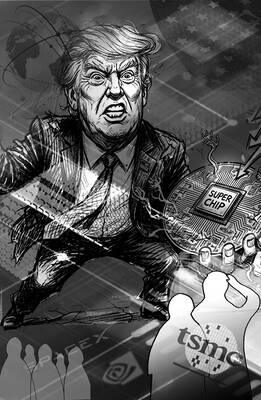
The White House’s decision to take a 9.9 percent stake in Intel Corp is looking like very shrewd business indeed. Since the government bought in at US$20.47 a share last August, the US chipmaker’s surging stock price has delivered the US a US$43 billion return. One of the reasons the investment has so far proved so sound is that the White House has made sure of it. According to The Wall Street Journal, Howard personally pushed deals on Intel’s behalf with some of the most lucrative clients imaginable. They include Nvidia Corp, the company at the heart of the AI
A single photograph can cut through a lot of noise, but it can also be used to misrepresent the truth. At the very least, it can concentrate the mind on something that requires further investigation. On Monday last week, Ma Ying-jeou Foundation CEO Tai Hsia-ling (戴遐齡) and former National Security Council secretary-general King Pu-tsung (金溥聰) held a news conference in which they showed a photograph of former foundation CEO Hsiao Hsu-tsen (蕭旭岑), now Chinese Nationalist Party (KMT) deputy chairman. In the image Hsiao is seated next to Xiamen Taiwan Businessmen Association chairman Han Ying-huan (韓螢煥). The two men were holding
I first met Professor Ray Jiing (井迎瑞) as a film and documentary student at Shih Hsin University’s (SHU) Department of Radio Television and Film in 1988. The following year, he went on to become the director of the Chinese Taipei Film Archive — forerunner of the Taiwan Film and Audiovisual Institute (TFAI). Over his eight-year tenure, Jiing rescued and restored over 200 classic Taiwanese films. In 1997, he established the Graduate Institute of Studies in Documentary and Film Archiving at Tainan National University of the Arts (TNNUA), and I joined the program in his third cohort of students. Beyond a
A recent report concerning a student who is suing his teacher posed the question in its headline: Does failing a student in two subjects constitute bullying? The college student in Chiayi County apparently sought NT$2 million (US$63,603) in state compensation, but a court dismissed the case. The first reaction of many might have been to ask: What has happened to students nowadays? Some say that teachers have lost their authority, while others say students are overindulged. Some even start reminiscing over the days when “whatever the teacher says goes.” However, the real issue might be overlooked if emotional reactions like that are the


 RSS
RSS