


Does the US government believe that Taiwan is a province of China, a nation separate from China, or perhaps something else? There is no answer to this question. If anything, the US position toward the international status of Taiwan has been “consistently inconsistent.”
In November 1943, then-US president Franklin Roosevelt, then-British prime minister Winston Churchill and Generalissimo Chiang Kai-shek (蔣介石) met in Cairo. The outcome of the meeting was the Cairo Declaration. This was a World War II era accord outlining the disposition of territories “stolen” by Japan — including Manchuria, the Pescadores and Taiwan. In keeping with the terms of the agreement, these territories were “restored to the Republic of China [ROC]” in 1945. Although lower-level officials in the US Department of State discussed other options, US policy held that Taiwan was part of China.
When Chiang’s forces retreated to Taiwan in 1949, the US position toward the island’s status was still clear. During a news conference on Dec. 22, 1949, then-US president Harry Truman declared that Taiwan is “not a free country,” but rather that “it is part of Nationalist China.” During private discussions with US lawmakers on Jan. 5, 1950, then-US secretary of state Dean Acheson argued that Taiwan was “essentially a Chinese territory” and that its fate had been “morally sealed by some form of prior agreement.”
Following the outbreak of the Korean War in June 1950, the US reversed its position. Much to the chagrin of Mao Zedong (毛澤東) and Chiang, Washington adopted the position that the status of Taiwan was “undetermined.” On June 27, 1950, Truman declared that “the future status of Formosa [Taiwan] must await the restoration of security in the Pacific, a peace settlement with Japan, or consideration by the United Nations.” However, the island’s status was not determined by any of these events. Moreover, the US did not adopt a clear position on Taiwan’s status when it concluded a defense treaty with the ROC in 1954. And when anticipating Taipei’s withdrawal from the UN in 1971, the US Department of State announced that “in our view, sovereignty over Taiwan and the Pescadores is an unsettled question.”
Some contend that the series of US-People’s Republic of China (PRC) communiques negotiated in the 1970s and 1980s settled the matter. They did not. In the US versions of the communiques, the US recognizes the PRC as the legitimate government of China and acknowledges Beijing’s position that there is only one China and Taiwan is a part of it. The word “acknowledge” was deliberately chosen as it indicates cognizance of, but not necessarily agreement with, the Chinese position. Interestingly, the PRC versions of the communiques state that both sides “agree” that there is only one China and that Taiwan is a part of it.
These public proclamations do not tell the whole story. Recently declassified documents reveal that former US president Richard Nixon stated plainly that Taiwan was a part of China during his 1972 visit to China. In top secret discussions with former Chinese premier Zhou Enlai (周恩來), the president declared that “there is one China, and Taiwan is a part of China. There will be no more statements made — if I can control the bureaucracy — to the effect that the status of Taiwan is undetermined.” Even more astonishing, then-US national security adviser Henry Kissinger seems to have conceded that Taiwan eventually will be absorbed by the PRC. Like Nixon, Kissinger pledged that Washington would never again refer to Taiwan’s status as “undetermined.”
Despite the promises of Nixon and Kissinger, statements about Taiwan’s “undetermined” status continued. With the end of the Cold War, the US Department of Defense released a study that referred to Taiwan, along with the Spratly (南沙群島) and Paracel (西沙群島) islands, as “unresolved territorial issues.” The ensuing uproar prompted the Department of Defense to backtrack and explain, “our policy is unchanged. The US acknowledges the Chinese position that there is only one China and that Taiwan is a part of China.” Of course, this meant nothing.
Confusion over US policy continues. The behavior of former US president George W. Bush’s administration was especially perplexing. According to a congressional study, in 2003, Bush reportedly promised Beijing’s leaders that the US opposes Taiwan’s independence from China. Some believe the inference was clear — namely, Taiwan belongs to China. Leaked diplomatic cables show that the Bush administration played a key role in crafting a secret agreement in 2005 whereby Taipei might participate in the WHO as “Taiwan, China.” Washington pressured Taipei to accept the nomenclature and urged it to keep the matter secret. However, according to leaked US diplomatic cables, in 2007, Washington pressured the UN and its secretary-general to stop using the phrase, “Taiwan is a part of China.” Confusing, isn’t it?
US policy toward Taiwan’s international status remains a favorite topic for discussion among activists with varying political agendas. It enables them to selectively “cherry pick” certain US statements to support almost any argument about Taiwan’s international status.
However, the preoccupation with US policy toward this issue may be misplaced. Despite its “superpower” status, the US government is in no position to unilaterally determine the international status of foreign territories or countries. Just because Nixon said Taiwan is part of China does not make it true or false.
In the final analysis, as AIT Chairman Raymond Burghardt opined recently, quibbling over the international status of Taiwan is similar to theology and “it’s not terribly useful to spend time on it, because each way you go, you get yourself into more trouble.”
Dennis Hickey is the director of the graduate program in global studies at Missouri State University and co-editor of New Thinking about the Taiwan Issue: Theoretical insights into its origins, dynamics and prospects.
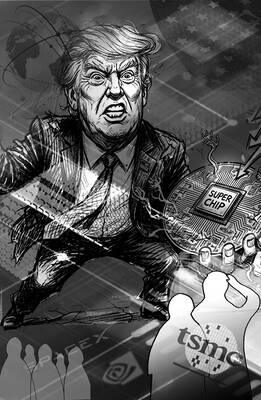
The White House’s decision to take a 9.9 percent stake in Intel Corp is looking like very shrewd business indeed. Since the government bought in at US$20.47 a share last August, the US chipmaker’s surging stock price has delivered the US a US$43 billion return. One of the reasons the investment has so far proved so sound is that the White House has made sure of it. According to The Wall Street Journal, Howard personally pushed deals on Intel’s behalf with some of the most lucrative clients imaginable. They include Nvidia Corp, the company at the heart of the AI
A single photograph can cut through a lot of noise, but it can also be used to misrepresent the truth. At the very least, it can concentrate the mind on something that requires further investigation. On Monday last week, Ma Ying-jeou Foundation CEO Tai Hsia-ling (戴遐齡) and former National Security Council secretary-general King Pu-tsung (金溥聰) held a news conference in which they showed a photograph of former foundation CEO Hsiao Hsu-tsen (蕭旭岑), now Chinese Nationalist Party (KMT) deputy chairman. In the image Hsiao is seated next to Xiamen Taiwan Businessmen Association chairman Han Ying-huan (韓螢煥). The two men were holding
I first met Professor Ray Jiing (井迎瑞) as a film and documentary student at Shih Hsin University’s (SHU) Department of Radio Television and Film in 1988. The following year, he went on to become the director of the Chinese Taipei Film Archive — forerunner of the Taiwan Film and Audiovisual Institute (TFAI). Over his eight-year tenure, Jiing rescued and restored over 200 classic Taiwanese films. In 1997, he established the Graduate Institute of Studies in Documentary and Film Archiving at Tainan National University of the Arts (TNNUA), and I joined the program in his third cohort of students. Beyond a
President William Lai Ching-te’s (賴清德) May 20 second-anniversary address was not just a routine policy review; it was damage control. US President Donald Trump’s remarks — that he did not want to see anyone move toward independence and that the delivery of a major Taiwan arms package could depend on the progress of US-China relations — unsettled Taiwan’s public and created an opening for opposition parties to question whether Taiwan was being treated as a bargaining chip in Washington’s dealings with Beijing. Lai’s speech was designed to close that opening. The address covered the expected ground: sovereignty, cross-strait relations, defense spending,


 RSS
RSS