


On Dec. 12, retired military leaders from Taiwan and China met at the first symposium on Sun Yat-sen Thought and the Whampoa Spirit at the 2010 Cross-strait Sun Yat-sen Forum.
Participants from Taiwan included former director of National Defense University, General Hsia Yin-chou (夏瀛洲), former military adviser to the Presidential Office and former director of the General Political Warfare Bureau Tsao Wen-shen (曹文生), former navy commander-in-chief Admiral Miao Yung-ching (苗永慶), former deputy air force commander-in-chief Lee Kui-fa (李貴發), and former president of the Graduate Institute of Strategic Studies at National Defense University Tseng Chang-jui (曾章瑞).
The Chinese participants included former deputy director of the technological research department at China’s National Defense University Wu Guifu (武桂馥), former director of the Institute for Strategic Studies at National Defense University Pan Zhenqiang (潘振強), former director of the Department of Strategic Research at the Chinese Academy of Military Science Yao Youzhi (姚有志), deputy director of the Department for Foreign Military Studies at the Chinese Academy of Military Science Fu Liqun (傅立群) and researcher at the Department of Strategic Studies at the Chinese Academy of Military Science Peng Guangqian (彭光謙).
This gathering grabbed the attention of officials and the media in Taiwan, the US and Japan.
Recently there has been a change in the domestic view of cross-strait affairs. When former National Security Council secretary-general Su Chi (蘇起) and Charles Kao (高希均), founder and chief executive of Commonwealth Publishing Group, participated in a Harvard University Forum in late May, they quoted an opinion survey by CommonWealth Magazine showing that after the signing of the Economic Cooperation Framework Agreement (ECFA), 53 percent of respondents agreed that it was still necessary to purchase better defensive weapons from the US. That was an increase of 5 percent on the previous year.
Although President Ma Ying-jeou (馬英九) has on several occasions demanded that China remove the missiles it aims at Taiwan, both the incumbent and former national defense ministers have told the legislature that doing so “is of no substantial military significance.” Quite a few domestic and external observers are already questioning Ma’s actions. In February US military expert Richard Fisher said that the Ma administration’s national defense policies lacked both pragmatism and vision and Mei Fu-hsing (梅復興), director of the US-based Taiwan Security -Analysis Center, has penned articles questioning the government’s use of the US administration’s indecision over arms sales as a bargaining chip.
It is worth noting that according to the transcript of a meeting between US Deputy Secretary of State James Steinberg and former Singaporean prime minister Lee Kuan Yew (李光耀) on May 30 last year recently made public by WikiLeaks, Lee said that Chinese President Hu Jintao (胡錦濤) would be pragmatic on Taiwan, believing that the key is to first build economic links.
This corroborates what former deputy minister of national defense Lin Chong-pin (林中斌) said at a forum on Taiwan Strait security and mutual trust in June, namely that Beijing has realized that “it is cheaper to buy Taiwan than to attack it.”
Another thing worthy of note is that the Democratic Progressive Party (DPP) made was less critical of cross-strait affairs during the recent special municipality election campaigns than it has been in the past, and once they were over the DPP announced its intention to establish a think tank aimed at initiating exchanges with China. This implies an acceptance that regardless of which party holds power, cross-strait exchange is now an unstoppable trend.
This unofficial, non-governmental exchange — the so-called second track — differs from previous meetings between retired high-ranking military officers in that it is organized and has a direction and an agenda.
Although retired Chinese officers still focus on the idea of national revival as a way to resolve the Taiwan issue, retired military officers from Taiwan emphasized the need to set up a mechanism for cross-strait military contacts through non-military means rather than focus on the most intractable aspects of the cross-strait relationship. They expressed the view that cross-strait development should take precedence over the threats of the past, in the hope that China would take a more enlightened approach to the promotion of mutual trust.
Both the retired Chinese and Taiwanese officers had things that they insisted on, but the Taiwanese side rejected the currently optimistic Chinese view, stressing Taiwanese democracy and identity. They also suggested a multilateral model to facilitate stability in the Taiwan Strait and deal with threats that are not purely military in nature, including the removal of the missiles China aims at Taiwan.
It is certainly more pragmatic and innovative to rely on simulation analysis as a scientific basis for the promotion of practical and feasible cross-strait military exchange.
Wang Jyh-perng is an associate research fellow at the Association for Managing Defense and Strategies.
TRANSLATED BY PERRY SVENSSON
Minister of Labor Hung Sun-han (洪申翰) on April 9 said that the first group of Indian workers could arrive as early as this year as part of a memorandum of understanding (MOU) between the Taipei Economic and Cultural Center in India and the India Taipei Association. Signed in February 2024, the MOU stipulates that Taipei would decide the number of migrant workers and which industries would employ them, while New Delhi would manage recruitment and training. Employment would be governed by the laws of both countries. Months after its signing, the two sides agreed that 1,000 migrant workers from India would
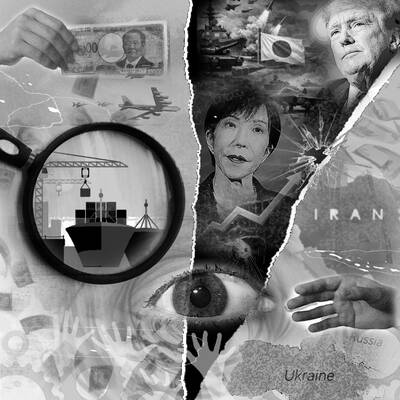
Japan’s imminent easing of arms export rules has sparked strong interest from Warsaw to Manila, Reuters reporting found, as US President Donald Trump wavers on security commitments to allies, and the wars in Iran and Ukraine strain US weapons supplies. Japanese Prime Minister Sanae Takaichi’s ruling party approved the changes this week as she tries to invigorate the pacifist country’s military industrial base. Her government would formally adopt the new rules as soon as this month, three Japanese government officials told Reuters. Despite largely isolating itself from global arms markets since World War II, Japan spends enough on its own
On March 31, the South Korean Ministry of Foreign Affairs released declassified diplomatic records from 1995 that drew wide domestic media attention. One revelation stood out: North Korea had once raised the possibility of diplomatic relations with Taiwan. In a meeting with visiting Chinese officials in May 1995, as then-Chinese president Jiang Zemin (江澤民) prepared for a visit to South Korea, North Korean officials objected to Beijing’s growing ties with Seoul and raised Taiwan directly. According to the newly released records, North Korean officials asked why Pyongyang should refrain from developing relations with Taiwan while China and South Korea were expanding high-level
When 17,000 troops from the US, the Philippines, Australia, Japan, Canada, France and New Zealand spread across the Philippine archipelago for the Balikatan military exercise, running from tomorrow through May 8, the official language would be about interoperability, readiness and regional peace. However, the strategic subtext is becoming harder to ignore: The exercises are increasingly about the military geography around Taiwan. Balikatan has always carried political weight. This year, however, the exercise looks different in ways that matter not only to Manila and Washington, but also to Taipei. What began in 2023 as a shift toward a more serious deterrence posture


 RSS
RSS