


Two recent articles about climate change (“How much more proof is needed for people to act?” and “Ignoring the future — the psychology of denial,” Dec. 4, page 9) emphasized the importance of facing major issues that will have an impact on the future of the human species. Climate change is indeed an issue that is on everyone’s mind, and while Taiwan seems to be far removed from the experts who recently made their way to Copenhagen to try to hammer out blueprints to prevent global warming from having a Doomsday impact on humankind, Taiwan is also on the front lines of these issues.
Despite most observers’ belief that solutions lie in mitigation, there are a growing number of climatologists and scientists who believe that the A-word — adaptation — must be confronted head-on, too. The fact is — despite the head-in-the-sand protestations of denialists like Marc Morano and Sarah Palin in the US — that we cannot stop climate change or global warming. The Earth’s atmosphere has already passed the tipping point, and in the next 500 years, temperatures and sea levels will rise considerably and millions, even billions, of people from the tropical and temperate zones will be forced to migrate in search of food, fuel and shelter. This includes the people of Taiwan.
By the year 2500, Taiwan will be largely uninhabited, except for a few stragglers eking out a subsistence life in the heights of the Central Mountain Range. The rest of the population will have migrated north to Russia’s northern coast or northern parts of Alaska and Canada to find safe harbor from the devastating impact of global warming.
A researcher at Academia Sinica, Wang Chung-ho (王中和), told a reporter for the Liberty Times (the Taipei Times’ sister newspaper) earlier this year that there was a good chance Taipei would be flooded by the end of this century, adding that the the capital might have to be relocated to higher ground in less than 100 years. Wang said the entire Taipei basin would likely be engulfed by rising seas by 2100, triggered, of course, by global warming. Wang said his research showed that most of the west coast of Taiwan would be submerged by rising sea levels by that time, as well.
Wang’s report, which was presented at a public forum sponsored by Academia Sinica, theorized that sea levels would rise by at least 1m, gobbling up all low-lying areas of Taiwan, from Kaohsiung to Taipei. “Taiwan must be prepared for the worst-case scenario,” Wang said, according to the Liberty Times.
If Wang is correct, and Taipei is faced with major flooding in 90 years, then what will life be like in Taiwan in 490 years? Most likely, Taiwan’s population will have left the country for faraway northern regions to find shelter in UN-funded climate refuges in places such as Russia, Canada and Alaska. Taiwanese climate refugees will join millions of others from India, Vietnam, Thailand, Japan and the Philippines. It won’t be a pretty picture.
When a reporter asked Wang if this was a possible future scenario for Taiwan some 500 years from now, he said it was very possible, and that these issues needed to be addressed now, if only as a thought exercise, and even if it all sounded like a science fiction movie script. When the same reporter asked acclaimed British scientist James Lovelock if such a scenario for Taiwan were likely, he said in an e-mail: “It may very well happen, yes.”
We humans cannot engineer our way out of global warming, although scientists who believe in geo-engineering have offered theories on how to do it. There are no easy fixes. Humankind has pumped too many greenhouse gases into the atmosphere, the result of the industrial revolution that gave us trains, planes, automobiles and much more, enabling us to live comfortable and trendy lives — and now there is so much carbon dioxide in the atmosphere that the Earth cannot recover.
Forget using your reusable steel chopsticks at Taipei eateries, forget planting more trees around the island, forget cleaning up the polluted rivers of Taiwan, forget trying to be more “green” in your daily life. Taiwan, like the rest of the world, is doomed to a bleak future full of billions of climate refugees seeking shelter in the far north, and in places like New Zealand, Tasmania and Antarctica in the far south.
Meetings in Copenhagen and Rio de Janeiro and at the UN in Manhattan will not stop global warming.
What we need to focus on now is preparing future generations for what our world will become in the next 500 years and how best to survive it.
For the next 100 years or so, life will go on as normal in Taiwan. There is nothing to worry about now. For the next 100 years posh department stores will hawk their trendy items, computer firms will launch their latest gadgets and airline companies will continue to offer passengers quick passage here and there, to the Maldives and to Manhattan, for business and for pleasure.
But in the next 500 years, according to Wang and other scientists who are not afraid to think outside the box and push the envelope, things are going to get bad. Unspeakably bad.
Those of us who are alive today won’t suffer, and the next few generations will be fine, too. The big trouble will probably start around 2200 — Wang says 2100 for Taipei — and last for some 300 years or so.
By 2500, Taiwan will be history, as will the nations of Africa, Asia, North America and Europe.
We are entering uncharted waters, and as the waters rise and the temperatures go up, future generations will have some important choices to make: where to live, how to live, how to grow food, how to power their climate refugee settlements, how to plan and how to pray.
In a recent op-ed on this page (“Taiwan remains oblivious to climate,” Dec. 14) Chen Meei-shia (陳美霞), a professor of public health at National Cheng Kung University, said “the lives of most Taiwanese are based on the aspiration to and an obsession with consuming large amounts of products.” One can therefore conclude that most people in Taiwan are not interested in thinking about the future impact of climate change on their country.
This attitude does not bode well for the future of Isla Formosa, the “beautiful island.”
Dan Bloom is a writer based in Chiayi.
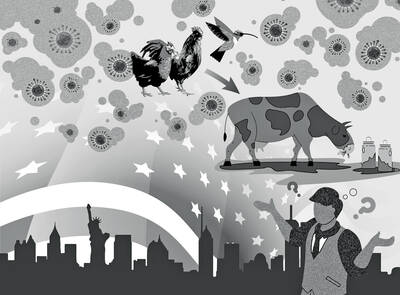
The bird flu outbreak at US dairy farms keeps finding alarming new ways to surprise scientists. Last week, the US Department of Agriculture (USDA) confirmed that H5N1 is spreading not just from birds to herds, but among cows. Meanwhile, media reports say that an unknown number of cows are asymptomatic. Although the risk to humans is still low, it is clear that far more work needs to be done to get a handle on the reach of the virus and how it is being transmitted. That would require the USDA and the Centers for Disease Control and Prevention (CDC) to get

For the incoming Administration of President-elect William Lai (賴清德), successfully deterring a Chinese Communist Party (CCP) attack or invasion of democratic Taiwan over his four-year term would be a clear victory. But it could also be a curse, because during those four years the CCP’s People’s Liberation Army (PLA) will grow far stronger. As such, increased vigilance in Washington and Taipei will be needed to ensure that already multiplying CCP threat trends don’t overwhelm Taiwan, the United States, and their democratic allies. One CCP attempt to overwhelm was announced on April 19, 2024, namely that the PLA had erred in combining major missions
On April 11, Japanese Prime Minister Fumio Kishida delivered a speech at a joint meeting of the US Congress in Washington, in which he said that “China’s current external stance and military actions present an unprecedented and the greatest strategic challenge … to the peace and stability of the international community.” Kishida emphasized Japan’s role as “the US’ closest ally.” “The international order that the US worked for generations to build is facing new challenges,” Kishida said. “I understand it is a heavy burden to carry such hopes on your shoulders,” he said. “Japan is already standing shoulder to shoulder
Former president Chiang Ching-kuo (蔣經國) used to push for reforms to protect Taiwan by adopting the “three noes” policy as well as “Taiwanization.” Later, then-president Lee Teng-hui (李登輝) wished to save the Chinese Nationalist Party (KMT) by pushing for the party’s “localization,” hoping to compete with homegrown political parties as a pro-Taiwan KMT. However, the present-day members of the KMT do not know what they are talking about, and do not heed the two former presidents’ words, so the party has suffered a third consecutive defeat in the January presidential election. Soon after gaining power with the help of the KMT’s


 RSS
RSS