


In actuality, the everyday choices of most Muslims in Europe are dictated more by their experience of globalized economies and cultures than their readings in the Koran or Shariah. Along with their Hindu and Sikh peers, many Muslims in Europe suffer from the usual pathologies of traditional rural communities transitioning to urban secular cultures: The encounter with social and economic individualism inevitably provokes a crisis of control in nuclear families, as well as such ills as forced marriage, the poor treatment of women and militant sectarianism.
However, in practice, millions of Muslims, many of them with bitter experiences of authoritarian states, coexist frictionlessly and gratefully with regimes committed to democracy, freedom of religion and equality before the law.
For many of these Muslim aspirants for full and equal citizenship, the urgent questions are whether the old-style liberalism of many European nation-states, which has traditionally assumed cultural homogeneity, can accommodate minority identity, and whether majority communities in Europe can tolerate expressions of cultural and religious distinctiveness. A part of the secular intellectual priesthood, which cannot survive without its theological opposition between the Enlightenment and Islam, thinks not. In 2004, France’s ban on the wearing of headscarves in public schools bluntly clarified that Muslims will have to renounce all signs of their religion in order to become fully French.
This expectation of identity suicide has a rather grim history in enlightened Europe. Voltaire burnished his credentials as a defender of reason and civility with attacks on “ignorant” and “barbarous” Jews who, as slaves to their scripture, were, “all of them, born with raging fanaticism in their hearts.” (The Nazis put together a sizable anthology of Voltaire’s rants against Jews.) Accused of mistreating their women and proliferating with devious rapidity, and goaded to abandon their religious and cultural baggage, many Jews in the 19th century paid an even higher cost of “integration” than that confronting Muslims today in France.
As it turned out, those Jews who suppressed the Torah and Talmud and underwent drastic embourgeoisement became even more vulnerable to malign prejudice in post-Enlightenment Europe’s secular nation-states. The persecution of Alfred Dreyfus in France convinced Theodore Herzl, the creator of modern Zionism, that “the Jew who tries to adapt himself to his environment, to speak its languages, to think its thoughts” would remain a potentially treacherous “alien” in the secular West. Reporting in the 1920s on Jewish communities exposed to a particularly vicious recrudescence of anti-Semitism, the novelist Joseph Roth denounced assimilation as a dangerous illusion, blaming its failure on the “habitual bias that governs the actions, decisions, and opinions of the average western European.”
Roth, who trusted Europe’s old “fear of God” more than its “so-called modern humanism,” bluntly questioned the “civilizing missions” of European empires in Asia and Africa in a preface he wrote to his book in 1937: “What is it,” he asked, “that allows European states to go spreading civilization and ethics in foreign parts but not at home?”
Joan Wallach Scott’s account of France’s colonial history reveals that violent prejudice against religious and racial “others” was also an intrinsic part of spreading European civilization and ethics abroad. The veil, fixed in the 19th century by the French as a symbol of Islam’s primitive backwardness, was used to justify the brutal pacification of north African Muslims and to exclude them from full citizenship. Geoffrey Brahm Levey and Tariq Modood, the editors of Secularism, Religion and Multicultural Citizenship, write: “How Muslims are perceived today is connected to how they have been perceived and treated by European empires and their racial hierarchies.”
Meanwhile, as colonialist stereotypes again proliferate, second- and third-generation Muslim women creatively use their head-coverings in their own passage to modernity. In Another Cosmopolitanism, the political philosopher Seyla Benhabib describes the bold actions of three French girls who in 1989 consciously risked expulsion by wearing headscarves to school.
“They used the symbol of the home to gain entry into the public sphere by retaining the modesty required of Islam in covering their heads; yet at the same time, they left the home to become public actors in a civil public space in which they defied the state,” he wrote
Liberal spaces within Europe have brought many more Muslim women out of their old confinements. Benhabib asserts that these women, who “struggle at first to retain their traditional and given identities against the pressures of the state,” then go on to engage and contest their Islamic traditions. As Europe’s own passage from tradition showed, this necessary reconfiguration is not the work of a day. It requires the practices and institutions of European citizenship to grow more rather than less flexible.
In historic terms, Muslims are a recent presence in Europe, especially when compared with the minorities in different parts of the continent — Jewish, Italian, Portuguese and black — that were once feared to be unassimilable. Their initial position as barely tolerated “temporary workers” was never likely to create the conditions for quick integration. Muslims from a young, globalized and highly political generation are now poised to enter the public spheres open to them, or to embrace extremism, or, like many of their parents, to retreat into passive resentment. But these choices in turn depend on how quickly and readily their “hosts” — ordinary Europeans as well as their governments — will make them feel at home. Strident invocations of the Enlightenment or some other historically and eternally fixed essence of Europe seem increasingly symptoms of intellectual lag and cultural defensiveness. Multi-ethnic Europe is an immutable fact, and needs, appropriately, a more inclusive, open-ended identity, one derived more from its pluralistic and relatively peaceful present, and supranational future, than its brutishly nationalist and imperialist past.
Writing in 1937 about the minority then most despised in Europe, Joseph Roth predicted that “Jews will only attain complete equality, and the dignity of external freedom, once their ‘host nations’ have attained their own inner freedom, as well as the dignity conferred by sympathy for the plight of others.”
This proved to be too much to ask of Europe in 1937. But the moral challenge has not gone away — civilization remains an ideal rather than an irreversible achievement — and the dangers of leaving it unmet are incalculable.
This is part two of a two-part piece. The first part ran yesterday.
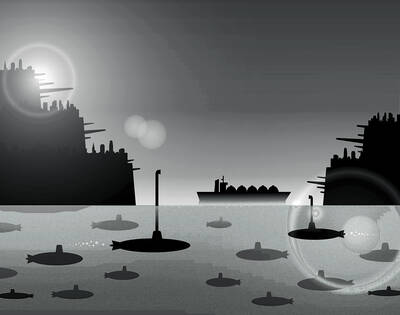
In the event of a war with China, Taiwan has some surprisingly tough defenses that could make it as difficult to tackle as a porcupine: A shoreline dotted with swamps, rocks and concrete barriers; conscription for all adult men; highways and airports that are built to double as hardened combat facilities. This porcupine has a soft underbelly, though, and the war in Iran is exposing it: energy. About 39,000 ships dock at Taiwan’s ports each year, more than the 30,000 that transit the Strait of Hormuz. About one-fifth of their inbound tonnage is coal, oil, refined fuels and liquefied natural gas (LNG),
To counter the CCP’s escalating threats, Taiwan must build a national consensus and demonstrate the capability and the will to fight. The Chinese Communist Party (CCP) often leans on a seductive mantra to soften its threats, such as “Chinese do not kill Chinese.” The slogan is designed to frame territorial conquest (annexation) as a domestic family matter. A look at the historical ledger reveals a different truth. For the CCP, being labeled “family” has never been a guarantee of safety; it has been the primary prerequisite for state-sanctioned slaughter. From the forced starvation of 150,000 civilians at the Siege of Changchun
The two major opposition parties, the Chinese Nationalist Party (KMT) and the Taiwan People’s Party (TPP), jointly announced on Tuesday last week that former TPP lawmaker Chang Chi-kai (張啟楷) would be their joint candidate for Chiayi mayor, following polling conducted earlier this month. It is the first case of blue-white (KMT-TPP) cooperation in selecting a joint candidate under an agreement signed by their chairpersons last month. KMT and TPP supporters have blamed their 2024 presidential election loss on failing to decide on a joint candidate, which ended in a dramatic breakdown with participants pointing fingers, calling polls unfair, sobbing and walking
In recent weeks, Taiwan has witnessed a surge of public anxiety over the possible introduction of Indian migrant workers. What began as a policy signal from the Ministry of Labor quickly escalated into a broader controversy. Petitions gathered thousands of signatures within days, political figures issued strong warnings, and social media became saturated with concerns about public safety and social stability. At first glance, this appears to be a straightforward policy question: Should Taiwan introduce Indian migrant workers or not? However, this framing is misleading. The current debate is not fundamentally about India. It is about Taiwan’s labor system, its


 RSS
RSS