


China is heading for big trouble. Fearful of a political backlash from the sort of deep recession being suffered in the west, Beijing has embarked on a program of reckless expansion that is providing short-term gain at the expense of long-term pain.
This is an unfashionable view. The conventional wisdom is that China has taken the bold steps necessary to tackle the global downturn, and that its mixture of Keynesian pump-priming and Leninist centralised control will help drag the rest of the world back to prosperity.
Strategically, it’s a pivotal moment. It is assumed that at some point in the 21st century, the role of the world economic (and hence political) superpower will be ceded by the US to China, and that the slump of the past two years will hasten this process.
Why? Because traditionally it has been the US that has acted as the locomotive for the rest of the global economy and this time it is China in the vanguard; if German manufacturers now look to Guangdong rather than the Midwest to boost their order books, that marks a shift in power.
One half of this argument certainly rings true. The US remains by far the most powerful nation on earth, but bubble economics and military overstretch have sapped its strength.
Little wonder, then, that consumer spending is weak. With unemployment likely to hit 10 percent over the coming months and total hours worked in the economy’s private sector down 7 percent on a year ago, the US is in no position to act as the buyer of last resort for the rest of the world.
The US economy has deep-rooted problems: It has a hollowed out industrial base; it has over-indebted consumers; it has a crippled housing market.
To make matters worse it now has an exploding budget deficit and gently rising long-term interest rates. There is a very real risk of a double-dip recession in the US.
As a result, all eyes are now on China. On the face of it, there are encouraging signs. China’s economy bounced back in the second quarter and on some estimates grew at an annual rate of almost 15 percent in the three months ending in June. Put another way, the global economy grew by 1.6 percent in the second quarter; without China it would have been flat at best.
The optimistic case goes as follows. China is doing the heavy lifting for the rest of the world by pouring trillions of yuan into infrastructure projects and by expanding its money supply at a faster rate than any other country. Beijing’s actions will provide an outlet for exports from the rest of Asia and from Europe, while giving the US time to recuperate.
This all sounds a bit too good to be true. First, China, despite its explosive growth in the past three decades, remains a much smaller economy than the US. Measured by market exchange rates, the size of China’s economy is about 20 percent of the US or the EU, and that limits the extent to which it can act as an economic locomotive.
Nor are its economic statistics as squeaky clean as they might be. John Makin, in a piece for the American Enterprise think tank, said China was having a “bogus boom.” Dodgy accounting practices, he said, meant that goods count as sold when they leave factories, not when they are actually bought by consumers, and bank loans count towards GDP as soon as they are disbursed, even if companies hoard the cash or use the money to buy shares.
Second, China’s growth has been dominated by investment and exports. Consumption has accounted for a declining share of national output, in contrast to the west, which means — as the Marxist writer Chris Harman notes in a forthcoming book — that the colossal increase in production cannot be absorbed domestically.
Instead, the surplus goes into still higher levels of investment or is channelled into overseas markets.
Finally, it is almost inevitable that much of the stimulus package has been squandered. While it is comforting to believe that the leadership of the Chinese Communist Party calmly produced a blueprint for global recovery, the reality is somewhat different.
Chinese President Hu Jintao’s (胡錦濤) government is petrified by the possibility that recession will lead to social unrest. As Jonathan Fenby put it for Trusted Sources, a research group that specializes in emerging markets: “China’s policy responses to the current economic downturn are being powerfully shaped by political factors, given the regime’s need to maintain its claim to legitimacy through growth.”
In political terms, the policy is working. Opinion polls showed that people in China are far more positive about the prospects for the economy than people in the west. Economically, though, there is a cost.
Chucking money at the economy will lead to an even bigger problem of over-investment, an explosion in bad loans and a tendency for a good chunk of the increase in the money supply to leak out into speculation. Over-capacity and falling profit rates will mean that many inefficient companies kept alive by the injection of cheap money will have real problems in servicing their debts.
This approach to crisis management is nothing new. China has responded in the way that Alan Greenspan did after the dotcom crash: It has solved the problems of one bubble by creating another.
China’s fiscal boost is being spent on domestic infrastructure projects rather than on the military spending and the tax cuts favored by former US president George W. Bush, but by copying what Washington did between 2001 and 2003 Beijing is running similar risks. The reports of a spate of fake mortgages to buy flats on bank credit have clear echoes of the sort of malpractice associated with the subprime scandal in the US.
Fenby warns that China’s path out of the crisis “looks longer and more complex than the headlines suggest” and Chinese policy makers are certainly worried by rising property prices, a doubling in value of the Shanghai stockmarket and the need to mop up some of the excess liquidity sloshing around the economy. In June, the China Banking Regulatory Commission warned of “grim credit and market risk” as a result of a fall in corporate earnings and excess capacity.
It is encouraging that Beijing is aware there could be big trouble ahead, but being aware of a potential problem and doing something about it are quite different.
Tackling China’s economic problems will be tough, unpopular and time-consuming.
But if Beijing ducks the economic challenge for political reasons, the consequences threaten to be severe. Albert Edwards, analyst with Societe Generale, says China is now an accident waiting to happen.
“If the US in 2007 was a slow motion train wreck with carriage after carriage coming off the rails in turn, China will at some point soon be pile-driving straight into the buffers,” he said.
What’s more, if the recent US experience is anything to go by, the crash will not be long in coming.
Larry Elliott is the Guardian’s economics editor.
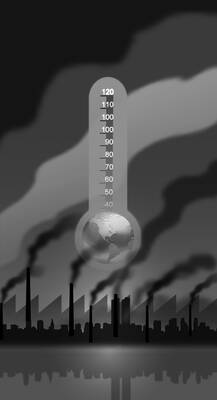
The closure of the Strait of Hormuz has sent the vast Asian chemicals industry into a tailspin. Deprived of the likes of Qatari natural gas and Saudi Arabian oil, the region’s fertilizer and plastics plants are slowing production or even shutting down. Everywhere except China, that is. In petrochemicals, China is unique. As well as a traditional industry that uses oil and gas as feedstock, it has parallel output that relies on its abundant domestic coal. Unsurprisingly, India and other regional powers want to copy and paste the Chinese method. This would not be easy — or climate friendly. The
KMT Chairwoman Cheng Li-wun’s (鄭麗文) recent visit to Beijing and her upcoming visit to Washington will serve as a high-level test of her diplomatic mettle. In Beijing, Cheng was received with symbolic gestures, a warm reception, and high-level access. In Washington, she will receive far less pomp and far sharper questions about the KMT’s vision for the future of Taiwan. Her challenge will be to persuade Washington that the KMT’s engagement with China can coexist with strong deterrence. Cheng’s April 7-12 visit to mainland China coincided with an intense period of conflict in Iran. Despite the strategic significance of Cheng’s trip,
History might remember 2026, not 2022, as the year artificial intelligence (AI) truly changed everything. ChatGPT’s launch was a product moment. What is happening now is an anthropological moment: AI is no longer merely answering questions. It is now taking initiative and learning from others to get things done, behaving less like software and more like a colleague. The economic consequence is the rise of the one-person company — a structure anticipated in the 2024 book The Choices Amid Great Changes, which I coauthored. The real target of AI is not labor. It is hierarchy. When AI sharply reduces the cost
US President Donald Trump recently repeated his claim that “Taiwan stole America’s chip industry,” reigniting public debate on the issue. As a former Taiwanese minister of economic affairs and an entrepreneur deeply involved in semiconductor supply chain development, I feel a responsibility to clarify this misunderstanding. From the perspective of global industrial evolution and the economic principle of comparative advantage, such a statement appears overly simplistic and risks obscuring the essence of the issue. The rise of Taiwan’s semiconductor industry was not built on “replacing America,” but rather emerged as a result of countries pursuing different development paths within the


 RSS
RSS