


While US bosses are under fire for “fat-cat” bonuses, Japanese executives have largely avoided a row over corporate greed by cutting their own pay or even working for free during the economic crisis.
When US auto bosses were being lambasted recently for flying to Washington in private jets to plead for government aid, the head of Japan Airlines (JAL), was taking the bus to work with regular commuters.
JAL president Haruka Nishimatsu cut his own pay and even lines up with other employees for lunch in the company cafeteria.
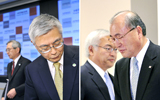
PHOTO: AFP
At Japanese computer chip maker Elpida Memory, group president Yukio Sakamoto voluntarily went without a salary for two months last year.
He is not the only one making sacrifices. A survey by the Nikkei Shimbun daily showed that the heads of more than 200 listed Japanese firms have cut their own pay since last April.
Toyota Motor has scrapped executive bonuses this year.
Even before the recession began, Japanese bosses’ salaries were relatively modest compared with their US peers.
“Japan’s CEO compensation is much lower compared to the United States,” said Hideaki Miyajima, a corporate governance expert at Waseda University.
The main reason is that a Japanese boss is a kind of a “representative of the employees” and will have typically joined the firm as a graduate and competed with colleagues for promotion.
In this kind of situation it is hard to pay the company head significantly more than colleagues of a similar age, he said.
In fact, a chief executive in the US earns about four times as much as a Japanese CEO, according to a survey by the human resources firm Towers Perrin published in 2006.
Japanese executives in general do not flaunt their wealth and bosses are often quick to step down when things start to go wrong.
Indeed, the presidents of companies including Toyota, Sony, Toshiba, Honda and Hitachi have all recently bowed out.
The humble approach in Japan has helped executives to avoid the kind of backlash seen in the US over corporate excess.
The woes of once-mighty US firms have prompted debate in Japan over whether firms should put the brakes on a slow shift towards Western-style practices, such as performance-related pay.
“Japanese corporate culture is in a bit of an identity crisis at the moment,” said Noriko Hama at Doshisha Business School in Kyoto.
“I think there is a lot of soul-searching about the way companies were headed before this crisis hit. A lot of Japanese executives were saying, ‘We need to get away from the old Japanese way of doing things.’ That’s really starting to change again but nobody really knows where to go from here,” he said.
Experts say that the row in the US over the multimillion-dollar bonuses paid out by insurance giant AIG after being bailed out by Washington is likely to make Japanese firms remain wary about linking pay to performance.
One prominent US Senator even suggested that top AIG executives ought to quit or commit suicide, which he described as the Japanese model of taking responsibility.
Japan has not had to save its banks or automakers from collapse but companies including Toyota and Honda have said they may apply for government loans because of difficulties raising credit.
And while they have avoided a row over their pay, Japanese companies have angered workers with a wave of layoffs.
“People do feel that the corporate leadership has become very disloyal to the workers. It is that aspect that they find the most unforgivable,” Hama said.
Japanese companies “had a lot of surplus cash that they chose to keep and to get rid of people. The workers saw that as a betrayal,” he said.
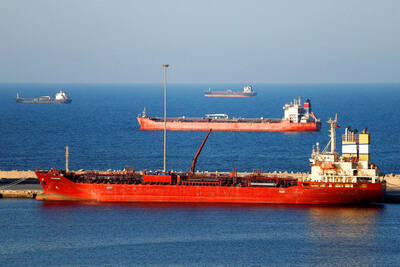
HORMUZ ISSUE: The US president said he expected crude prices to drop at the end of the war, which he called a ‘minor excursion’ that could continue ‘for a little while’ The United Arab Emirates (UAE) and Kuwait started reducing oil production, as the near-closure of the crucial Strait of Hormuz ripples through energy markets and affects global supply. Abu Dhabi National Oil Co (ADNOC) is “managing offshore production levels to address storage requirements,” the company said in a statement, without giving details. Kuwait Petroleum Corp said it was lowering production at its oil fields and refineries after “Iranian threats against safe passage of ships through the Strait of Hormuz.” The war in the Middle East has all but closed Hormuz, the narrow waterway linking the Persian Gulf to the open seas,

Apple Inc increased iPhone production in India by about 53 percent last year and now makes a quarter of its marquee devices there, reflecting the US company’s efforts to avoid tariffs on China. The company assembled about 55 million iPhones in India last year, up from 36 million a year earlier, people familiar with the matter said, asking not to be named because the numbers aren’t public. Apple makes about 220 million to 230 million iPhones a year globally, with India’s share of the total increasing rapidly. Apple has accelerated its expansion in the world’s most populous country in recent years, bolstered

HEADWINDS: The company said it expects its computer business, as well as consumer electronics and communications segments to see revenue declines due to seasonality Pegatron Corp (和碩) yesterday said it aims to grow its artificial intelligence (AI) server revenue more than 10-fold this year from last year, driven by orders from neocloud solutions clients and large cloud service providers. The electronics manufacturing service provider said AI server revenue growth would be driven primarily by the Nvidia Corp GB300 server platform. Server shipments are expected to increase each quarter this year, with the second half likely to outperform the first half, it said. The AI server market is expected to broaden this year as more inference applications emerge, which would drive demand for system-on-chip, application-specific integrated circuits
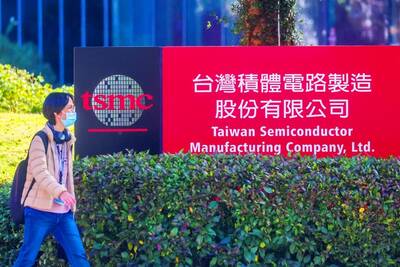
PROJECTION: TSMC said it expects strong growth this year, with revenue in US dollars projected to grow by about 30 percent, outperforming the industry Taiwan Semiconductor Manufacturing Co (TSMC, 台積電) yesterday reported consolidated sales last month reached NT$317.66 billion (US$9.98 billion), the highest ever for the month of February, driven by robust demand for chips built using the company’s advanced 3-nanometer (3nm) process. Last month’s figure was up 22.2 percent from a year earlier, but fell 20.8 percent from January, the world’s largest contract chipmaker said in a statement. For the first two months of the year, TSMC posted cumulative sales of NT$718.91 billion, up 29.9 percent from a year earlier. Analysts attributed the growth to sustained global demand for artificial intelligence (AI) products


 RSS
RSS