


Far from the gleaming skyscrapers usually associated with Hong Kong, a large iron gate keeps one team contesting the East Asian Games away from prying eyes.
The only hint of what lies beyond the security at the front of the Tso Kung Tam Outdoor Recreation Centre is the blue, white and red flag with a single star close to its center, flapping quietly in the breeze.
This is where the 76-strong team representing the Democratic People’s Republic of Korea — North Korea — are staying for the duration of the 12-day, nine-team East Asian Games.
While the rest of the competing countries and territories soak up the hustle and bustle for which Hong Kong is famous, in areas such as Causeway Bay, Wan Chai and Tsim Sha Tsui, the North Koreans have chosen to seclude themselves in relative obscurity.
The recreation center, positioned in the far west of Kowloon, high above the town of Tsuen Wan, which represents the last stop on Hong Kong’s public underground network, is as far removed from the attractions and distractions of the city as possible.
While the athletes from other teams reside in relative luxury, the North Koreans are being housed in more austere surroundings.
The older style seven-story building — which is barely visible from the road that runs past its locked gates and wire fences — contains dormitories which house up to 240 residents in rooms for up to 10 people, as well as a swimming pool, restaurant, games hall and karaoke room.
It is all part of an isolation strategy at these Games that mirrors the Stalinist state’s policies, something which Timothy Fok, chairman of the East Asian Games planning committee, has been able to accommodate.
“They requested that, so we made special arrangements for them, but at the same time I think we are all sports leaders, it’s all about young men and women coming here and we want to try and integrate them,” said Fok, who is also a vice president of the Olympic Council of Asia.
So far, though, it seems as if the North Koreans have been resistant to such moves.
The team — the smallest of those involved in the Games — is ferried to and from events in transportation separate from other participants, while individual athletes are rarely allowed to interact either with their fellow competitors or with the media.
Fok, though, is hoping that sport can at least play a role in bringing down some of the barriers that exist between the nations.
“It’s not only a sporting meet, but we also share the cultural background,” he said. “It doesn’t matter whether it’s Japan or North Korea, we will bring out the welcome mat for them. I’ve spoken to the North Koreans and they’re very happy so far. They have felt part of the event, but what we decided was we would make special arrangements for them.”
Fok, who is head of the Hong Kong Olympic Committee, believes the East Asian Games can play a role in breaking down the barriers that exist within the region, whether it is North Korea’s isolationist policy or the tension that remains between China and Taiwan.
“Now I would say we have to take the politics out of sport because this is a moment for the athletes. It’s about everyone participating,” he said. “We have North and South Korea, China and [Taiwan], but when they come here they are all the same, young men and women competing in this wonderful festival. Sport is a wonderful vehicle to bring people together and I hope we have done our small part.”
At some previous multi-sports events, North and South Korean teams have marched into the opening ceremonies together. There were even negotiations to form a combined team for last year’s Beijing Olympics, but that broke down amid concerns, including how the team should be selected.
South Korea and North Korea both qualified for the 2010 soccer World Cup from the same group in Asian competition.
For his part, Jo Tong Sop, head coach of the young North Korean soccer team selected for the East Asian Games, feels the remote nature of his team’s base in Hong Kong has had few disadvantages.
“There been no impact on our performances because of the accommodation, even though we are on the other side of town,” said Jo, whose team lost in a penalty shootout in the semi-finals against Hong Kong on Thursday. “The accommodation is good. It’s good for our players and has allowed us to prepare properly for these Games.”

After letting another big lead slip with an error-strewn performance at the French Open on Wednesday, top-ranked Aryna Sabalenka felt like getting as far away from the courts as possible. “Just want to quit tennis right now,” Sabalenka said after wasting a lead of a set and two breaks in a 3-6, 7-5, 6-0 loss to Diana Shnaider in the women’s singles quarter-finals. “We’ll see in few days. Hopefully I’ll get back on track mentally.” Sabalenka’s wait for a first French Open title continues despite the four-time major winner leading 4-1 in the second set and being two points from victory while

BIG NAMES GONE: Zverev is the clear favorite for a maiden Grand Slam title, reaching semi-finals for the fifth time in six years and finishing second on three occasions Alexander Zverev on Tuesday breezed past Rafael Jodar to stay on course for an elusive Grand Slam title at the French Open, while Jakub Mensik halted Joao Fonseca’s scintillating run in the quarter-finals. Zverev, the highest-ranked player left in the men’s draw, put an end to Spanish teenager Jodar’s impressive Roland Garros debut, easing into the semi-finals with a 7-6, (7/3), 6-1, 6-3 win. The 29-year-old Zverev is the clear favorite for a maiden Grand Slam title. He has finished runner-up on three occasions, including at the 2024 French Open. “I want to win the matches that are ahead of

For some, Cristiano Ronaldo remains the essential spearhead for Portugal’s FIFA World Cup bid, while others believe his presence would prevent Roberto Martinez’s strong side from flourishing. The debate around the five-time Ballon d’Or winner rages on, as it did at UEFA Euro 2024 and four years ago in Qatar — yet Ronaldo endures, ready to play in a record sixth World Cup. The 41-year-old remains a global superstar despite swapping the European elite for Saudi Arabia’s Al-Nassr, and is the leading men’s international goalscorer with 143 strikes. With 25 of those coming in 30 games under Martinez, the coach
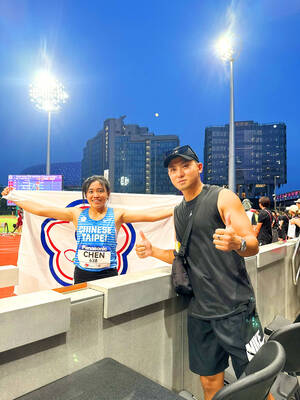
Taiwanese sprinter Chen Yi-cen on Friday won the silver medal in the women’s 400m final at the Asian U20 Athletics Championships in Hong Kong, with a time of 53.16 seconds. Chen, 15, was the youngest among the eight finalists, and her performance also met the qualifying standard of 53.50 seconds for the Nagoya Asian Games in Japan in September and October. Chen first made her mark at the National Games in Tainan in 2023, at the age of 13, winning the women’s 400m final in 55.55 seconds to become the youngest gold medalist in the history of the event. Meanwhile,


 RSS
RSS