


The US administration found itself in an awkward position on Monday after Afghanistan’s offer of peace talks with Mullah Mohammad Omar, the fugitive Taliban leader long seen by Washington as an arch-enemy.
US officials spoke cautiously when asked about a possible negotiation with one of the most wanted men in the world, a day after Afghan President Hamid Karzai’s offer of reconciliation.
Backing Karzai’s proposal would mark an about-face for US President George W. Bush’s administration, with the Pentagon last month ruling out any reconciliation with a man who has “the blood of thousands of Americans on his hands.”
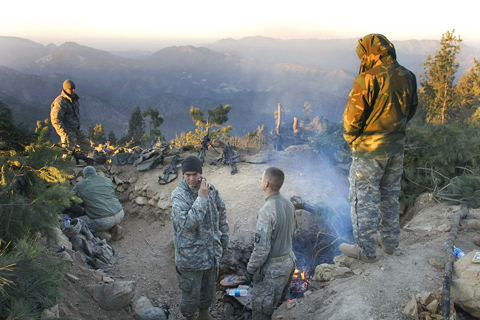
PHOTO: AFP
But explicitly rejecting such a move would put the US government at odds with one of its staunch allies, Karzai, at a moment when Afghanistan faces mounting violence.
SUPPORT
“We support Hamid Karzai,” White House Spokeswoman Dana Perino said, when asked if the administration endorsed Karzai’s offer. “What we have seen from the Taliban, however, and from Mullah Omar — who we haven’t heard from in some time — is an unwillingness to renounce violence.”
Karzai said on Sunday he would go to “any length” to protect Omar if the Taliban leader agreed to peace talks and was willing to risk a rift with his international partners.
Karzai has for years pushed for peace talks with the Taliban as a way out of a deadly insurgency in which foreign militants, including those from al-Qaeda, are said to be playing a part.
However, he has always insisted that his government would only consider talks with “Afghan Taliban” who do not have ties with al-Qaeda and agree to lay down their weapons and accept the post-Taliban Constitution.
Admiral Michael Mullen, chairman of the US Joint Chiefs of Staff, sidestepped the question of Omar but said that the time would come to hold talks with elements of the Taliban who were willing to reconcile. But the time was not yet right, he said.
‘REALISTIC’
Mullen said the same approach was used successfully in Iraq and in counter-insurgency efforts elsewhere, saying that it was “very realistic” to pursue talks with insurgents in Afghanistan.
At the White House, Perino said US officials “are skeptical about what the Taliban’s ultimate intentions are.”
“But we recognize that, at some point, there might be some Taliban that are willing to reconcile and to renounce violence and to be productive members of the Afghanistan society.”
US State Department Spokesman Sean McCormack said “it’s hard to imagine” any circumstances under which US forces would offer safe passage to senior Taliban leaders.
The Afghan president told reporters he would offer protection to the Taliban leader even if it meant defying Afghanistan’s international partners, who could remove him from his job or leave the country in disagreement.

‘CROSSING THE LINE’: China’s embassy in Seoul criticized US Forces Korea Commander General Xavier Brunson, asking if his ‘hostile’ remarks were authorized by Washington South Korea and the US are in talks over recent public remarks by the commander of US Forces Korea, Seoul’s presidential office said yesterday, after the comments drew sharp criticism from China. In a recent podcast interview, US Forces Korea Commander General Xavier Brunson described South Korea as “the dagger in the heart of Asia” from China’s east coast, prompting the Chinese embassy in Seoul to say that he had “truly crossed the line.” The interview came amid growing speculation that Washington might seek to expand the role of US Forces Korea in countering the growing regional influence of China, a key

SEEKING ORDER: Rodrigo Paz said that ‘anyone who wants to destroy the nation will have to deal with this president and the full force of the constitution’ Bolivian President Rodrigo Paz on Wednesday said that the nation was at a “breaking point” after nearly a month of protests that have caused shortages of food, fuel and medicine. Paz, who took office six months ago amid the worst economic crisis there in four decades, is battling a groundswell of fury over his policies. The political capital, La Paz, has been besieged by low-income workers and members of the indigenous majority calling for his resignation. “The country needs order and is reaching breaking point,” the 58-year-old said at a public event in La Paz, renewing his appeal for dialogue. On Tuesday, the Bolivian

Through the noise of rushing papers and whirring belts at a print factory in Kyoto, two creators watch their photo essay come to life in broadsheet form — part of an effort to win new audiences in the age of artificial intelligence (AI). Despite the decline of the publishing industry, self-publication and handmade “zine” magazines are growing in popularity in Japan, reflecting the nation’s enduring love of paper in the digital era. While speaking to Agence France-Presse at the plant, his hands black with ink, one of the creators, Kazuma Obara, said: “I think [paper] is a medium that engages all five

Australian researchers have trained lab-grown brain cells on a silicon computer chip to play the 1990s shooter game Doom and said they are just scratching the surface of what the neurons could be capable of doing. It is the science-fiction work of biotech boffins at Cortical Labs, who researched and developed the technology that harnesses the workings of the brain’s networking system. Each so-called “biological computer” contains about 200,000 living human brain cells, grown from stem cells that were harvested from blood donations. Having mastered the simple computer game Pong, where a paddle is moved up and down to send a ball


 RSS
RSS