


Japanese Nobel Physics laureate Toshihide Maskawa, an introvert devoted to thinking about the universe, has no passport to go to Stockholm to accept the prize, his wife revealed yesterday.
Maskawa, 68, was one of three physicists to share the prestigious award announced on Tuesday for his groundbreaking work on fundamental particles.
But his wife, Akiko, said that Maskawa does not travel overseas and feels “quite allergic to trying to speak English.”
“And if he needs to go to the award ceremony, he’ll need first to apply for a passport,” she said at her home in the western city of Kyoto, where Maskawa is a professor of theoretical physics at Kyoto Sangyo University.
Maskawa, bespectacled with gray hair, charmed reporters after the prize was announced by trying to conceal his shyness, at one point sobbing and at another moment forcing such a grin that he stuck out his tongue.
He also raised his arms over his head and said to eager reporters: “You’d like me to do this to show I’m happy, right?”
He earlier told reporters abruptly that he was “not that happy” about receiving the Nobel Prize, which will be handed out at a ceremony in Stockholm on Dec. 10.
“It’s just a society party,” he said.
But he backtracked yesterday.
“I play the devil’s advocate, so when somebody tells me to look left, I look right,” he said with a big smile.
“As a scientist, I feel the most pleased when fellow scientists tell me I was right,” he said. “Of course I get happy when I get compliments.”
Every time Maskawa was invited abroad to receive an award or make a speech, Makoto Kobayashi, who shared the Nobel Prize with him, went instead.
In the 1970s, Maskawa and Kobayashi came up with a theory on why antimatter sometimes does not obey the same rules as matter. They found that nature had three families of quarks, an elementary particle.
The third winner to share the prize was Yoichiro Nambu, a Japanese-born American of the University of Chicago, for his groundbreaking theories on the nature of subatomic particles and how they move.
Laureates receive a gold medal, a diploma and 10 million Swedish kronor (US$1.42 million).

‘CROSSING THE LINE’: China’s embassy in Seoul criticized US Forces Korea Commander General Xavier Brunson, asking if his ‘hostile’ remarks were authorized by Washington South Korea and the US are in talks over recent public remarks by the commander of US Forces Korea, Seoul’s presidential office said yesterday, after the comments drew sharp criticism from China. In a recent podcast interview, US Forces Korea Commander General Xavier Brunson described South Korea as “the dagger in the heart of Asia” from China’s east coast, prompting the Chinese embassy in Seoul to say that he had “truly crossed the line.” The interview came amid growing speculation that Washington might seek to expand the role of US Forces Korea in countering the growing regional influence of China, a key

Through the noise of rushing papers and whirring belts at a print factory in Kyoto, two creators watch their photo essay come to life in broadsheet form — part of an effort to win new audiences in the age of artificial intelligence (AI). Despite the decline of the publishing industry, self-publication and handmade “zine” magazines are growing in popularity in Japan, reflecting the nation’s enduring love of paper in the digital era. While speaking to Agence France-Presse at the plant, his hands black with ink, one of the creators, Kazuma Obara, said: “I think [paper] is a medium that engages all five

Australian researchers have trained lab-grown brain cells on a silicon computer chip to play the 1990s shooter game Doom and said they are just scratching the surface of what the neurons could be capable of doing. It is the science-fiction work of biotech boffins at Cortical Labs, who researched and developed the technology that harnesses the workings of the brain’s networking system. Each so-called “biological computer” contains about 200,000 living human brain cells, grown from stem cells that were harvested from blood donations. Having mastered the simple computer game Pong, where a paddle is moved up and down to send a ball
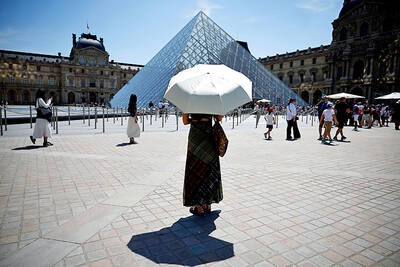
France experienced its hottest spring on record, the French weather service said on Tuesday, after an exceptional early heat wave that also broke highs for the season in England and Wales. Meteo-France said the average nationwide temperature over March to May was 13.8°C — about 1.7°C above the norm, and surpassing records set in 2011 and 2020. “The warmest spring since records began in 1900,” it said in a bulletin. All three months were warmer than average, but the onset of an “unprecedented heatwave” late last month pushed the mercury to highs typically seen at the height of the summer. “Our country had never


 RSS
RSS