


If you tell a lie big enough and keep repeating it, White House security advisers will eventually come to believe it. So it is with the stubborn myth of the "1992 consensus" between Taiwan and China, which now has the distinction of tricking Stephen Hadley, national security adviser to US President George W. Bush, into thinking that it ever existed.
Discussing a telephone conversation between Bush and Chinese President Hu Jintao (
The problem with this, of course, is that no such basis has ever been accepted by Taiwan's government, and any hope of a true consensus -- formalizing the idea of "one China," but with different interpretations -- was overwhelmed by former president Lee Teng-hui's (
The "1992 consensus" has new impetus today partly because of its utility for the incoming administration of president-elect Ma Ying-jeou (
In 2006, Lee repudiated the term "1992 consensus," and in so doing it emerged that the term was manufactured by Chinese Nationalist Party (KMT) think tank guru and former legislator Su Chi (
These days, it seems, fiction has a role to play in cross-strait affairs if it fits the template of peaceful deference to Chinese sensibilities.
For Hadley's benefit, it should be said that Su is no stranger to creative tweaking of reality. He had a role to play in the dissemination to the US Congress of the Bulletgate leaflet composed by KMT think tank members. This ham-fisted propaganda campaign meant to serve as a framework for the pan-blue-camp fantasy that the assassination attempt on Chen and the vice president on the eve of the 2004 presidential election was staged.
Then there were his allegations in late 2005 that the Taipei Times was being manipulated by the DPP government -- a laughable insult for which no evidence was presented.
At the time this all seemed more hilarious than offensive. But with Su in the running for secretary-general of the National Security Council, things are not so funny anymore.
Whether in the habit of slandering media outlets that oppose his ideology, fabricating the diplomatic record or actively eroding confidence in the nation's prosecutors and police, one must ask whether a politician who can hypnotize people with such bunkum -- at home and abroad -- should be allowed anywhere near an institution that is charged with monitoring the security of a free country.
Then one must ask what comes next if that person actually gets the job.
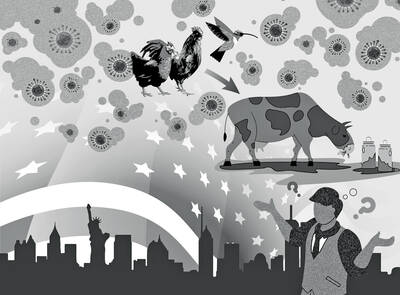
The bird flu outbreak at US dairy farms keeps finding alarming new ways to surprise scientists. Last week, the US Department of Agriculture (USDA) confirmed that H5N1 is spreading not just from birds to herds, but among cows. Meanwhile, media reports say that an unknown number of cows are asymptomatic. Although the risk to humans is still low, it is clear that far more work needs to be done to get a handle on the reach of the virus and how it is being transmitted. That would require the USDA and the Centers for Disease Control and Prevention (CDC) to get
For the incoming Administration of President-elect William Lai (賴清德), successfully deterring a Chinese Communist Party (CCP) attack or invasion of democratic Taiwan over his four-year term would be a clear victory. But it could also be a curse, because during those four years the CCP’s People’s Liberation Army (PLA) will grow far stronger. As such, increased vigilance in Washington and Taipei will be needed to ensure that already multiplying CCP threat trends don’t overwhelm Taiwan, the United States, and their democratic allies. One CCP attempt to overwhelm was announced on April 19, 2024, namely that the PLA had erred in combining major missions
On April 11, Japanese Prime Minister Fumio Kishida delivered a speech at a joint meeting of the US Congress in Washington, in which he said that “China’s current external stance and military actions present an unprecedented and the greatest strategic challenge … to the peace and stability of the international community.” Kishida emphasized Japan’s role as “the US’ closest ally.” “The international order that the US worked for generations to build is facing new challenges,” Kishida said. “I understand it is a heavy burden to carry such hopes on your shoulders,” he said. “Japan is already standing shoulder to shoulder
Former president Chiang Ching-kuo (蔣經國) used to push for reforms to protect Taiwan by adopting the “three noes” policy as well as “Taiwanization.” Later, then-president Lee Teng-hui (李登輝) wished to save the Chinese Nationalist Party (KMT) by pushing for the party’s “localization,” hoping to compete with homegrown political parties as a pro-Taiwan KMT. However, the present-day members of the KMT do not know what they are talking about, and do not heed the two former presidents’ words, so the party has suffered a third consecutive defeat in the January presidential election. Soon after gaining power with the help of the KMT’s


 RSS
RSS