


In the context of converging cross-strait policies of the Chinese Nationalist Party (KMT) and Democratic Progressive Party (DPP) presidential candidates, both men must seriously consider innovative economic measures that can rejuvenate Taiwan's economy.
In general, the economic blueprints put forth by both presidential candidates are still along the lines of Keynesian economics. In other words, they seek to increase domestic demand through governmental public investment. However, many economists have doubted this approach since the 1970s oil crisis. Furthermore, in the 1990s, Japan attempted to stimulate its economy through fiscal and monetary policies, which not only failed, but also racked up public debt because of the enormous government expenditures.
In recent years, the field of institutional economics became a main tool for stimulating economic growth in developing countries. The World Bank, the IMF and other organizations have already begun to consider how institutional reform and redesign can be used to achieve economic targets. Based on this logic, if domestic demand is to be boosted by public consumption, a policy must then be designed to lure the public into consuming rather than letting their money stagnate in their pockets or their bank accounts.
The first possibility is to change salary practices. In Taiwan, salaries -- in the private sector and in government -- are paid monthly, at the beginning or end of each month.
During my stay as a student in the US, I discovered that salaries there are paid out twice monthly and usually transferred into employee accounts on Fridays. Receiving the money on a Friday evening, wage earners have a strong incentive to consume.
In the US economic growth structure, 60 percent comes from domestic consumption.
Of course, economic growth caused by a high proportion of domestic consumption may arise from many different causes, not all of which can be attributed to the practice of paying wages twice monthly. However, the theory of monetary exchange tells us that when the monetary supply remains unchanged, the more that money circulates within any given period, the larger the total value of transactions in an economy.
A second option is to promote patriotic consumption, of which South Korea is a paradigmatic example. During my time in the US, I was involved in a study on Asian communities around the Washington area, and thus had the chance to come in contact with US citizens of South Korean descent as well as South Korean students. I discovered that South Koreans, almost without exception, use Samsung or LG mobile phones, computers and electronic products, and drive Hyundai or Kia vehicles.
This phenomenon also explains why it is so difficult to introduce foreign products in the South Korean market. Even within mighty economies such as the US, non-profit organizations have begun "Buy American" movements to increase the consumption of US products manufactured by US workers at US companies.
By comparison, "Love Taiwan" is often merely an empty catchphrase whose implementation comes nowhere near that of South Korea or the US.
Taiwanese flock to buy imports and find no shame in consuming foreign products, making it difficult for Taiwanese companies to build their own brands. Hence the need for future governments to promote the idea of patriotic consumption.
The new president must reconsider current policy as a whole and recreate the economic miracle through reform.
Louis Liu is assistant professor at Tamkang University's Department of Public Administration.
Translated by Angela Hong
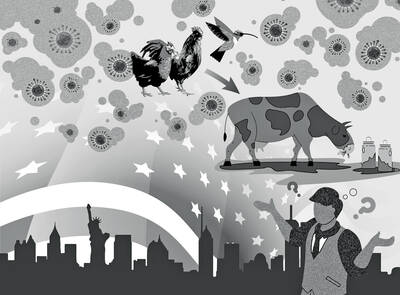
The bird flu outbreak at US dairy farms keeps finding alarming new ways to surprise scientists. Last week, the US Department of Agriculture (USDA) confirmed that H5N1 is spreading not just from birds to herds, but among cows. Meanwhile, media reports say that an unknown number of cows are asymptomatic. Although the risk to humans is still low, it is clear that far more work needs to be done to get a handle on the reach of the virus and how it is being transmitted. That would require the USDA and the Centers for Disease Control and Prevention (CDC) to get
For the incoming Administration of President-elect William Lai (賴清德), successfully deterring a Chinese Communist Party (CCP) attack or invasion of democratic Taiwan over his four-year term would be a clear victory. But it could also be a curse, because during those four years the CCP’s People’s Liberation Army (PLA) will grow far stronger. As such, increased vigilance in Washington and Taipei will be needed to ensure that already multiplying CCP threat trends don’t overwhelm Taiwan, the United States, and their democratic allies. One CCP attempt to overwhelm was announced on April 19, 2024, namely that the PLA had erred in combining major missions
On April 11, Japanese Prime Minister Fumio Kishida delivered a speech at a joint meeting of the US Congress in Washington, in which he said that “China’s current external stance and military actions present an unprecedented and the greatest strategic challenge … to the peace and stability of the international community.” Kishida emphasized Japan’s role as “the US’ closest ally.” “The international order that the US worked for generations to build is facing new challenges,” Kishida said. “I understand it is a heavy burden to carry such hopes on your shoulders,” he said. “Japan is already standing shoulder to shoulder
Former president Chiang Ching-kuo (蔣經國) used to push for reforms to protect Taiwan by adopting the “three noes” policy as well as “Taiwanization.” Later, then-president Lee Teng-hui (李登輝) wished to save the Chinese Nationalist Party (KMT) by pushing for the party’s “localization,” hoping to compete with homegrown political parties as a pro-Taiwan KMT. However, the present-day members of the KMT do not know what they are talking about, and do not heed the two former presidents’ words, so the party has suffered a third consecutive defeat in the January presidential election. Soon after gaining power with the help of the KMT’s


 RSS
RSS