


I agree with Kao Shih-fan (高士凡, "Keeping it English in the classroom," Dec. 25, page 8) that learning by speaking and listening in small groups compares favorably to learning through large group discussions or traditional teacher-centered activities, but no matter how many English teachers agree that interaction and communication is how language is best learned, studies show that there are more efficient and rewarding ways to teach English than by staging the dog and pony shows that in large Taiwanese institutions have come to represent the communicative approach.
A serious problem associated with having students practice with each other in a simulated environment is that they listen to language that is not constructed naturally. They hear guesswork collocations from their peers which, when repeated later, do more to amuse and confuse native speakers than to convey their intended meanings.
Assuming the ultimate purpose is natural, fluent communication with native speakers in social, cultural and business contexts, it is irresponsible on the part of instructors and despicable on the part of institutions to facilitate environments wherein learners are guaranteed to reinforce each others' errors.
Sure, the instructor will monitor activities and will also usually comment on them afterward, but with several pairs or groups practicing simultaneously at a downright virulent rate of error perpetuation there is little the instructor can do to prevent language learning sores from festering.
And I am not aware of any evidence of Kao's contention that if students don't speak English in the classroom, they won't speak it outside the classroom and they'll never improve.
Using one's native language to clarify an English word or phrase will facilitate understanding much more than babbling under pressure ever will. There is no need to rush. It's not a race.
Demanding production right on the spot strips the learner of the autonomy that is the indispensable condition of meaningful learning. (By meaningful I refer to how the target language will some day make a positive contribution to one's life.) A caring instructor's responsibility is to help the individual establish their own target context, to assist in choosing appropriate content and media and to be there when guidance is needed.
Unfortunately, many institutions in Taiwan have their instructors teach two-hour conversation classes comprising more than 60 students. Factoring in minimum teacher talk and a break, that works out to just a little over a minute-and-a-half that an instructor can actually listen to any individual student speak, evaluate what needs to be addressed and provide suitable feedback. So temptation heightens to get groups speaking and listening. Group conversation is a dynamic and workable classroom management approach for a high number of students in a department dictating the use of a traditional classroom: The instructor can, through a few simple techniques, basically get a class running all by itself. It's high time instructors began pressuring their institutions to stop this nonsense.
Martin de Jonge
Fulong, Taipei County
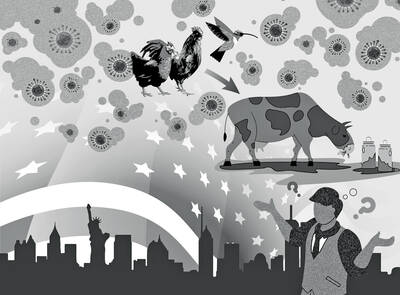
The bird flu outbreak at US dairy farms keeps finding alarming new ways to surprise scientists. Last week, the US Department of Agriculture (USDA) confirmed that H5N1 is spreading not just from birds to herds, but among cows. Meanwhile, media reports say that an unknown number of cows are asymptomatic. Although the risk to humans is still low, it is clear that far more work needs to be done to get a handle on the reach of the virus and how it is being transmitted. That would require the USDA and the Centers for Disease Control and Prevention (CDC) to get
For the incoming Administration of President-elect William Lai (賴清德), successfully deterring a Chinese Communist Party (CCP) attack or invasion of democratic Taiwan over his four-year term would be a clear victory. But it could also be a curse, because during those four years the CCP’s People’s Liberation Army (PLA) will grow far stronger. As such, increased vigilance in Washington and Taipei will be needed to ensure that already multiplying CCP threat trends don’t overwhelm Taiwan, the United States, and their democratic allies. One CCP attempt to overwhelm was announced on April 19, 2024, namely that the PLA had erred in combining major missions
On April 11, Japanese Prime Minister Fumio Kishida delivered a speech at a joint meeting of the US Congress in Washington, in which he said that “China’s current external stance and military actions present an unprecedented and the greatest strategic challenge … to the peace and stability of the international community.” Kishida emphasized Japan’s role as “the US’ closest ally.” “The international order that the US worked for generations to build is facing new challenges,” Kishida said. “I understand it is a heavy burden to carry such hopes on your shoulders,” he said. “Japan is already standing shoulder to shoulder
Former president Chiang Ching-kuo (蔣經國) used to push for reforms to protect Taiwan by adopting the “three noes” policy as well as “Taiwanization.” Later, then-president Lee Teng-hui (李登輝) wished to save the Chinese Nationalist Party (KMT) by pushing for the party’s “localization,” hoping to compete with homegrown political parties as a pro-Taiwan KMT. However, the present-day members of the KMT do not know what they are talking about, and do not heed the two former presidents’ words, so the party has suffered a third consecutive defeat in the January presidential election. Soon after gaining power with the help of the KMT’s


 RSS
RSS