


The nation's long-time quest to boost its international standing in the biotechnology sector was partially rewarded last week with the government's announcement that it would invest US$20 million in a new biotech company that will focus on developing AIDS drugs, hepatitis vaccines and bird flu vaccines.
TaiMed Biologics Co is expected to bring a new AIDS drug, TNX-355, to the market in three years, which would make it the first drug to be produced and marketed globally by a Taiwanese company.
TNX-355 is a humanized monoclonal antibody that can prevent HIV from breaching immune system cells. It was first developed by the US pharmaceutical firm Tanox. Genentech acquired the patent following a merger earlier this year.
TaiMed Biologics secured authorization to use the patented antibody from Genentech and will conduct a second clinical trial of the drug later this year in the US, Europe and South America to evaluate its safety and efficacy.
At issue is an ambitious investment for a private biotech start-up that has obtained massive funding from the state-owned National Development Fund in return for a stake of 40 percent in the company, and which is planning to raise US$50 million in capital globally.
Nearly as remarkable as the investment itself is the company's management line-up, which includes former vice premier Tsai Ing-wen (
No one can say for sure whether TaiMed Biologics will be profitable, because companies that intend to market a new drug must go through a complex, time-consuming and very expensive process.
On a positive note, the legislative passage of the Biotech and New Pharmaceutical Development Act (
The issue facing the government and investors is how to position TaiMed Biologics and how they will view similar local firms, if the nation aims to gain international recognition in the biotech sector.
A high level of education, a good health care system and quality medical research give Taiwan an edge in biotech development, but the nation lacks good support from a well-developed investment environment where efficient bureaucracy, committed enterprises and a sufficient pool of legal and financial professionals are crucial and interdependent.
But a more important issue is how Taiwan sees itself in the biotech supply chain: Is it a research-oriented participant or a end-product manufacturer?
Should our biotech firms focus on buying rights to promising drugs developed overseas that have a potential to become profitable? Or should the sector focus on making compounds based on customers' designs -- the way Taiwan Semiconductor Manufacturing Co does in the chip industry or Quanta Computer in the PC industry.
This would be a short-term option that would give local companies the experience they need by studying partly developed products and conducting clinical trials on a contract basis.
But in the long run, for Taiwan to really gain international visibility, it must have local biotech companies that are capable of developing new compounds in local laboratories and taking them through the clinical trial and regulatory approval stages. That will be very expensive. Does the government -- or local industry -- really have the deep pockets or the determination necessary to see this happen?
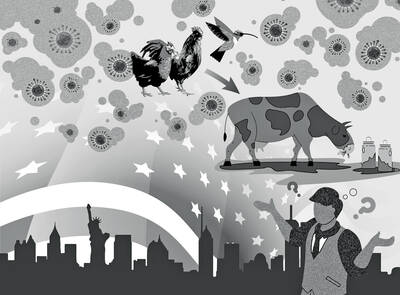
The bird flu outbreak at US dairy farms keeps finding alarming new ways to surprise scientists. Last week, the US Department of Agriculture (USDA) confirmed that H5N1 is spreading not just from birds to herds, but among cows. Meanwhile, media reports say that an unknown number of cows are asymptomatic. Although the risk to humans is still low, it is clear that far more work needs to be done to get a handle on the reach of the virus and how it is being transmitted. That would require the USDA and the Centers for Disease Control and Prevention (CDC) to get
For the incoming Administration of President-elect William Lai (賴清德), successfully deterring a Chinese Communist Party (CCP) attack or invasion of democratic Taiwan over his four-year term would be a clear victory. But it could also be a curse, because during those four years the CCP’s People’s Liberation Army (PLA) will grow far stronger. As such, increased vigilance in Washington and Taipei will be needed to ensure that already multiplying CCP threat trends don’t overwhelm Taiwan, the United States, and their democratic allies. One CCP attempt to overwhelm was announced on April 19, 2024, namely that the PLA had erred in combining major missions
As Maldivian President Mohamed Muizzu’s party won by a landslide in Sunday’s parliamentary election, it is a good time to take another look at recent developments in the Maldivian foreign policy. While Muizzu has been promoting his “Maldives First” policy, the agenda seems to have lost sight of a number of factors. Contemporary Maldivian policy serves as a stark illustration of how a blend of missteps in public posturing, populist agendas and inattentive leadership can lead to diplomatic setbacks and damage a country’s long-term foreign policy priorities. Over the past few months, Maldivian foreign policy has entangled itself in playing
Former president Chiang Ching-kuo (蔣經國) used to push for reforms to protect Taiwan by adopting the “three noes” policy as well as “Taiwanization.” Later, then-president Lee Teng-hui (李登輝) wished to save the Chinese Nationalist Party (KMT) by pushing for the party’s “localization,” hoping to compete with homegrown political parties as a pro-Taiwan KMT. However, the present-day members of the KMT do not know what they are talking about, and do not heed the two former presidents’ words, so the party has suffered a third consecutive defeat in the January presidential election. Soon after gaining power with the help of the KMT’s


 RSS
RSS