


The contributions that the Consumers' Foundation has made to ensure quality and the care they have shown for organic farming products are admirable. However, for many years the foundation's test reports and views on organic farming have had a negative impact on the development of organic farming.
In the middle of March, the Council of Agriculture introduced the draft enforcement rules of the Agricultural Products Production And Certification Screening Management Law (農產品生產及驗證管理法). The draft rules would allow pesticide levels of up to 5 percent of the safety limit for conventionally grown produce set by the Department of Health.
The Consumers' Foundation and the public believe that the council's loosening of the restrictions on pesticides in organic products implies that organic farms are now allowed to use pesticides. They have therefore denounced the proposed law as going against the concept of organic farming. Misleading reports and their negative influence on public perceptions of organic produce has even caused some organic farmers to protest. They want to avoid such reports resulting in consumers losing faith in their products.
Clause 13 of the Agricultural Products Production And Certification Screening Management Law states very clearly that chemical pesticides, chemical fertilizers, animal medicines and other chemical substances are not allowed in organic agricultural and processed agricultural products and that violations of this rule will be punished.
This means that although organic products are allowed to contain traces of pesticides, the use of pesticides in organic farming is still prohibited. The council's purpose with the draft law was to prevent organic farmers who do not use pesticides from being fined or losing their certification because their produce has been contaminated by chemicals found in nearby farms or the environment.
In May 2004, the Consumers' Foundation published a report titled There are Fake Organic Vegetables, which said that pesticides had been found in three batches of organic vegetables on the market. This was picked up by all the major media in the country, dealing a heavy blow to organic farming. Three of the accused farmers sued the Consumers' Foundation for compensation, and in the second appeal in April last year the court ruled in favor of the farmers. This was the first time the Consumers' Foundation had lost a court case.
The Homemakers' Union and Foundation and the Consumers' Foundation both exist for the good of consumers. When it comes to ensuring the quality of organic products, the contributions of the Homemakers' Union are no less than those of the Consumers' Foundation. The Homemakers' Union even upped the ante by offering reliable organic products to its members. It knows that in the absence of farmers willing to grow organic products, consumers will have nowhere to turn for reliable products. Hence its encouragement of, assistance to and selection of conscientious organic farmers, which creates an environment in which both producers and consumers of organic products benefit.
I am of two minds on the Consumers' Foundation assessing the quality of organic products. Although its demands on the quality of organic products are sound, its understanding of and support for organic farming leaves a lot to be desired.
One would therefore hope that the Consumers' Foundation will abandon its zero-tolerance policy on pesticides as the benchmark for assessing organic farms.
Huang Tzeng Chang-ju is a professor at National Ilan University's department of applied economics and is responsible for the Organic Agriculture Information Portal.
Translated by Anna Stiggelbout
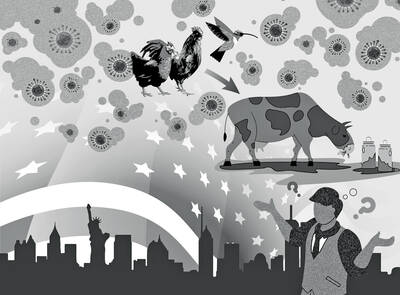
The bird flu outbreak at US dairy farms keeps finding alarming new ways to surprise scientists. Last week, the US Department of Agriculture (USDA) confirmed that H5N1 is spreading not just from birds to herds, but among cows. Meanwhile, media reports say that an unknown number of cows are asymptomatic. Although the risk to humans is still low, it is clear that far more work needs to be done to get a handle on the reach of the virus and how it is being transmitted. That would require the USDA and the Centers for Disease Control and Prevention (CDC) to get

For the incoming Administration of President-elect William Lai (賴清德), successfully deterring a Chinese Communist Party (CCP) attack or invasion of democratic Taiwan over his four-year term would be a clear victory. But it could also be a curse, because during those four years the CCP’s People’s Liberation Army (PLA) will grow far stronger. As such, increased vigilance in Washington and Taipei will be needed to ensure that already multiplying CCP threat trends don’t overwhelm Taiwan, the United States, and their democratic allies. One CCP attempt to overwhelm was announced on April 19, 2024, namely that the PLA had erred in combining major missions
On April 11, Japanese Prime Minister Fumio Kishida delivered a speech at a joint meeting of the US Congress in Washington, in which he said that “China’s current external stance and military actions present an unprecedented and the greatest strategic challenge … to the peace and stability of the international community.” Kishida emphasized Japan’s role as “the US’ closest ally.” “The international order that the US worked for generations to build is facing new challenges,” Kishida said. “I understand it is a heavy burden to carry such hopes on your shoulders,” he said. “Japan is already standing shoulder to shoulder
Former president Chiang Ching-kuo (蔣經國) used to push for reforms to protect Taiwan by adopting the “three noes” policy as well as “Taiwanization.” Later, then-president Lee Teng-hui (李登輝) wished to save the Chinese Nationalist Party (KMT) by pushing for the party’s “localization,” hoping to compete with homegrown political parties as a pro-Taiwan KMT. However, the present-day members of the KMT do not know what they are talking about, and do not heed the two former presidents’ words, so the party has suffered a third consecutive defeat in the January presidential election. Soon after gaining power with the help of the KMT’s


 RSS
RSS