

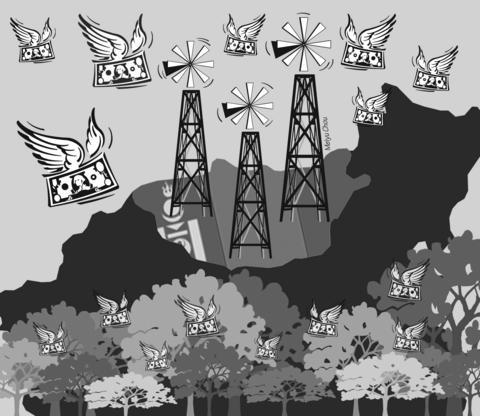
The wind turbines rising 55m above this dusty village at the hilly edge of Inner Mongolia could be an environmentalist's dream: Their electricity is clean, sparing the horizon sooty clouds or global warming gases.
But the wind-power generators are also part of a growing dispute over a UN program that is the centerpiece of international efforts to help developing countries combat global warming.
That program, the Clean Development Mechanism (CDM), has become a kind of Robin Hood, raising billions of dollars from rich countries and transferring them to poor countries to curb the emission of global warming gases. The biggest beneficiary is no longer so poor: China, with US$1.2 trillion in foreign exchange reserves, received three-fifths of the money last year.
Scientists increasingly worry about the emissions from developing countries, which may contribute to global environmental problems even sooner than previously expected.
China is expected to surpass the US this year or next to become the world's largest emitter of global warming gases. And as a result, some of the poorest countries are being left out.
That draws attention to the Clean Development Mechanism, which has grown at an extraordinary pace, to US$4.8 billion in transfer payments last year to developing countries from less than US$100 million in 2002.
The CDM raises its money through a complex market in trading pollution credits: Businesses and governments in affluent regions like Europe and Japan help pay to reduce pollution in poorer countries, offsetting their own emissions. This helps advanced industrial nations stay within their Kyoto Protocol limits for emitting climate-changing gases like carbon dioxide. For each tonne of global warming gases that a developing country can prove it has eliminated, the secretariat of the Clean Development Mechanism in Bonn, Germany, awards it a credit. Developing countries sold credits last year to richer nations for an average price of US$10.70 each.
Its growth has come almost entirely by focusing on efficient projects in China and other fast-growing countries that spread the administrative costs over many large efforts, while poorer lands have received almost nothing. And that is why the program is becoming a battleground, pitting an unlikely coalition of bankers, traders, industrialists and environmentalists, who defend it, against economic development advocates, who warn of distortions.
According to the World Bank, China captured US$3 billion of the US$4.8 billion in subsidies last year for dozens of projects. Yet it accounted for less than two-fifths of the developing world's fossil fuel consumption, the main source of warming gases.
One of the projects is the wind farm here -- nestled on a pine-forested hill beside a blue lake fringed by broad fields tilled into long furrows of freshly planted wheat. It is profitable even without the subsidies and is owned by a group of Chinese companies traded on the Shanghai Stock Exchange.
But it is China's financial sophistication that has helped it soak up so much in subsidies. A vigorous cottage industry of project designers and brokers has sprung up in Shanghai -- with workers translating forms into Chinese, promoting the program and taking steps to make it easy and inexpensive for Chinese companies to participate.
"There are a lot of people who know how to do it," said Tao Fuchang, general manager and chief engineer of the Liaoning Zhangwu Jinshan Wind Power Electricity Co, which built and operates the turbines here.
Next in line are India, Brazil, Mexico and Argentina, which get most of the rest of the subsidies, along with South Korea, which was incongruously classified as a developing nation by the Kyoto Protocol, the 1997 pact to limit emissions that also led to the creation of the Clean Development Mechanism.
Trailing far behind are African countries. Payments totaled less than US$150 million last year for all of Africa, where government officials say they have been largely left out of one of the biggest bonanzas for the developing world in many years.
"We see this problem everywhere in Africa," said Sateeaved Seebaluck, a high-ranking environment official in Mauritius, an island nation east of Africa.
Even when very poor countries are able to organize development projects, they may lack expertise and must sometimes pay out as much as half the credits in the form of fees for international consultants and credit brokers.
UN executives respond, with considerable support from environmentalists, bankers and corporations, that the program's primary task is to reduce the tonnage of carbon dioxide and other warming gases entering the atmosphere -- regardless of where it comes from. By that measure, they say, the program is a success.
Kai-Uwe Schmidt, the CDM's executive board secretary, said the organization was acutely aware of regional imbalances in global warming projects and hoped to address them. But setting up an emissions reduction project usually requires considerable investment.
"We do not see many investments flowing into Africa in the first place," he said.
Subsidies are readily available for a wide range of projects -- straw-fired power plants, wind turbines, even the capture and burning of methane leaking from landfills. Though detailed procedures have been developed for projects in China and other fast-growing countries, they can easily be copied for use in other places.
But before manufacturers can obtain the subsidies, their national governments need to set up a legal framework for handling the money, which some of the poorest countries have not yet been able to do.
The projects that have produced the greatest number of credits so far involve attaching waste-gas incinerators to chemical factories that manufacture an ozone destroying air-conditioner refrigerant, HCFC-22. These factories are found almost exclusively in the more prosperous developing countries.
Kristalina Georgieva, director of sustainable development strategy and operations at the World Bank, said the CDM's secretariat could simplify its rules to help poorer nations.
Georgieva said the secretariat should also pay more attention to fostering renewable energy in very poor lands, because 1.6 billion people lack any electricity and it is crucial to choose power-generating technologies for them that will contribute as little as possible to global warming.
"How the developing countries choose to electrify will determine the fate of the earth," she said in a recent speech.
Some say the verification process is too burdensome for the poorest countries. But too much streamlining of the process could undermine the confidence of investors in rich countries that the pollution credits are genuine, Georgieva acknowledged in an interview.
"What you may get is eroding trust in the system," she said.
David Doniger, an environmental official in the Clinton administration who took part in many Kyoto Protocol drafting meetings in 1997 that led to the creation of the Clean Development Mechanism, said questions had been raised then about whether very poor countries would be able to obtain credits.
But the negotiators decided against any system for guaranteeing a division of credits by region, preferring one focused on reducing emissions wherever they occurred.
"Those were rejected on the grounds that you wanted to get more bang for the buck and they didn't want this to turn into another UN institution with a lot of emphasis on regional balance," said Doniger, who is now climate policy director at the Natural Resources Defense Council.
The wind turbine project here in Houxinqiu, an impoverished area of China, shows the pluses and minuses of the current system. It generates nearly 24 megawatts of electricity that would otherwise come from coal. China is already building enough coal-fired power plants each year to light all of Britain.
Farmers here still use mules to pull their steel-tip wooden plows and draw their aging wooden carts, the rough-hewn slats bleached white by years of sun and rain. The setting sun vanishes into a dark murk over the plains to the west, where China has been rapidly building coal-fired power plants.
Li Guohai, a local peasant riding his mule cart home with his wife on a recent evening, explained how he had received free electricity since the wind turbines were erected four years ago. He has saved enough money that he bought an all-steel plow for his mules to pull; the new plow now frees his son to finish junior high school and perhaps go to high school, Li said.
The project is narrowly profitable even without Clean Development Mechanism payments, Tao, the general manager, said. But the payments made the project more attractive and easier to raise money for it.
While Tao was reluctant to discuss the company's finances, Clean Development Mechanism records show that the wind farm saves the equivalent of 31,859 tonnes of carbon dioxide emissions a year. At US$8 a credit, that is worth US$281,000. Tao does not rely on that money to make the project viable, as the CDM subsidies aim to do, but it helps him pay for more turbines.
"Without the Clean Development Mechanism, we'd still be profitable," Tao said. But "you need the CDM for further expansion."
Taiwan’s domestic political situation is following recognizable political rhythms, while the international environment surrounding Taiwan is undergoing a major transformation. Within Taiwan, there are ongoing battles between the legislative and executive branches over the budget, and between cities and the central government over resources. Tensions between political parties dominate headlines and consume much of the attention of party leaders. Jockeying is underway for local elections this November and national elections in 2028. And the longstanding philosophical debate inside Taiwan over how best to protect Taiwan and promote the good life remains unresolved. Amidst all of this, Taiwan continues to function well. It
In an article published on Tuesday in The Atlantic, titled “Will Taiwan Just Give Up?”, journalist Simon Shuster emphasizes the unpredictability of the US as an ally under US President Donald Trump and cites diminishing faith in the US as a contributor to what he sees as waning determination to resist China. As the title suggests, Shuster views a deal between Taiwan and China as an increasingly inevitable alternative to a costly war — one that Taiwan, lacking reliable allies and military capabilities, would eventually be destined to lose. He focuses on Chinese Nationalist Party (KMT) Chairwoman Cheng Li-wun (鄭麗文) — her
With candidate registration for this year’s local elections closed on Sept. 4 and the elections less than 80 days away, Democratic Progressive Party (DPP) Legislator and Taipei mayoral candidate Puma Shen’s (沈伯洋) rapidly growing popularity has become the focus of political talk shows and online discussions over the past week, heating up the mayoral election race in Taipei. Local media headlines and political pundits have picked up his supporters’ slogan “ocean current” (洋流) — a play on the last character of Shen’s name, which literally means “ocean” (洋), and the character (流), which can mean “current,” “flow” or “trend” — to
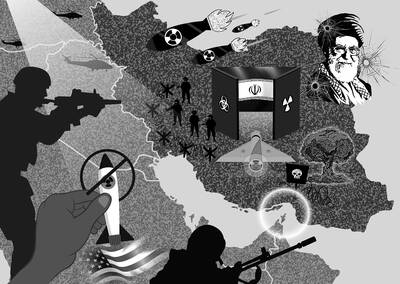
When was the last time you heard a meaningful proposal to prevent Iran from developing a nuclear arsenal? There has been nothing on the subject since the June Memorandum of Understanding between the US and Iran; the promised 60 days of talks to settle questions around Tehran’s uranium-enrichment program never began and have long since expired. When the war was launched, on Feb. 28, a resolution of the nuclear dispute was prominent among the dizzying array of US and Israeli aims to explain the attack. But as should be clear by now, the attempt was entirely reliant on achieving regime change. That


 RSS
RSS